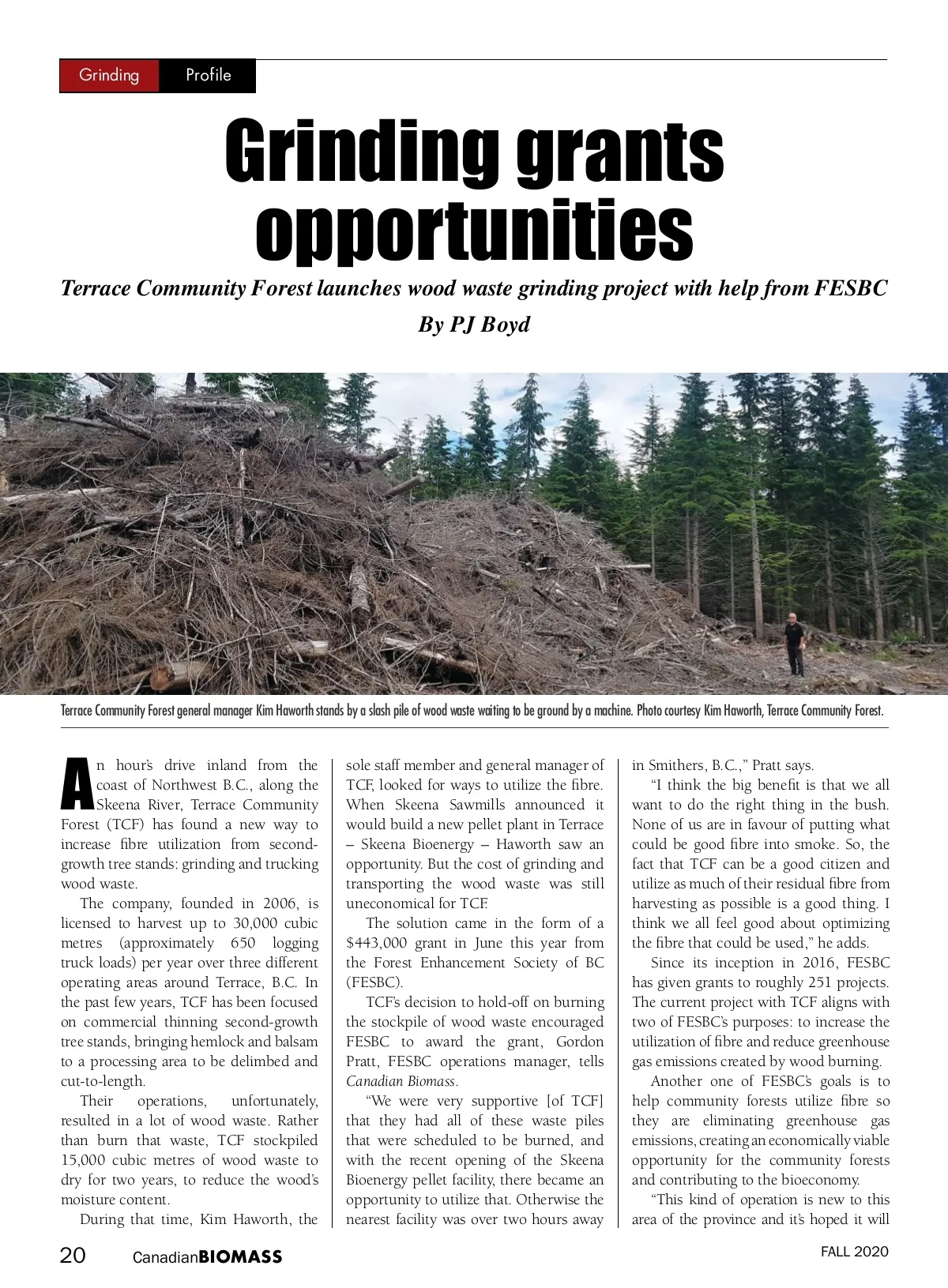
Grinding Profile Terrace Community Forest launches wood waste grinding project with help from FESBC By PJ Boyd Grinding grants opportunities Terrace Community Forest general manager Kim Haworth stands by a slash pile of wood waste waiting to be ground by a machine. Photo courtesy Kim Haworth, Terrace Community Forest. A n hour’s drive inland from the coast of Northwest B.C., along the Skeena River, Terrace Community Forest (TCF) has found a new way to increase fibre utilization from second-growth tree stands: grinding and trucking wood waste. The company, founded in 2006, is licensed to harvest up to 30,000 cubic metres (approximately 650 logging truck loads) per year over three different operating areas around Terrace, B.C. In the past few years, TCF has been focused on commercial thinning second-growth tree stands, bringing hemlock and balsam to a processing area to be delimbed and cut-to-length. Their operations, unfortunately, resulted in a lot of wood waste. Rather than burn that waste, TCF stockpiled 15,000 cubic metres of wood waste to dry for two years, to reduce the wood’s moisture content. During that time, Kim Haworth, the sole staff member and general manager of TCF , looked for ways to utilize the fibre. When Skeena Sawmills announced it would build a new pellet plant in Terrace – Skeena Bioenergy – Haworth saw an opportunity. But the cost of grinding and transporting the wood waste was still uneconomical for TCF . The solution came in the form of a $443,000 grant in June this year from the Forest Enhancement Society of BC (FESBC). TCF’s decision to hold-off on burning the stockpile of wood waste encouraged FESBC to award the grant, Gordon Pratt, FESBC operations manager, tells Canadian Biomass . “We were very supportive [of TCF] that they had all of these waste piles that were scheduled to be burned, and with the recent opening of the Skeena Bioenergy pellet facility, there became an opportunity to utilize that. Otherwise the nearest facility was over two hours away in Smithers, B.C.,” Pratt says. “I think the big benefit is that we all want to do the right thing in the bush. None of us are in favour of putting what could be good fibre into smoke. So, the fact that TCF can be a good citizen and utilize as much of their residual fibre from harvesting as possible is a good thing. I think we all feel good about optimizing the fibre that could be used,” he adds. Since its inception in 2016, FESBC has given grants to roughly 251 projects. The current project with TCF aligns with two of FESBC’s purposes: to increase the utilization of fibre and reduce greenhouse gas emissions created by wood burning. Another one of FESBC’s goals is to help community forests utilize fibre so they are eliminating greenhouse gas emissions, creating an economically viable opportunity for the community forests and contributing to the bioeconomy. “This kind of operation is new to this area of the province and it’s hoped it will FALL 2020 20 Canadian BIOMASS
Canadian Biomass Fall 2020: Page 20