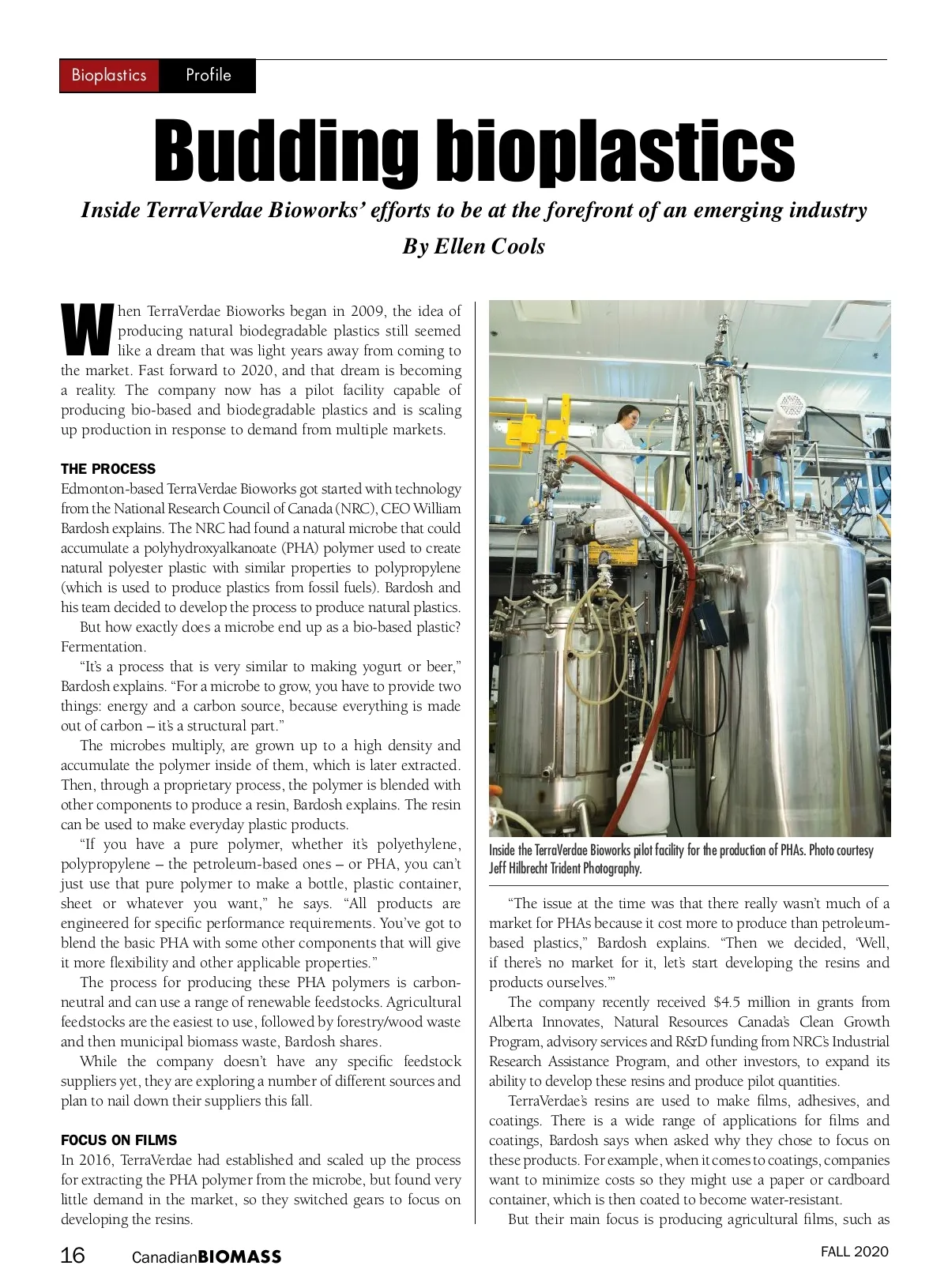
Bioplastics Profile Inside TerraVerdae Bioworks’ efforts to be at the forefront of an emerging industry By Ellen Cools Budding bioplastics hen TerraVerdae Bioworks began in 2009, the idea of producing natural biodegradable plastics still seemed like a dream that was light years away from coming to the market. Fast forward to 2020, and that dream is becoming a reality. The company now has a pilot facility capable of producing bio-based and biodegradable plastics and is scaling up production in response to demand from multiple markets. THE PROCESS W Edmonton-based TerraVerdae Bioworks got started with technology from the National Research Council of Canada (NRC), CEO William Bardosh explains. The NRC had found a natural microbe that could accumulate a polyhydroxyalkanoate (PHA) polymer used to create natural polyester plastic with similar properties to polypropylene (which is used to produce plastics from fossil fuels). Bardosh and his team decided to develop the process to produce natural plastics. But how exactly does a microbe end up as a bio-based plastic? Fermentation. “It’s a process that is very similar to making yogurt or beer,” Bardosh explains. “For a microbe to grow, you have to provide two things: energy and a carbon source, because everything is made out of carbon – it’s a structural part.” The microbes multiply, are grown up to a high density and accumulate the polymer inside of them, which is later extracted. Then, through a proprietary process, the polymer is blended with other components to produce a resin, Bardosh explains. The resin can be used to make everyday plastic products. “If you have a pure polymer, whether it’s polyethylene, polypropylene – the petroleum-based ones – or PHA, you can’t just use that pure polymer to make a bottle, plastic container, sheet or whatever you want,” he says. “All products are engineered for specific performance requirements. You’ve got to blend the basic PHA with some other components that will give it more flexibility and other applicable properties.” The process for producing these PHA polymers is carbon-neutral and can use a range of renewable feedstocks. Agricultural feedstocks are the easiest to use, followed by forestry/wood waste and then municipal biomass waste, Bardosh shares. While the company doesn’t have any specific feedstock suppliers yet, they are exploring a number of different sources and plan to nail down their suppliers this fall. FOCUS ON FILMS Inside the TerraVerdae Bioworks pilot facility for the production of PHAs. Photo courtesy Jeff Hilbrecht Trident Photography. In 2016, TerraVerdae had established and scaled up the process for extracting the PHA polymer from the microbe, but found very little demand in the market, so they switched gears to focus on developing the resins. “The issue at the time was that there really wasn’t much of a market for PHAs because it cost more to produce than petroleum-based plastics,” Bardosh explains. “Then we decided, ‘Well, if there’s no market for it, let’s start developing the resins and products ourselves.’” The company recently received $4.5 million in grants from Alberta Innovates, Natural Resources Canada’s Clean Growth Program, advisory services and R&D funding from NRC’s Industrial Research Assistance Program, and other investors, to expand its ability to develop these resins and produce pilot quantities. TerraVerdae’s resins are used to make films, adhesives, and coatings. There is a wide range of applications for films and coatings, Bardosh says when asked why they chose to focus on these products. For example, when it comes to coatings, companies want to minimize costs so they might use a paper or cardboard container, which is then coated to become water-resistant. But their main focus is producing agricultural films, such as FALL 2020 16 Canadian BIOMASS
Canadian Biomass Fall 2020: Page 16