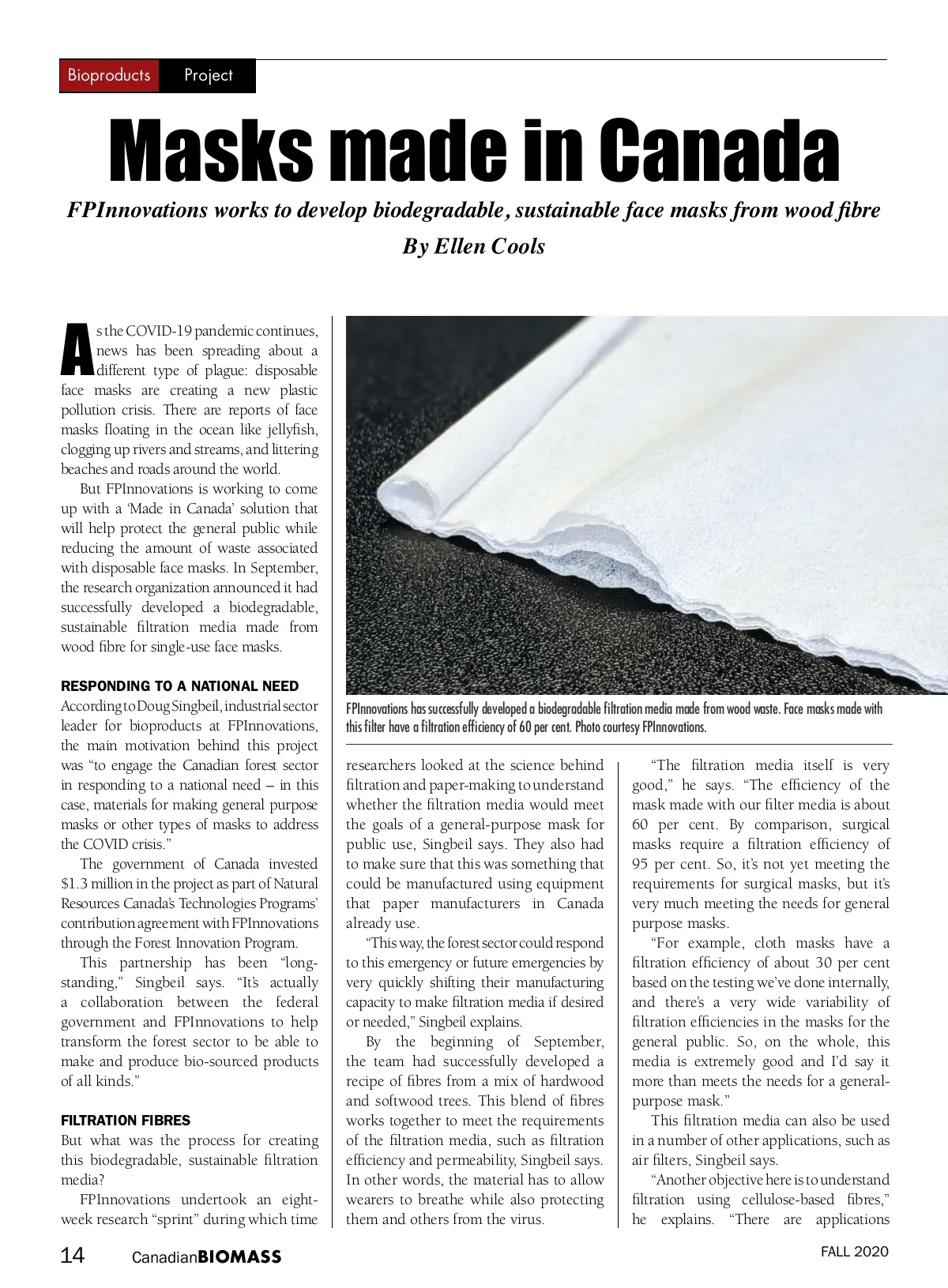
everywhere for filtration media in our everyday lives, and for the most part, the filtration media that are used are based on plastics or plastic materials. So, what we learned from this project will also help us understand how to replace plastics with cellulosic-based fibres.” This opens the door for a number of new markets for the Canadian wood products industry. A FULLY BIODEGRADABLE MASK But FPInnovations doesn’t plan on stopping there. In fact, the research organization has already embarked on phase two of the project, which will take approximately six to 10 months. There are three goals for this phase, Singbeil says. The first is to produce masks commercially using the filtration media that has been developed. FPInnovations is currently collaborating with mask manufacturers to test these masks for commercial production. The second is to increase the efficiency of the filter and look at other attributes that may be necessary to make the mask suitable for surgical use. “The third objective is to actually find a way to make a fully biodegradable mask,” Singbeil says. “Right now, the filtration media itself is biodegradable, but it’s the inner layer of a three-layer mask. The two outer layers, even in the current iteration, will still be made of plastic-based materials. We’ve been able to replace about 40 per cent of the plastic in a general-purpose mask, but the ultimate objective is to be able to make a fully biodegradable mask.” As with the biodegradable filtration media, the intent is to find ways for pulp and paper companies to manufacture the outer layers for these masks as well. This way, the material for the masks will be made in Canada by Canadian pulp and paper mills, Singbeil says. Consequently, this project will demonstrate “the ability of the forest sector to develop bio-sourced materials and products that can displace plastics and be fully biodegradable,” he adds. Of course, developing a biodegradable, sustainable face mask will also have far-reaching consequences for the environment. “I think it’s extremely important because you just need to look around at the masks that are discarded after one use and left lying on the ground or not disposed of effectively,” Singbeil says. “Having a biodegradable mask is incredibly important to making the use of masks sustainable.” This project will also help set in motion a future where more single-use plastics can be replaced by sustainably sourced biodegradable materials. The key point is that the filtration media, along with other future products, are coming from sustainably harvested forests, Singbeil says. “Even if the use of masks declines as we come out of the current crisis, the industry will be well-positioned to respond to the next event, if it ever comes. And in the meantime, we’re also developing and using the knowledge we’ve gained from this exercise to continue to find ways to make these sustainably bio-sourced products for everyday life,” he concludes. • • 10’ x 45’ platform and 63° tilt • over-the-road transport • no foundation required 563-264-8066 airoflex.com • 45-ton lifting capacity • approximately 3 minute up-cycle time CB_Hoffman/Airoflex_Sprimg20_CSA.indd 1 Canadian BIOMASS 2020-03-27 3:13 PM 15
Canadian Biomass Fall 2020: Page 15