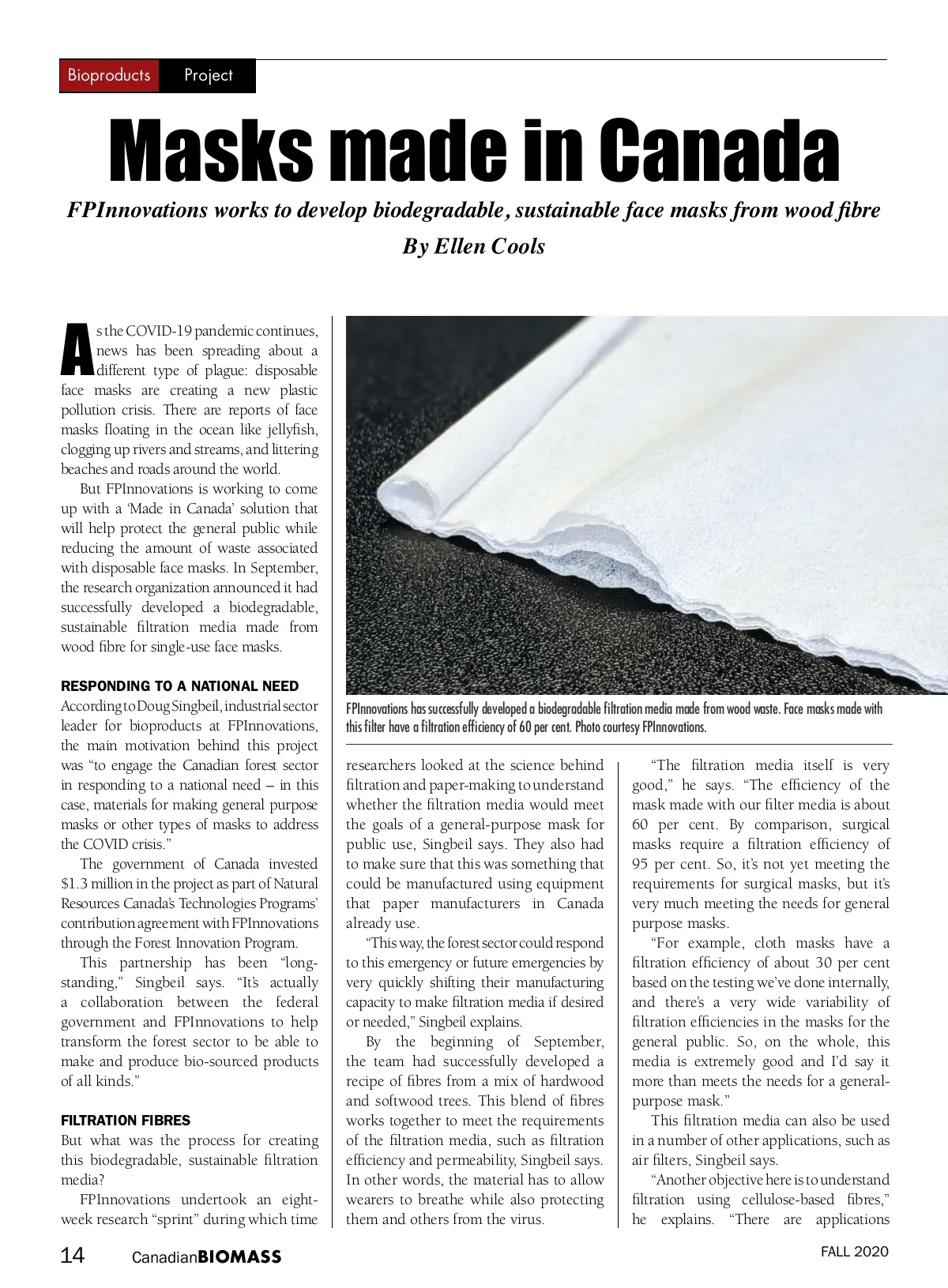
Bioproducts Project FPInnovations works to develop biodegradable, sustainable face masks from wood fibre By Ellen Cools Masks made in Canada A s the COVID-19 pandemic continues, news has been spreading about a different type of plague: disposable face masks are creating a new plastic pollution crisis. There are reports of face masks floating in the ocean like jellyfish, clogging up rivers and streams, and littering beaches and roads around the world. But FPInnovations is working to come up with a ‘Made in Canada’ solution that will help protect the general public while reducing the amount of waste associated with disposable face masks. In September, the research organization announced it had successfully developed a biodegradable, sustainable filtration media made from wood fibre for single-use face masks. RESPONDING TO A NATIONAL NEED According to Doug Singbeil, industrial sector leader for bioproducts at FPInnovations, the main motivation behind this project was “to engage the Canadian forest sector in responding to a national need – in this case, materials for making general purpose masks or other types of masks to address the COVID crisis.” The government of Canada invested $1.3 million in the project as part of Natural Resources Canada’s Technologies Programs’ contribution agreement with FPInnovations through the Forest Innovation Program. This partnership has been “long-standing,” Singbeil says. “It’s actually a collaboration between the federal government and FPInnovations to help transform the forest sector to be able to make and produce bio-sourced products of all kinds.” FILTRATION FIBRES FPInnovations has successfully developed a biodegradable filtration media made from wood waste. Face masks made with this filter have a filtration efficiency of 60 per cent. Photo courtesy FPInnovations. But what was the process for creating this biodegradable, sustainable filtration media? FPInnovations undertook an eight-week research “sprint” during which time researchers looked at the science behind filtration and paper-making to understand whether the filtration media would meet the goals of a general-purpose mask for public use, Singbeil says. They also had to make sure that this was something that could be manufactured using equipment that paper manufacturers in Canada already use. “This way, the forest sector could respond to this emergency or future emergencies by very quickly shifting their manufacturing capacity to make filtration media if desired or needed,” Singbeil explains. By the beginning of September, the team had successfully developed a recipe of fibres from a mix of hardwood and softwood trees. This blend of fibres works together to meet the requirements of the filtration media, such as filtration efficiency and permeability, Singbeil says. In other words, the material has to allow wearers to breathe while also protecting them and others from the virus. “The filtration media itself is very good,” he says. “The efficiency of the mask made with our filter media is about 60 per cent. By comparison, surgical masks require a filtration efficiency of 95 per cent. So, it’s not yet meeting the requirements for surgical masks, but it’s very much meeting the needs for general purpose masks. “For example, cloth masks have a filtration efficiency of about 30 per cent based on the testing we’ve done internally, and there’s a very wide variability of filtration efficiencies in the masks for the general public. So, on the whole, this media is extremely good and I’d say it more than meets the needs for a general-purpose mask.” This filtration media can also be used in a number of other applications, such as air filters, Singbeil says. “Another objective here is to understand filtration using cellulose-based fibres,” he explains. “There are applications FALL 2020 14 Canadian BIOMASS
Canadian Biomass Fall 2020: Page 14