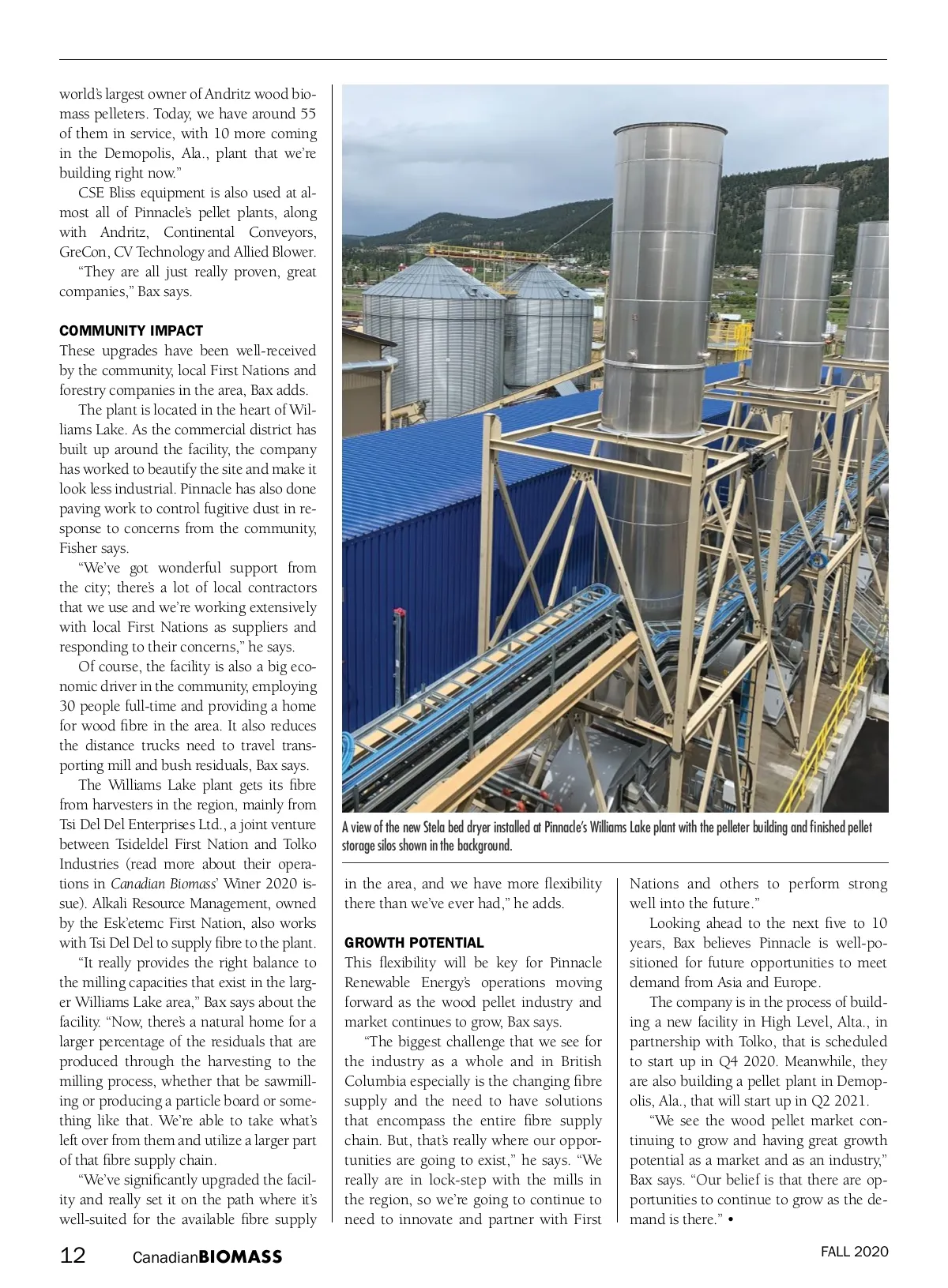
world’s largest owner of Andritz wood bio-mass pelleters. Today, we have around 55 of them in service, with 10 more coming in the Demopolis, Ala., plant that we’re building right now.” CSE Bliss equipment is also used at al-most all of Pinnacle’s pellet plants, along with Andritz, Continental Conveyors, GreCon, CV Technology and Allied Blower. “They are all just really proven, great companies,” Bax says. COMMUNITY IMPACT These upgrades have been well-received by the community, local First Nations and forestry companies in the area, Bax adds. The plant is located in the heart of Wil-liams Lake. As the commercial district has built up around the facility, the company has worked to beautify the site and make it look less industrial. Pinnacle has also done paving work to control fugitive dust in re-sponse to concerns from the community, Fisher says. “We’ve got wonderful support from the city; there’s a lot of local contractors that we use and we’re working extensively with local First Nations as suppliers and responding to their concerns,” he says. Of course, the facility is also a big eco-nomic driver in the community, employing 30 people full-time and providing a home for wood fibre in the area. It also reduces the distance trucks need to travel trans-porting mill and bush residuals, Bax says. The Williams Lake plant gets its fibre from harvesters in the region, mainly from Tsi Del Del Enterprises Ltd., a joint venture between Tsideldel First Nation and Tolko Industries (read more about their opera-tions in Canadian Biomass ’ Winer 2020 is-sue). Alkali Resource Management, owned by the Esk’etemc First Nation, also works with Tsi Del Del to supply fibre to the plant. “It really provides the right balance to the milling capacities that exist in the larg-er Williams Lake area,” Bax says about the facility. “Now, there’s a natural home for a larger percentage of the residuals that are produced through the harvesting to the milling process, whether that be sawmill-ing or producing a particle board or some-thing like that. We’re able to take what’s left over from them and utilize a larger part of that fibre supply chain. “We’ve significantly upgraded the facil-ity and really set it on the path where it’s well-suited for the available fibre supply A view of the new Stela bed dryer installed at Pinnacle’s Williams Lake plant with the pelleter building and finished pellet storage silos shown in the background. in the area, and we have more flexibility there than we’ve ever had,” he adds. GROWTH POTENTIAL This flexibility will be key for Pinnacle Renewable Energy’s operations moving forward as the wood pellet industry and market continues to grow, Bax says. “The biggest challenge that we see for the industry as a whole and in British Columbia especially is the changing fibre supply and the need to have solutions that encompass the entire fibre supply chain. But, that’s really where our oppor-tunities are going to exist,” he says. “We really are in lock-step with the mills in the region, so we’re going to continue to need to innovate and partner with First Nations and others to perform strong well into the future.” Looking ahead to the next five to 10 years, Bax believes Pinnacle is well-po-sitioned for future opportunities to meet demand from Asia and Europe. The company is in the process of build-ing a new facility in High Level, Alta., in partnership with Tolko, that is scheduled to start up in Q4 2020. Meanwhile, they are also building a pellet plant in Demop-olis, Ala., that will start up in Q2 2021. “We see the wood pellet market con-tinuing to grow and having great growth potential as a market and as an industry,” Bax says. “Our belief is that there are op-portunities to continue to grow as the de-mand is there.” • FALL 2020 12 Canadian BIOMASS
Canadian Biomass Fall 2020: Page 12