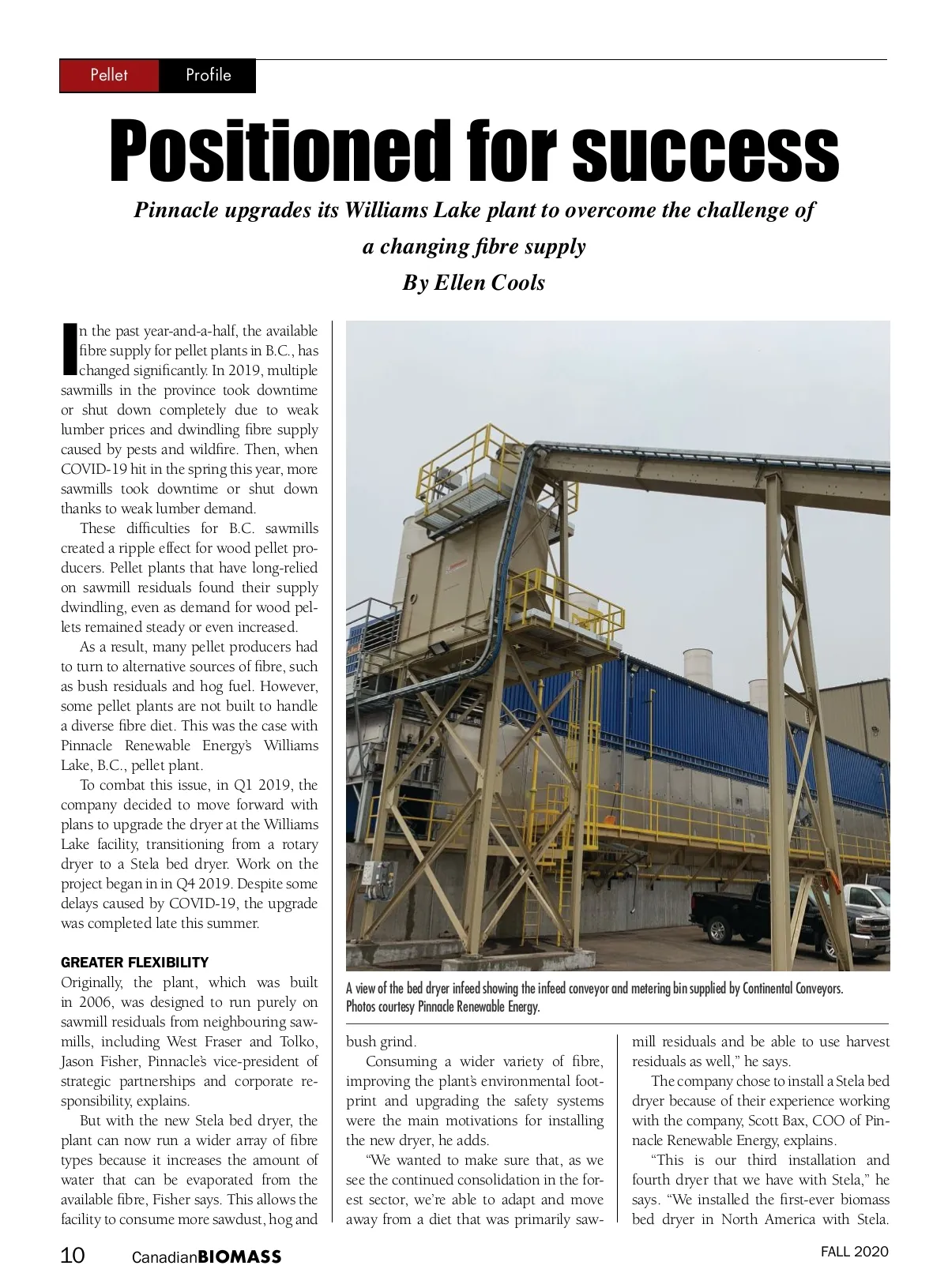
We’ve been with them since 2015 when we built our Lavington facility. We put two bed dryers in there, and one in our Smith-ers facility.” Stela, based in Germany, is “a real-ly reliable company to work with,” Bax adds. “They’re able to deliver a really sol-id product.” Along with the new bed dryer, Pinnacle added two new CSE Bliss hammer mills at the facility to handle a wider range of fibre types. The project was part of Pinnacle’s $30 million Cariboo Upgrade Project, which consisted of two projects: the dryer and fibre breakdown upgrades at the Williams Lake plant, and a new emissions control device at the company’s Meadowbank fa-cility, Bax shares. Of the $30 million, more than $20 million was allocated to the Wil-liams Lake project. As a result of these upgrades, the Wil-liams Lake plant can now process 50,000 more metric tonnes per year, for a total production capacity of 230,000 tonnes per year. This is close to the plant’s original production capacity. “As we saw our fibre supply change over time, production definitely dipped as a result of that,” Fisher explains. “So, this is Pinnacle getting back to where the plant was designed to be and making us more efficient and flexible from a production standpoint.” INSIDE THE PLANT The plant itself consists of a mix of old-er and newer technology. Fibre first goes through one of two infeeds – one for green, wet material and one for shavings. “The point of having a shavings-only infeed is that material doesn’t need to go through the dryer; it’s dry enough, and we’ll mix it with what comes out of the dryer,” Bax explains. From the green infeed, the biomass goes through a primary fibre breakdown unit. This unit is old custom technology, similar to a large hammermill, Bax says. The fibre then goes to the Stela bed dry-er through conveyors from Quebec-based Continental Conveyors. When the product comes out of the dry-er, it is mixed with the shavings, and then goes to two CSE Bliss 4460 hammer mills. From there, the material is conveyed again through Continental Conveyors to five Andritz 26LM pellet mills. The pellets then go into CSE Bliss coolers, and then across vibratory screens from Edem, an Optimil company, to screen out the fines. Finally, the pellets are conveyed to Pin-nacle’s rail load-out system, ready to be shipped either to Pinnacle’s Westview Ter-minal in Prince Rupert, B.C. or FibreCo in Vancouver. The pellets from the Williams Lake fa-cility are bound either for Japan and South Korea or Europe (most often to Drax Group in the UK), Bax says. CV Technology safety equipment is in-stalled throughout the entire facility, along with GreCon spark detection equipment. An Allied Blower air system also pulls air off the hammermills and the CSE Bliss pel-let coolers. Pinnacle has a long history with all of these suppliers, Bax says. “All of them were involved in oth-er projects that Pinnacle has done,” he explains. “For example, Pinnacle is the Continental Bulk Handling Storage and Reclaiming Mechanical Conveying Feeding and Sizing Fuel and Ash Handling Contact us to see how we can help you convey bulk materials. Thetford Mines, QC : 418-338-4682 Winnipeg, MB : 204-661-3321 Vancouver, BC : 604-233-2008 Napanee, ON : 613-354-3318 Edmonton, AB : 780-245-1664 New Orleans, LA : 504-284-7759 www.continentalconveyor.ca CBM_Contintenalbiomass)_Dec16_CSA.indd 1 Canadian BIOMASS 2016-11-07 3:06 PM 11
Canadian Biomass Fall 2020: Page 11