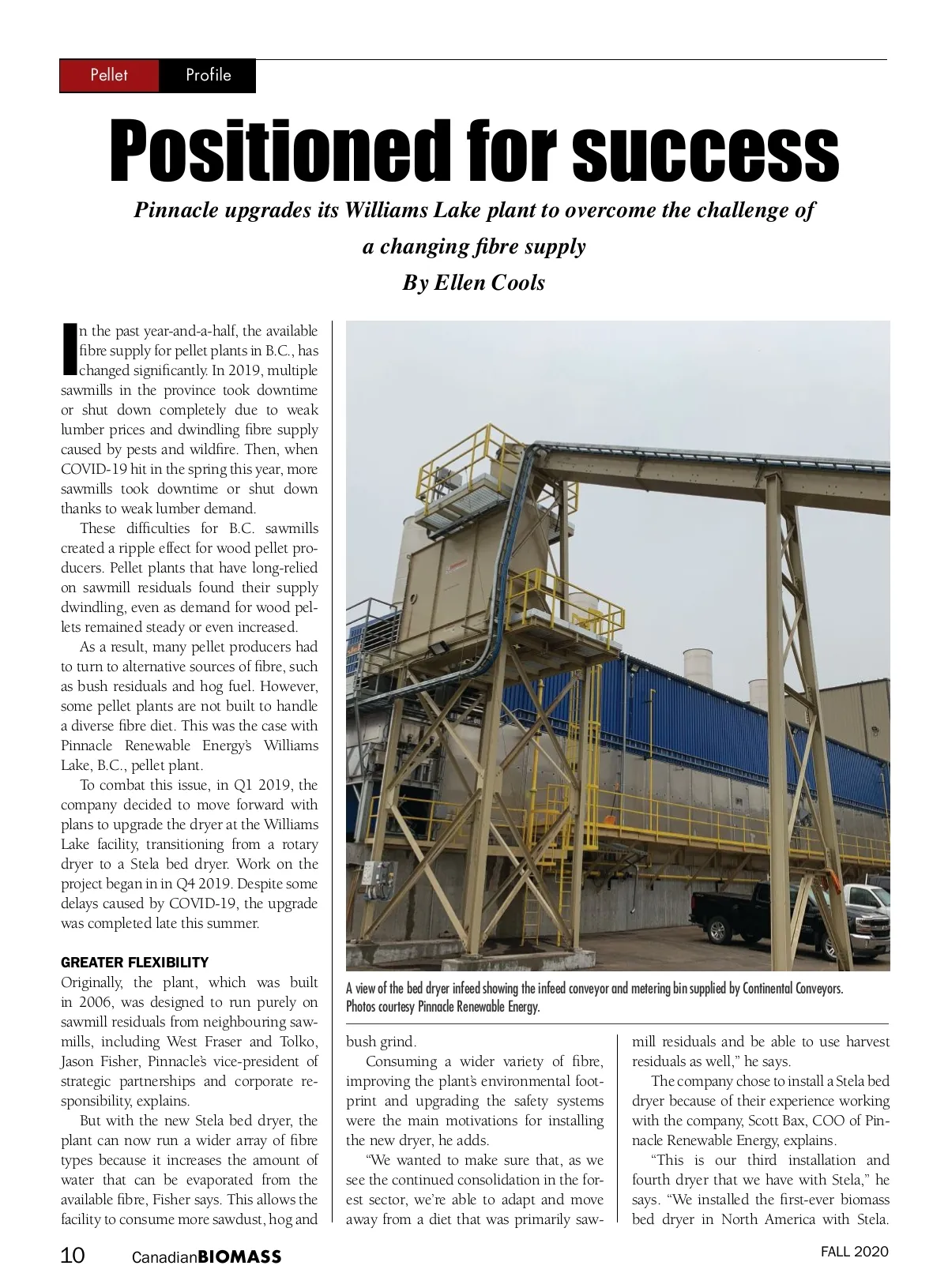
Pellet Profile Positioned for success Pinnacle upgrades its Williams Lake plant to overcome the challenge of a changing fibre supply By Ellen Cools n the past year-and-a-half, the available fibre supply for pellet plants in B.C., has changed significantly. In 2019, multiple sawmills in the province took downtime or shut down completely due to weak lumber prices and dwindling fibre supply caused by pests and wildfire. Then, when COVID-19 hit in the spring this year, more sawmills took downtime or shut down thanks to weak lumber demand. These difficulties for B.C. sawmills created a ripple effect for wood pellet pro-ducers. Pellet plants that have long-relied on sawmill residuals found their supply dwindling, even as demand for wood pel-lets remained steady or even increased. As a result, many pellet producers had to turn to alternative sources of fibre, such as bush residuals and hog fuel. However, some pellet plants are not built to handle a diverse fibre diet. This was the case with Pinnacle Renewable Energy’s Williams Lake, B.C., pellet plant. To combat this issue, in Q1 2019, the company decided to move forward with plans to upgrade the dryer at the Williams Lake facility, transitioning from a rotary dryer to a Stela bed dryer. Work on the project began in in Q4 2019. Despite some delays caused by COVID-19, the upgrade was completed late this summer. GREATER FLEXIBILITY I Originally, the plant, which was built in 2006, was designed to run purely on sawmill residuals from neighbouring saw-mills, including West Fraser and Tolko, Jason Fisher, Pinnacle’s vice-president of strategic partnerships and corporate re-sponsibility, explains. But with the new Stela bed dryer, the plant can now run a wider array of fibre types because it increases the amount of water that can be evaporated from the available fibre, Fisher says. This allows the facility to consume more sawdust, hog and A view of the bed dryer infeed showing the infeed conveyor and metering bin supplied by Continental Conveyors. Photos courtesy Pinnacle Renewable Energy. bush grind. Consuming a wider variety of fibre, improving the plant’s environmental foot-print and upgrading the safety systems were the main motivations for installing the new dryer, he adds. “We wanted to make sure that, as we see the continued consolidation in the for-est sector, we’re able to adapt and move away from a diet that was primarily saw-mill residuals and be able to use harvest residuals as well,” he says. The company chose to install a Stela bed dryer because of their experience working with the company, Scott Bax, COO of Pin-nacle Renewable Energy, explains. “This is our third installation and fourth dryer that we have with Stela,” he says. “We installed the first-ever biomass bed dryer in North America with Stela. FALL 2020 10 Canadian BIOMASS
Canadian Biomass Fall 2020: Page 10