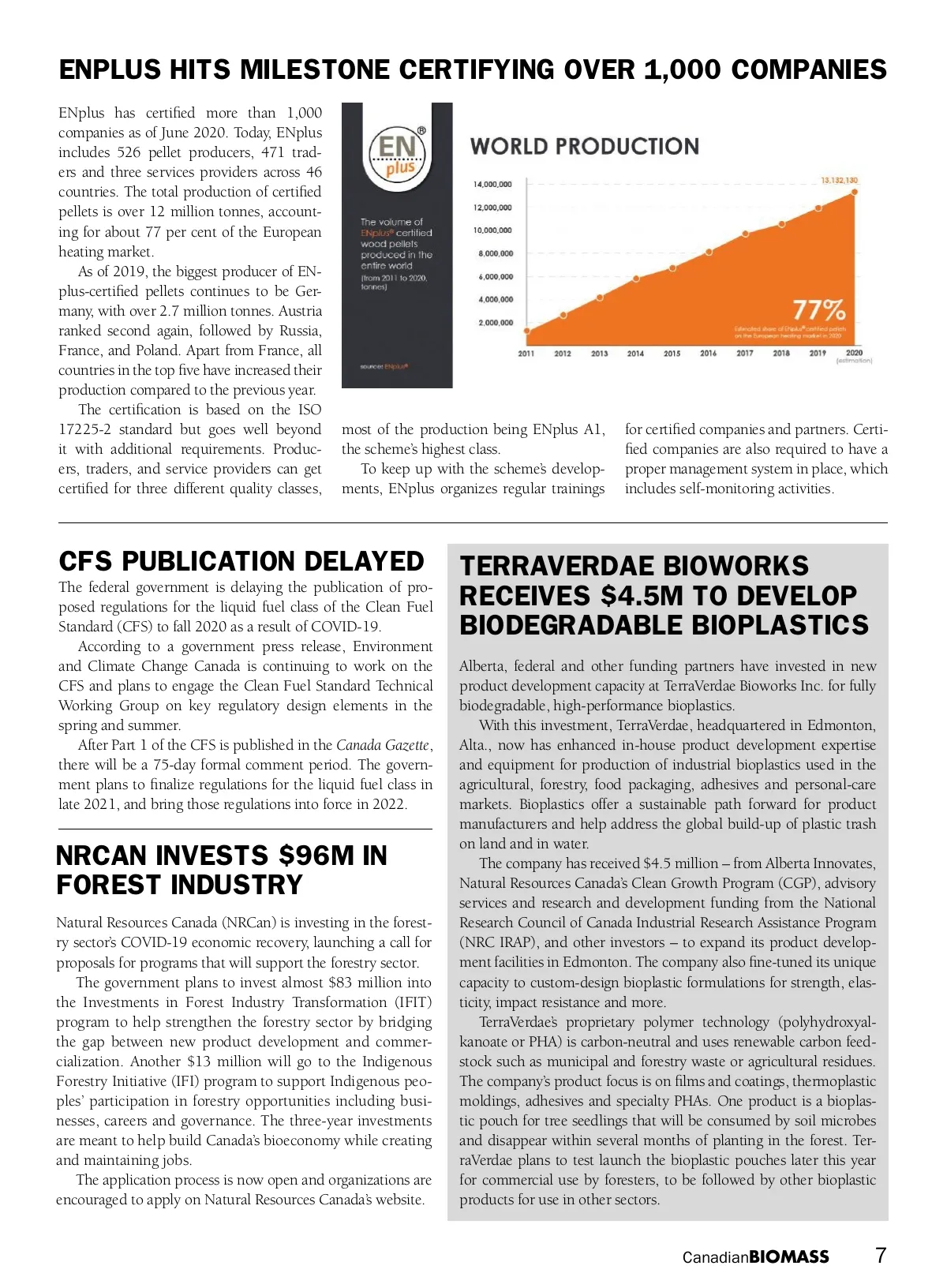
ENPLUS HITS MILESTONE CERTIFYING OVER 1,000 COMPANIES ENplus has certified more than 1,000 companies as of June 2020. Today, ENplus includes 526 pellet producers, 471 trad-ers and three services providers across 46 countries. The total production of certified pellets is over 12 million tonnes, account-ing for about 77 per cent of the European heating market. As of 2019, the biggest producer of EN-plus-certified pellets continues to be Ger-many, with over 2.7 million tonnes. Austria ranked second again, followed by Russia, France, and Poland. Apart from France, all countries in the top five have increased their production compared to the previous year. The certification is based on the ISO 17225-2 standard but goes well beyond it with additional requirements. Produc-ers, traders, and service providers can get certified for three different quality classes, most of the production being ENplus A1, the scheme’s highest class. To keep up with the scheme’s develop-ments, ENplus organizes regular trainings for certified companies and partners. Certi-fied companies are also required to have a proper management system in place, which includes self-monitoring activities. CFS PUBLICATION DELAYED The federal government is delaying the publication of pro-posed regulations for the liquid fuel class of the Clean Fuel Standard (CFS) to fall 2020 as a result of COVID-19. According to a government press release, Environment and Climate Change Canada is continuing to work on the CFS and plans to engage the Clean Fuel Standard Technical Working Group on key regulatory design elements in the spring and summer. After Part 1 of the CFS is published in the Canada Gazette , there will be a 75-day formal comment period. The govern-ment plans to finalize regulations for the liquid fuel class in late 2021, and bring those regulations into force in 2022. TERRAVERDAE BIOWORKS RECEIVES $4.5M TO DEVELOP BIODEGRADABLE BIOPLASTICS Alberta, federal and other funding partners have invested in new product development capacity at TerraVerdae Bioworks Inc. for fully biodegradable, high-performance bioplastics. With this investment, TerraVerdae, headquartered in Edmonton, Alta., now has enhanced in-house product development expertise and equipment for production of industrial bioplastics used in the agricultural, forestry, food packaging, adhesives and personal-care markets. Bioplastics offer a sustainable path forward for product manufacturers and help address the global build-up of plastic trash on land and in water. The company has received $4.5 million – from Alberta Innovates, Natural Resources Canada’s Clean Growth Program (CGP), advisory services and research and development funding from the National Research Council of Canada Industrial Research Assistance Program (NRC IRAP), and other investors – to expand its product develop-ment facilities in Edmonton. The company also fine-tuned its unique capacity to custom-design bioplastic formulations for strength, elas-ticity, impact resistance and more. TerraVerdae’s proprietary polymer technology (polyhydroxyal-kanoate or PHA) is carbon-neutral and uses renewable carbon feed-stock such as municipal and forestry waste or agricultural residues. The company’s product focus is on films and coatings, thermoplastic moldings, adhesives and specialty PHAs. One product is a bioplas-tic pouch for tree seedlings that will be consumed by soil microbes and disappear within several months of planting in the forest. Ter-raVerdae plans to test launch the bioplastic pouches later this year for commercial use by foresters, to be followed by other bioplastic products for use in other sectors. NRCAN INVESTS $96M IN FOREST INDUSTRY Natural Resources Canada (NRCan) is investing in the forest-ry sector’s COVID-19 economic recovery, launching a call for proposals for programs that will support the forestry sector. The government plans to invest almost $83 million into the Investments in Forest Industry Transformation (IFIT) program to help strengthen the forestry sector by bridging the gap between new product development and commer-cialization. Another $13 million will go to the Indigenous Forestry Initiative (IFI) program to support Indigenous peo-ples’ participation in forestry opportunities including busi-nesses, careers and governance. The three-year investments are meant to help build Canada’s bioeconomy while creating and maintaining jobs. The application process is now open and organizations are encouraged to apply on Natural Resources Canada’s website. Canadian BIOMASS 7
Canadian Biomass Summer 2020: Page 7