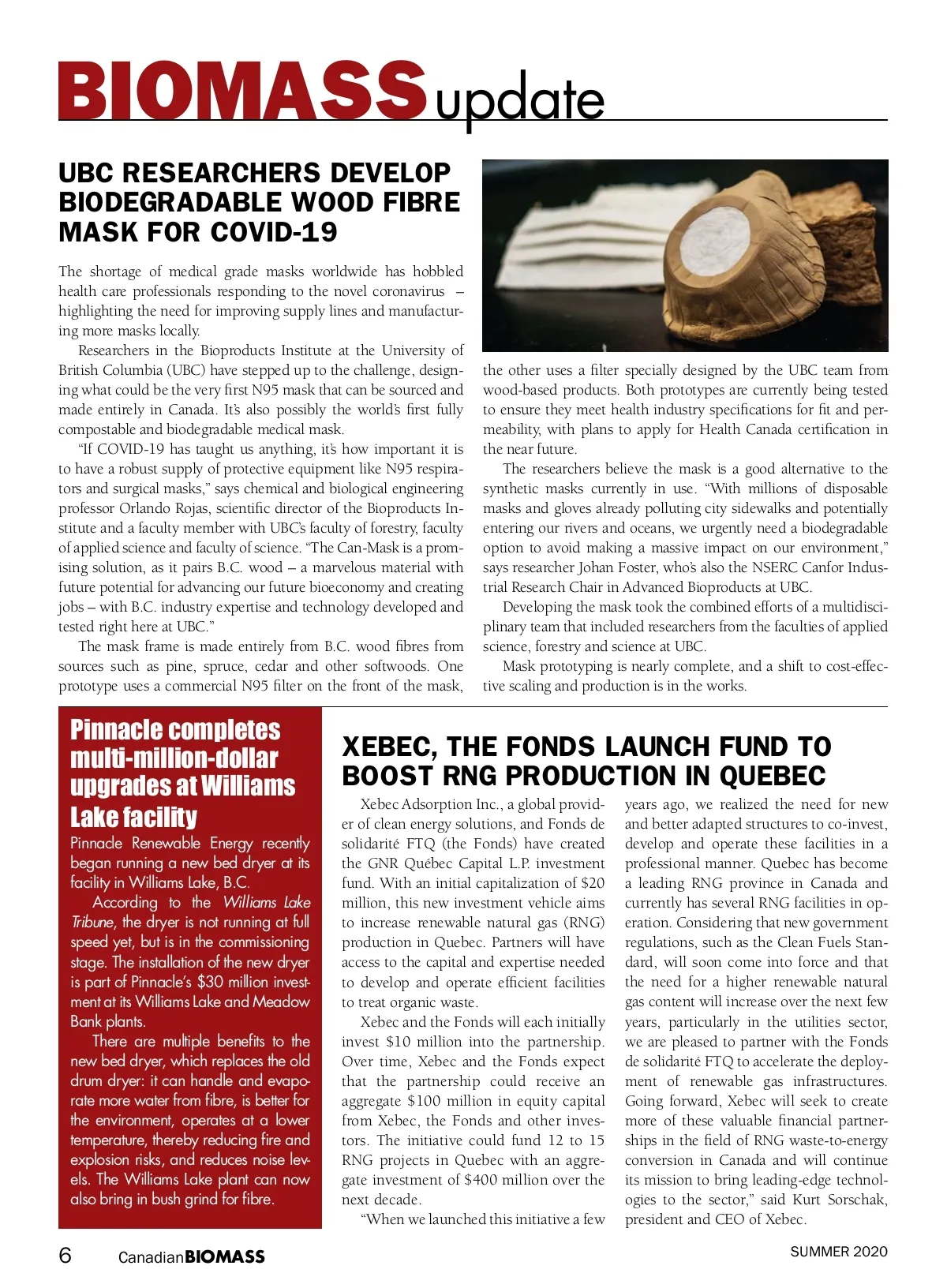
BIOMASS update UBC RESEARCHERS DEVELOP BIODEGRADABLE WOOD FIBRE MASK FOR COVID-19 The shortage of medical grade masks worldwide has hobbled health care professionals responding to the novel coronavirus – highlighting the need for improving supply lines and manufactur-ing more masks locally. Researchers in the Bioproducts Institute at the University of British Columbia (UBC) have stepped up to the challenge, design-ing what could be the very first N95 mask that can be sourced and made entirely in Canada. It’s also possibly the world’s first fully compostable and biodegradable medical mask. “If COVID-19 has taught us anything, it’s how important it is to have a robust supply of protective equipment like N95 respira-tors and surgical masks,” says chemical and biological engineering professor Orlando Rojas, scientific director of the Bioproducts In-stitute and a faculty member with UBC’s faculty of forestry, faculty of applied science and faculty of science. “The Can-Mask is a prom-ising solution, as it pairs B.C. wood – a marvelous material with future potential for advancing our future bioeconomy and creating jobs – with B.C. industry expertise and technology developed and tested right here at UBC.” The mask frame is made entirely from B.C. wood fibres from sources such as pine, spruce, cedar and other softwoods. One prototype uses a commercial N95 filter on the front of the mask, the other uses a filter specially designed by the UBC team from wood-based products. Both prototypes are currently being tested to ensure they meet health industry specifications for fit and per-meability, with plans to apply for Health Canada certification in the near future. The researchers believe the mask is a good alternative to the synthetic masks currently in use. “With millions of disposable masks and gloves already polluting city sidewalks and potentially entering our rivers and oceans, we urgently need a biodegradable option to avoid making a massive impact on our environment,” says researcher Johan Foster, who’s also the NSERC Canfor Indus-trial Research Chair in Advanced Bioproducts at UBC. Developing the mask took the combined efforts of a multidisci-plinary team that included researchers from the faculties of applied science, forestry and science at UBC. Mask prototyping is nearly complete, and a shift to cost-effec-tive scaling and production is in the works. Pinnacle completes multi-million-dollar upgrades at Williams Lake facility XEBEC, THE FONDS LAUNCH FUND TO BOOST RNG PRODUCTION IN QUEBEC Xebec Adsorption Inc., a global provid-er of clean energy solutions, and Fonds de solidarité FTQ (the Fonds) have created the GNR Québec Capital L.P. investment fund. With an initial capitalization of $20 million, this new investment vehicle aims to increase renewable natural gas (RNG) production in Quebec. Partners will have access to the capital and expertise needed to develop and operate efficient facilities to treat organic waste. Xebec and the Fonds will each initially invest $10 million into the partnership. Over time, Xebec and the Fonds expect that the partnership could receive an aggregate $100 million in equity capital from Xebec, the Fonds and other inves-tors. The initiative could fund 12 to 15 RNG projects in Quebec with an aggre-gate investment of $400 million over the next decade. “When we launched this initiative a few years ago, we realized the need for new and better adapted structures to co-invest, develop and operate these facilities in a professional manner. Quebec has become a leading RNG province in Canada and currently has several RNG facilities in op-eration. Considering that new government regulations, such as the Clean Fuels Stan-dard, will soon come into force and that the need for a higher renewable natural gas content will increase over the next few years, particularly in the utilities sector, we are pleased to partner with the Fonds de solidarité FTQ to accelerate the deploy-ment of renewable gas infrastructures. Going forward, Xebec will seek to create more of these valuable financial partner-ships in the field of RNG waste-to-energy conversion in Canada and will continue its mission to bring leading-edge technol-ogies to the sector,” said Kurt Sorschak, president and CEO of Xebec. SUMMER 2020 Pinnacle Renewable Energy recently began running a new bed dryer at its facility in Williams Lake, B.C . According to the Williams Lake Tribune , the dryer is not running at full speed yet, but is in the commissioning stage. The installation of the new dryer is part of Pinnacle’s $30 million invest-ment at its Williams Lake and Meadow Bank plants. There are multiple benefits to the new bed dryer, which replaces the old drum dryer: it can handle and evapo-rate more water from fibre, is better for the environment, operates at a lower temperature, thereby reducing fire and explosion risks, and reduces noise lev-els. The Williams Lake plant can now also bring in bush grind for fibre. 6 Canadian BIOMASS
Canadian Biomass Summer 2020: Page 6