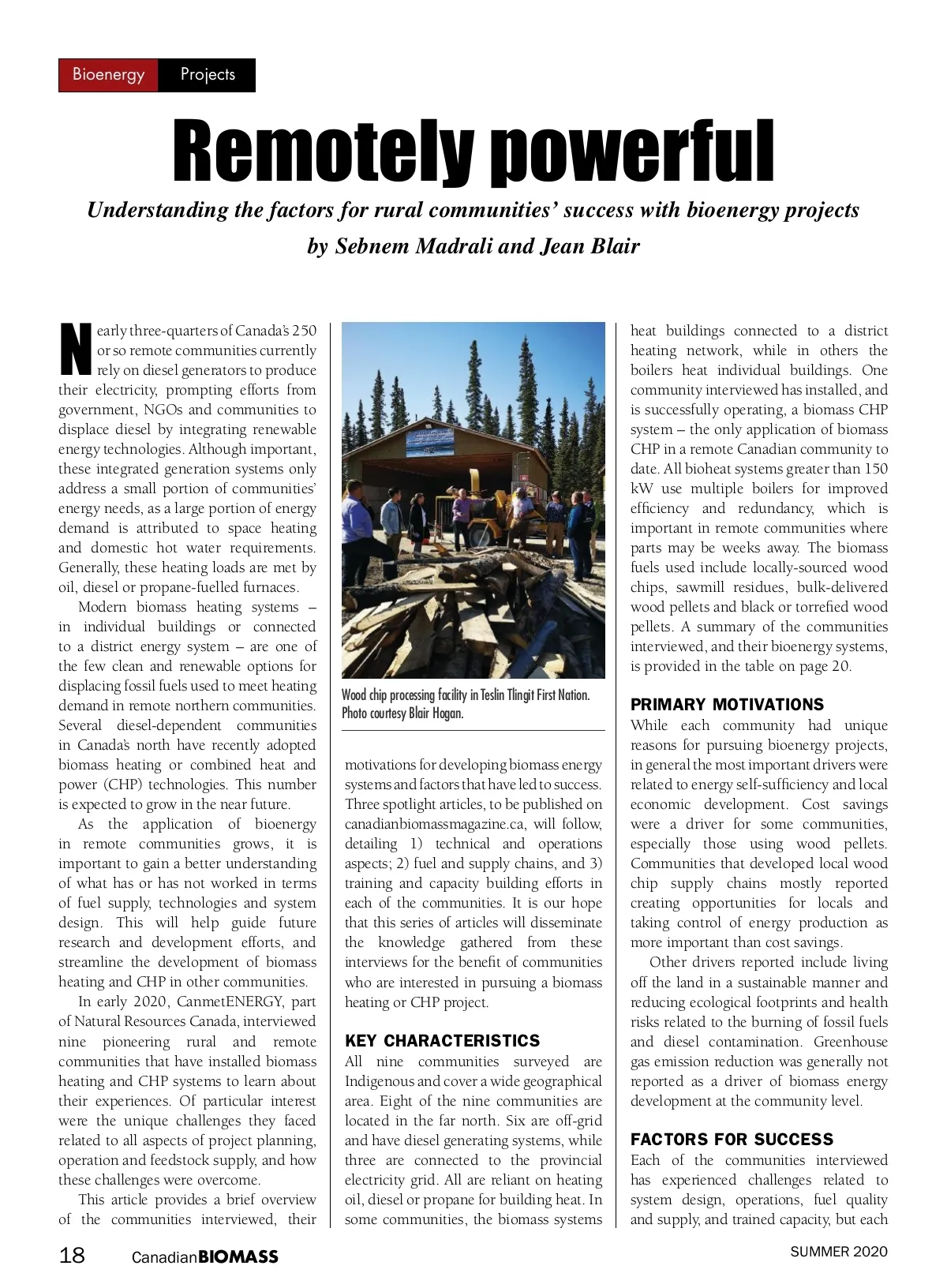
Bioenergy Projects Understanding the factors for rural communities’ success with bioenergy projects by Sebnem Madrali and Jean Blair Remotely powerful early three-quarters of Canada’s 250 or so remote communities currently rely on diesel generators to produce their electricity, prompting efforts from government, NGOs and communities to displace diesel by integrating renewable energy technologies. Although important, these integrated generation systems only address a small portion of communities’ energy needs, as a large portion of energy demand is attributed to space heating and domestic hot water requirements. Generally, these heating loads are met by oil, diesel or propane-fuelled furnaces. Modern biomass heating systems – in individual buildings or connected to a district energy system – are one of the few clean and renewable options for displacing fossil fuels used to meet heating demand in remote northern communities. Several diesel-dependent communities in Canada’s north have recently adopted biomass heating or combined heat and power (CHP) technologies. This number is expected to grow in the near future. As the application of bioenergy in remote communities grows, it is important to gain a better understanding of what has or has not worked in terms of fuel supply, technologies and system design. This will help guide future research and development efforts, and streamline the development of biomass heating and CHP in other communities. In early 2020, CanmetENERGY, part of Natural Resources Canada, interviewed nine pioneering rural and remote communities that have installed biomass heating and CHP systems to learn about their experiences. Of particular interest were the unique challenges they faced related to all aspects of project planning, operation and feedstock supply, and how these challenges were overcome. This article provides a brief overview of the communities interviewed, their N heat buildings connected to a district heating network, while in others the boilers heat individual buildings. One community interviewed has installed, and is successfully operating, a biomass CHP system – the only application of biomass CHP in a remote Canadian community to date. All bioheat systems greater than 150 kW use multiple boilers for improved efficiency and redundancy, which is important in remote communities where parts may be weeks away. The biomass fuels used include locally-sourced wood chips, sawmill residues, bulk-delivered wood pellets and black or torrefied wood pellets. A summary of the communities interviewed, and their bioenergy systems, is provided in the table on page 20. Wood chip processing facility in Teslin Tlingit First Nation. Photo courtesy Blair Hogan. PRIMARY MOTIVATIONS motivations for developing biomass energy systems and factors that have led to success. Three spotlight articles, to be published on canadianbiomassmagazine.ca, will follow, detailing 1) technical and operations aspects; 2) fuel and supply chains, and 3) training and capacity building efforts in each of the communities. It is our hope that this series of articles will disseminate the knowledge gathered from these interviews for the benefit of communities who are interested in pursuing a biomass heating or CHP project. KEY CHARACTERISTICS All nine communities surveyed are Indigenous and cover a wide geographical area. Eight of the nine communities are located in the far north. Six are off-grid and have diesel generating systems, while three are connected to the provincial electricity grid. All are reliant on heating oil, diesel or propane for building heat. In some communities, the biomass systems While each community had unique reasons for pursuing bioenergy projects, in general the most important drivers were related to energy self-sufficiency and local economic development. Cost savings were a driver for some communities, especially those using wood pellets. Communities that developed local wood chip supply chains mostly reported creating opportunities for locals and taking control of energy production as more important than cost savings. Other drivers reported include living off the land in a sustainable manner and reducing ecological footprints and health risks related to the burning of fossil fuels and diesel contamination. Greenhouse gas emission reduction was generally not reported as a driver of biomass energy development at the community level. FACTORS FOR SUCCESS Each of the communities interviewed has experienced challenges related to system design, operations, fuel quality and supply, and trained capacity, but each SUMMER 2020 18 Canadian BIOMASS
Canadian Biomass Summer 2020: Page 18