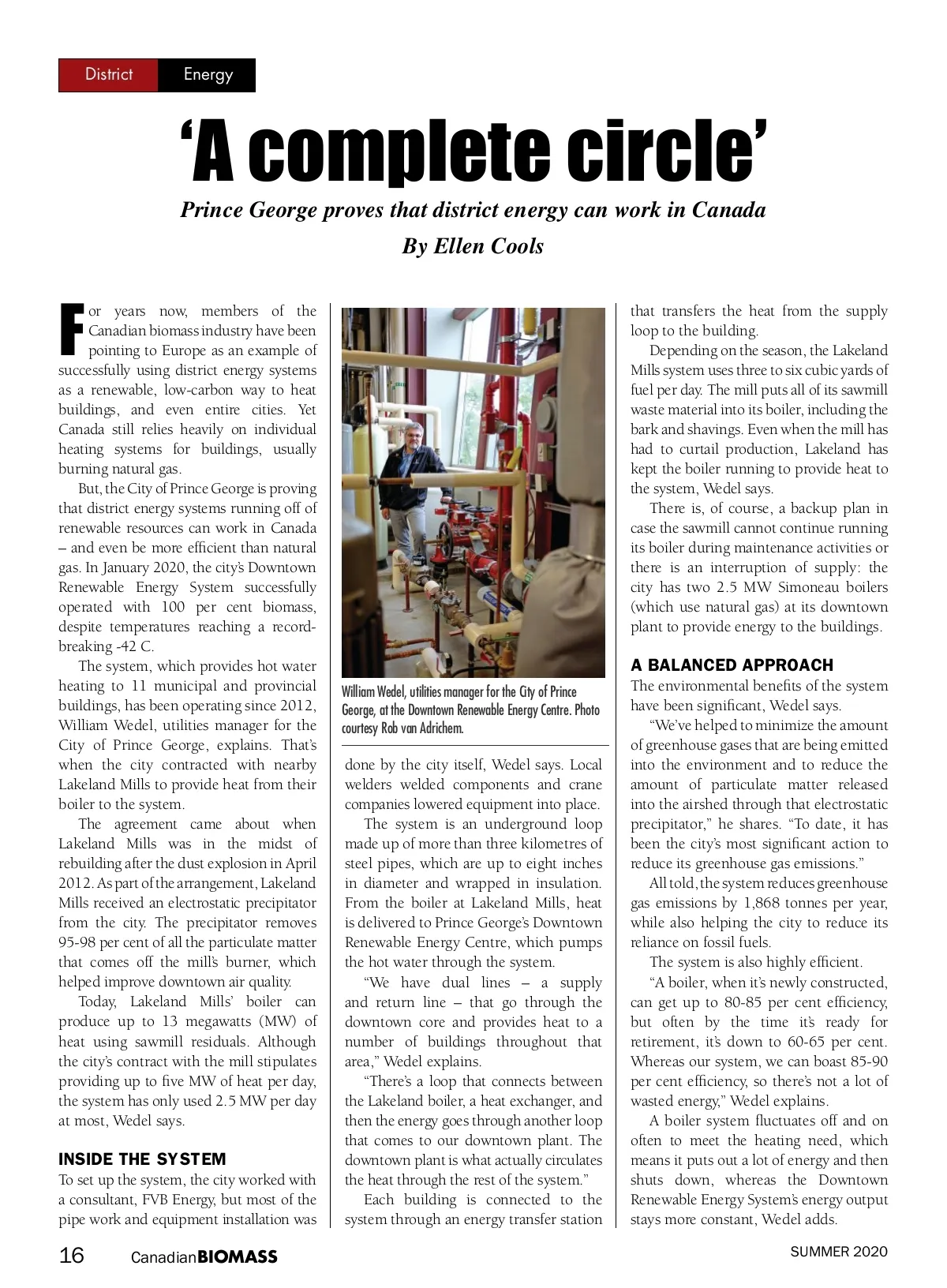
Economically, connecting just one building – the Prince George courthouse – to the system has saved the province of B.C. about $175,000 in carbon offsets and natural gas purchases. The city is also currently conducting a detailed analysis on the economic benefits of the system to learn more about its economic impact. For the buildings that connect to the system, initially it costs as much as installing a boiler system. But after 15-20 years, the buildings on the network won’t have to buy another boiler. GREAT POTENTIAL The heat exchangers that transfer the heat from Lakeland Mills to Prince George. Just one of these heat exchangers provides all of the heat for the buildings that are currently connected to the system. Photo courtesy William Wedel. Looking ahead, Wedel hopes to see more structures connected to the Prince George Downtown Renewable Energy System in five to 10 years, as awareness of the system and its benefits grows. In fact, Prince George began expanding the system in May this year to serve the city’s new parkade and a future new pool. Despite the many benefits of this system, Prince George is one of few cities in Canada that has a district energy system using a renewable fuel source. Wedel thinks this is partly because of Canada’s plentiful supply of natural gas and other sources of energy. But things are changing. “I think now we’re starting to look at things and say, ‘Okay, rather than just having another waste product, what if we can turn that waste into dollars and cents in a different fashion?’ We’re definitely seeing that a lot more with every industry – waste management is trying to find ways to divert usable products from landfills and pure disposal, to provide us with additional resources,” Wedel says. “It’s looking at all of these things as a complete circle, rather just the end of the line,” he adds. To encourage more district energy systems in Canada, Wedel says more awareness and incentives are needed. He also thinks Canadian municipalities need to look closer at the European experience with district energy. In 2018, the Canadian Bioeconomy Conference and Exhibition presented a delegation from Växjö, Sweden. “Växjö has about the same population as Prince George, but while we have nearly a dozen buildings connected to a biomass energy system, they have about 8,500,” Wedel says. “Initially, development of the system in Växjö was a big decision, but once they started to build the industry further, they started to realize it actually saves money and it actually spawns additional manufacturing industry and resources based on that system. The costs started to go down and public acceptance went up,” he elaborates. “Once it becomes more of a mainstream thing, it does become a lot more economically feasible for us to move in this direction.” And it looks like more cities in Canada are seeing the potential of district energy. In B.C., Quesnel and Williams Lake are looking into district energy systems. Quesnel is exploring the possibility of getting heat from the sawmills in their area that already have boiler systems providing heat for their own purposes, Wedel shares. But the development of district energy systems depends on municipalities’ locations and resources they can tap into. It’s optimal for “those locations that have mills or resources that are within close proximity, so we’re minimizing trucking or the length of the piping network,” Wedel explains. The proximity and density of buildings with significant, year-round heating demand is another consideration. Overall, Wedel says the potential for district energy systems – and the Prince George Renewable Downtown System in particular – is great. “Some people think that using wood for energy is not the best thing, but we’ve found that it can be very beneficial,” he says. “It has been a real accomplishment for Prince George to significantly reduce our GHG emissions while supporting such an important local industry and keeping our energy dollars local.” • Fink Machine Inc. , is very excited to announce that we have added Schmid Energy Solutions boilers to our current product portfolio. Fink’s success is based on Service and we are looking to continue that by adding Schmid boilers to its line of high quality products. Canada’s leading supplier of commercial and small industrial heating systems ASME and CSA certified 100 kW – 12 MW (0.3 MMBTU – 36 MMBTU) Over 130 energy efficient systems installed Fink District Heating System Box 308, 124 Old Vernon St. Enderby, B.C. V0E 1V0 Ph. 250.838.0077 | Fax. 250.838.0068 | www.FinkMachine.com Canadian BIOMASS CB_Fink_June20_EJS.indd 1 2020-06-26 8:08 AM 17
Canadian Biomass Summer 2020: Page 17