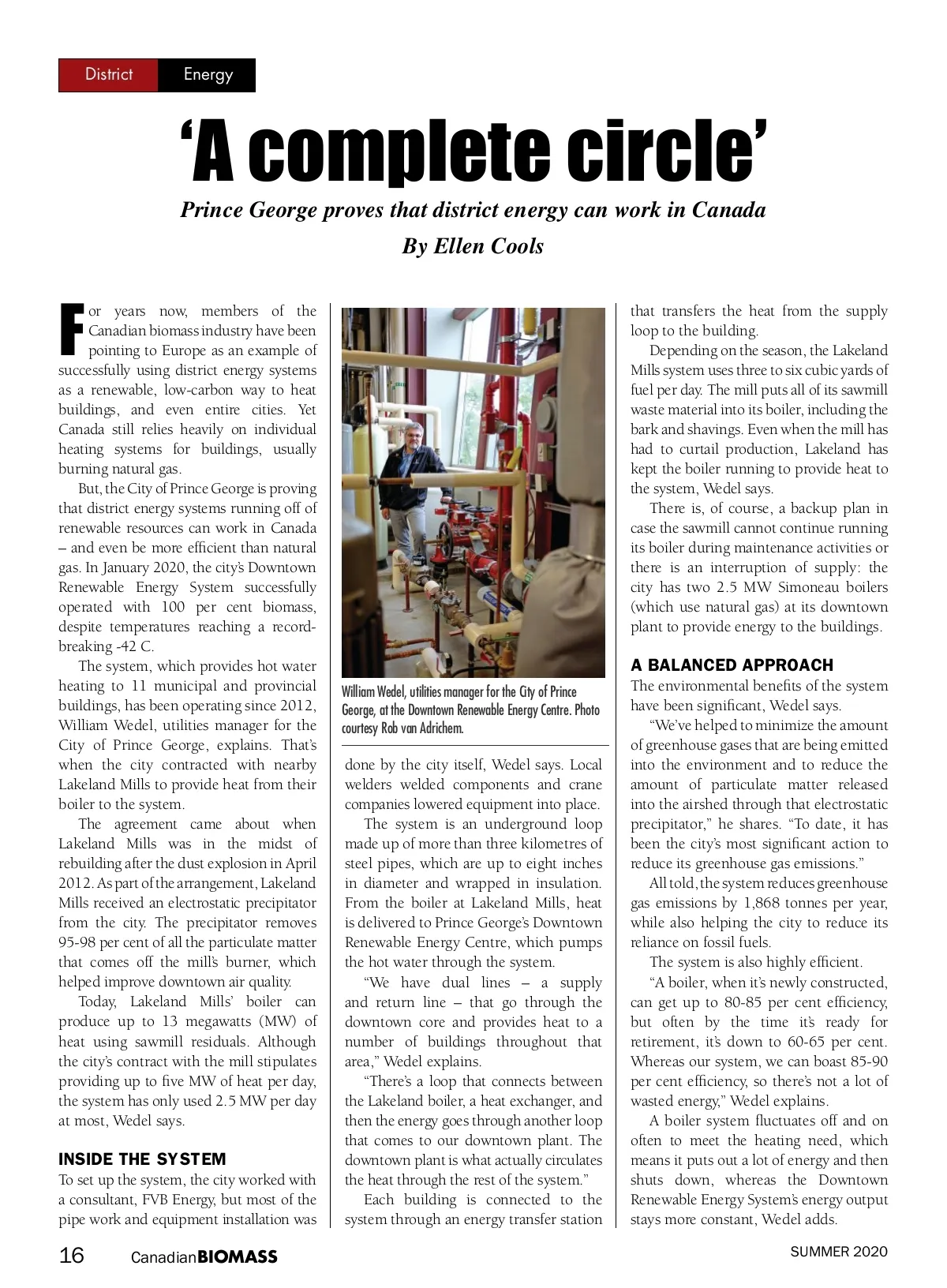
District Energy ‘A complete circle’ Prince George proves that district energy can work in Canada By Ellen Cools F or years now, members of the Canadian biomass industry have been pointing to Europe as an example of successfully using district energy systems as a renewable, low-carbon way to heat buildings, and even entire cities. Yet Canada still relies heavily on individual heating systems for buildings, usually burning natural gas. But, the City of Prince George is proving that district energy systems running off of renewable resources can work in Canada – and even be more efficient than natural gas. In January 2020, the city’s Downtown Renewable Energy System successfully operated with 100 per cent biomass, despite temperatures reaching a record-breaking -42 C. The system, which provides hot water heating to 11 municipal and provincial buildings, has been operating since 2012, William Wedel, utilities manager for the City of Prince George, explains. That’s when the city contracted with nearby Lakeland Mills to provide heat from their boiler to the system. The agreement came about when Lakeland Mills was in the midst of rebuilding after the dust explosion in April 2012. As part of the arrangement, Lakeland Mills received an electrostatic precipitator from the city. The precipitator removes 95-98 per cent of all the particulate matter that comes off the mill’s burner, which helped improve downtown air quality. Today, Lakeland Mills’ boiler can produce up to 13 megawatts (MW) of heat using sawmill residuals. Although the city’s contract with the mill stipulates providing up to five MW of heat per day, the system has only used 2.5 MW per day at most, Wedel says. that transfers the heat from the supply loop to the building. Depending on the season, the Lakeland Mills system uses three to six cubic yards of fuel per day. The mill puts all of its sawmill waste material into its boiler, including the bark and shavings. Even when the mill has had to curtail production, Lakeland has kept the boiler running to provide heat to the system, Wedel says. There is, of course, a backup plan in case the sawmill cannot continue running its boiler during maintenance activities or there is an interruption of supply: the city has two 2.5 MW Simoneau boilers (which use natural gas) at its downtown plant to provide energy to the buildings. A BALANCED APPROACH William Wedel, utilities manager for the City of Prince George, at the Downtown Renewable Energy Centre. Photo courtesy Rob van Adrichem. INSIDE THE SYSTEM To set up the system, the city worked with a consultant, FVB Energy, but most of the pipe work and equipment installation was done by the city itself, Wedel says. Local welders welded components and crane companies lowered equipment into place. The system is an underground loop made up of more than three kilometres of steel pipes, which are up to eight inches in diameter and wrapped in insulation. From the boiler at Lakeland Mills, heat is delivered to Prince George’s Downtown Renewable Energy Centre, which pumps the hot water through the system. “We have dual lines – a supply and return line – that go through the downtown core and provides heat to a number of buildings throughout that area,” Wedel explains. “There’s a loop that connects between the Lakeland boiler, a heat exchanger, and then the energy goes through another loop that comes to our downtown plant. The downtown plant is what actually circulates the heat through the rest of the system.” Each building is connected to the system through an energy transfer station The environmental benefits of the system have been significant, Wedel says. “We’ve helped to minimize the amount of greenhouse gases that are being emitted into the environment and to reduce the amount of particulate matter released into the airshed through that electrostatic precipitator,” he shares. “To date, it has been the city’s most significant action to reduce its greenhouse gas emissions.” All told, the system reduces greenhouse gas emissions by 1,868 tonnes per year, while also helping the city to reduce its reliance on fossil fuels. The system is also highly efficient. “A boiler, when it’s newly constructed, can get up to 80-85 per cent efficiency, but often by the time it’s ready for retirement, it’s down to 60-65 per cent. Whereas our system, we can boast 85-90 per cent efficiency, so there’s not a lot of wasted energy,” Wedel explains. A boiler system fluctuates off and on often to meet the heating need, which means it puts out a lot of energy and then shuts down, whereas the Downtown Renewable Energy System’s energy output stays more constant, Wedel adds. SUMMER 2020 16 Canadian BIOMASS
Canadian Biomass Summer 2020: Page 16