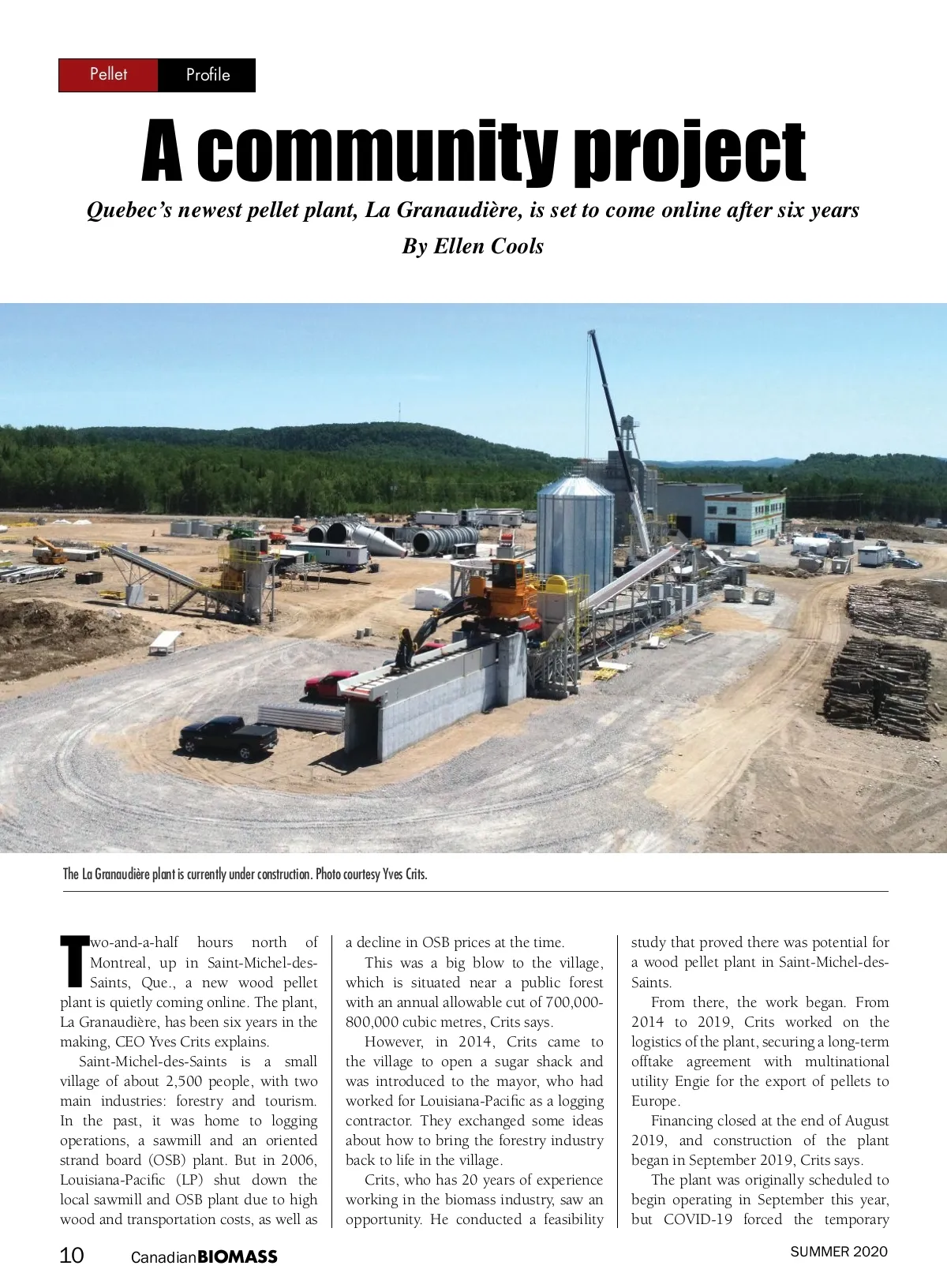
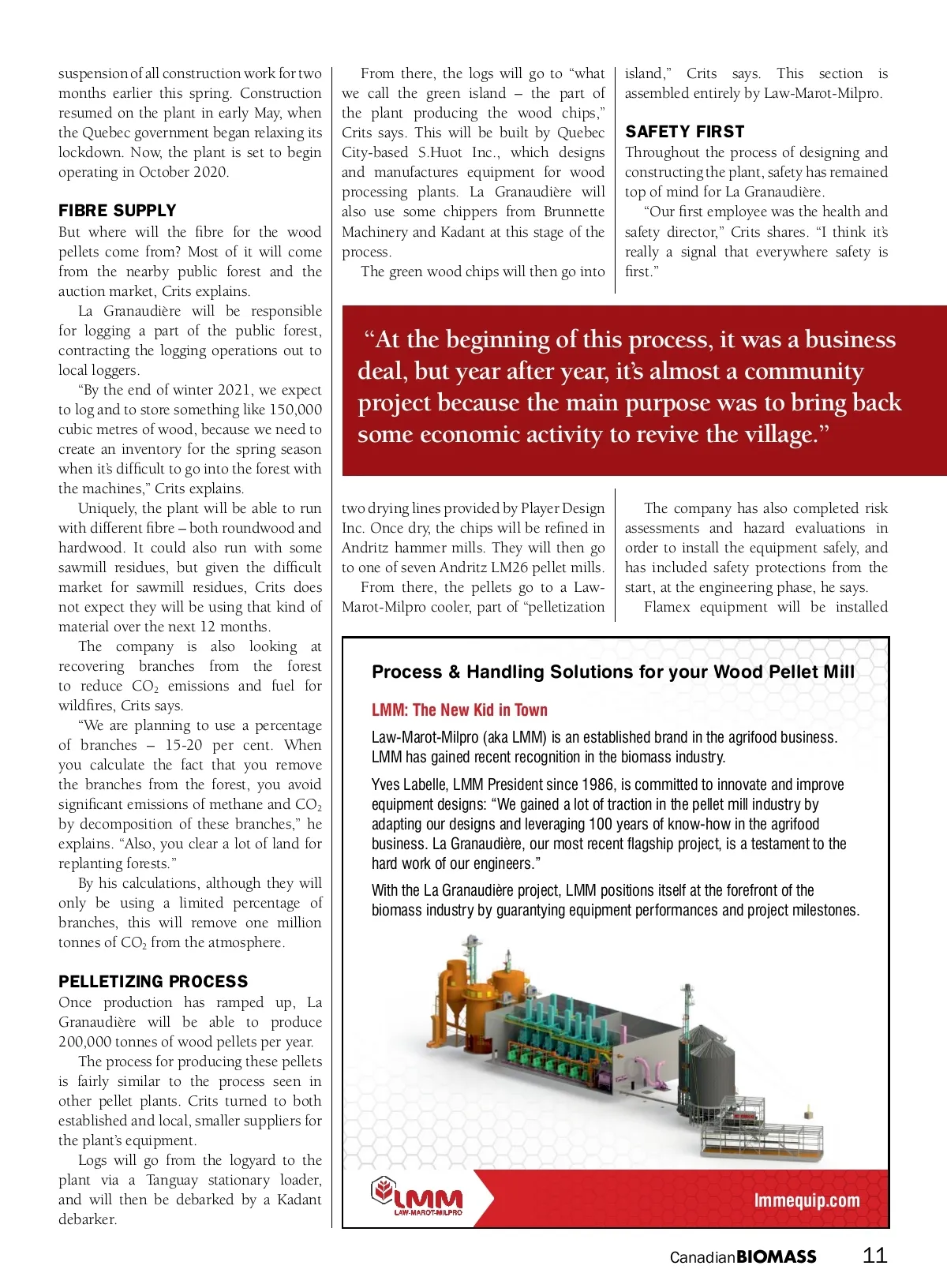
suspension of all construction work for two months earlier this spring. Construction resumed on the plant in early May, when the Quebec government began relaxing its lockdown. Now, the plant is set to begin operating in October 2020. FIBRE SUPPLY But where will the fibre for the wood pellets come from? Most of it will come from the nearby public forest and the auction market, Crits explains. La Granaudière will be responsible for logging a part of the public forest, contracting the logging operations out to local loggers. “By the end of winter 2021, we expect to log and to store something like 150,000 cubic metres of wood, because we need to create an inventory for the spring season when it’s difficult to go into the forest with the machines,” Crits explains. Uniquely, the plant will be able to run with different fibre – both roundwood and hardwood. It could also run with some sawmill residues, but given the difficult market for sawmill residues, Crits does not expect they will be using that kind of material over the next 12 months. The company is also looking at recovering branches from the forest to reduce CO 2 emissions and fuel for wildfires, Crits says. “We are planning to use a percentage of branches – 15-20 per cent. When you calculate the fact that you remove the branches from the forest, you avoid significant emissions of methane and CO 2 by decomposition of these branches,” he explains. “Also, you clear a lot of land for replanting forests.” By his calculations, although they will only be using a limited percentage of branches, this will remove one million tonnes of CO 2 from the atmosphere. PELLETIZING PROCESS From there, the logs will go to “what we call the green island – the part of the plant producing the wood chips,” Crits says. This will be built by Quebec City-based S.Huot Inc., which designs and manufactures equipment for wood processing plants. La Granaudière will also use some chippers from Brunnette Machinery and Kadant at this stage of the process. The green wood chips will then go into island,” Crits says. This section is assembled entirely by Law-Marot-Milpro. SAFETY FIRST Throughout the process of designing and constructing the plant, safety has remained top of mind for La Granaudière. “Our first employee was the health and safety director,” Crits shares. “I think it’s really a signal that everywhere safety is first.” “At the beginning of this process, it was a business deal, but year after year, it’s almost a community project because the main purpose was to bring back some economic activity to revive the village.” two drying lines provided by Player Design Inc. Once dry, the chips will be refined in Andritz hammer mills. They will then go to one of seven Andritz LM26 pellet mills. From there, the pellets go to a Law-Marot-Milpro cooler, part of “pelletization The company has also completed risk assessments and hazard evaluations in order to install the equipment safely, and has included safety protections from the start, at the engineering phase, he says. Flamex equipment will be installed Process & Handling Solutions for your Wood Pellet Mill LMM: The New Kid in Town Law-Marot-Milpro (aka LMM) is an established brand in the agrifood business. LMM has gained recent recognition in the biomass industry. Yves Labelle, LMM President since 1986, is committed to innovate and improve equipment designs: “We gained a lot of traction in the pellet mill industry by adapting our designs and leveraging 100 years of know-how in the agrifood business. La Granaudière, our most recent flagship project, is a testament to the hard work of our engineers.” With the La Granaudière project, LMM positions itself at the forefront of the biomass industry by guarantying equipment performances and project milestones. Once production has ramped up, La Granaudière will be able to produce 200,000 tonnes of wood pellets per year. The process for producing these pellets is fairly similar to the process seen in other pellet plants. Crits turned to both established and local, smaller suppliers for the plant’s equipment. Logs will go from the logyard to the plant via a Tanguay stationary loader, and will then be debarked by a Kadant debarker. lmmequip.com Canadian BIOMASS 11 2020-07-07 8:40 AM CB_Law-Marot-Milpro_Summer20_CSA.indd 1
Canadian Biomass Summer 2020: Page 11