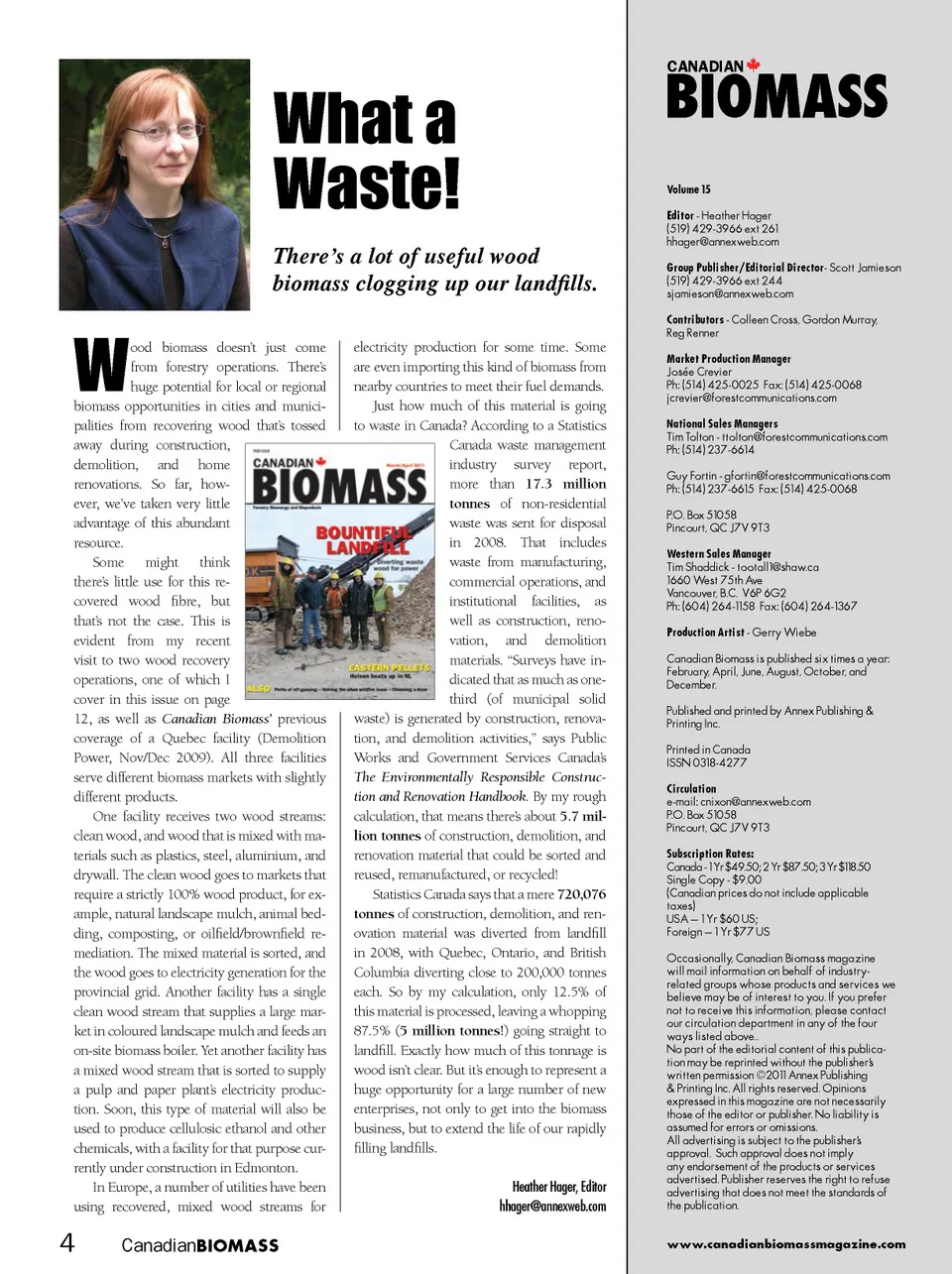
What a Waste! There’s a lot of useful wood biomass clogging up our landfills. BIOMASS CANADIAN Volume 15 Editor -Heather Hager (519) 429-3966 ext 261 [email protected] Group Publisher/Editorial Director -Scott Jamieson (519) 429-3966 ext 244 [email protected] Contributors -Colleen Cross, Gordon Murray, Reg Renner Market Production Manager Josée Crevier Ph: (514) 425-0025 Fax: (514) 425-0068 [email protected] National Sales Managers Tim Tolton [email protected] Ph: (514) 237-6614 Guy Fortin [email protected] Ph: (514) 237-6615 Fax: (514) 425-0068 P.O. Box 51058 Pincourt, QC J7V 9T3 Western Sales Manager Tim Shaddick [email protected] 1660 West 75th Ave Vancouver, B.C. V6P 6G2 Ph: (604) 264-1158 Fax: (604) 264-1367 Production Artist -Gerry Wiebe Canadian Biomass is published six times a year: February, April, June, August, October, and December. Published and printed by Annex Publishing & Printing Inc. Printed in Canada ISSN 0318-4277 Circulation e-mail: [email protected] P.O. Box 51058 Pincourt, QC J7V 9T3 Subscription Rates: Canada -1 Yr $49.50; 2 Yr $87.50; 3 Yr $118.50 Single Copy -$9.00 (Canadian prices do not include applicable taxes) USA – 1 Yr $60 US; Foreign – 1 Yr $77 US Occasionally, Canadian Biomass magazine will mail information on behalf of industry-related groups whose products and services we believe may be of interest to you. If you prefer not to receive this information, please contact our circulation department in any of the four ways listed above.. No part of the editorial content of this publica-tion may be reprinted without the publisher’ s written permission ©2011 Annex Publishing & Printing Inc. All rights reserved. Opinions expressed in this magazine are not necessarily those of the editor or publisher. No liability is assumed for errors or omissions. All advertising is subject to the publisher’ s approval. Such approval does not imply any endorsement of the products or services advertised. Publisher reserves the right to refuse advertising that does not meet the standards of the publication. www.canadianbiomassmagazine.com W ood biomass doesn’t just come from forestry operations. There’s huge potential for local or regional biomass opportunities in cities and munici-palities from recovering wood that’s tossed away during construction, demolition, and home renovations. So far, how-ever, we’ve taken very little advantage of this abundant resource. Some might think there’s little use for this re-covered wood fibre, but that’s not the case. This is evident from my recent visit to two wood recovery operations, one of which I cover in this issue on page 12, as well as Canadian Biomass’ previous coverage of a Quebec facility (Demolition Power, Nov/Dec 2009). All three facilities serve different biomass markets with slightly different products. One facility receives two wood streams: clean wood, and wood that is mixed with ma-terials such as plastics, steel, aluminium, and drywall. The clean wood goes to markets that require a strictly 100% wood product, for ex-ample, natural landscape mulch, animal bed-ding, composting, or oilfield/brownfield re-mediation. The mixed material is sorted, and the wood goes to electricity generation for the provincial grid. Another facility has a single clean wood stream that supplies a large mar-ket in coloured landscape mulch and feeds an on-site biomass boiler. Yet another facility has a mixed wood stream that is sorted to supply a pulp and paper plant’s electricity produc-tion. Soon, this type of material will also be used to produce cellulosic ethanol and other chemicals, with a facility for that purpose cur-rently under construction in Edmonton. In Europe, a number of utilities have been using recovered, mixed wood streams for electricity production for some time. Some are even importing this kind of biomass from nearby countries to meet their fuel demands. Just how much of this material is going to waste in Canada? According to a Statistics Canada waste management industry survey report, more than 17.3 million tonnes of non-residential waste was sent for disposal in 2008. That includes waste from manufacturing, commercial operations, and institutional facilities, as well as construction, reno-vation, and demolition materials. “Surveys have in-dicated that as much as one-third (of municipal solid waste) is generated by construction, renova-tion, and demolition activities,” says Public Works and Government Services Canada’s The Environmentally Responsible Construc-tion and Renovation Handbook. By my rough calculation, that means there’s about 5.7 mil-lion tonnes of construction, demolition, and renovation material that could be sorted and reused, remanufactured, or recycled! Statistics Canada says that a mere 720,076 tonnes of construction, demolition, and ren-ovation material was diverted from landfill in 2008, with Quebec, Ontario, and British Columbia diverting close to 200,000 tonnes each. So by my calculation, only 12.5% of this material is processed, leaving a whopping 87.5% ( 5 million tonnes! ) going straight to landfill. Exactly how much of this tonnage is wood isn’t clear. But it’s enough to represent a huge opportunity for a large number of new enterprises, not only to get into the biomass business, but to extend the life of our rapidly filling landfills. Heather Hager, Editor [email protected] 4 Canadian BIOMASS
Canadian Biomass April 2011: Page 4