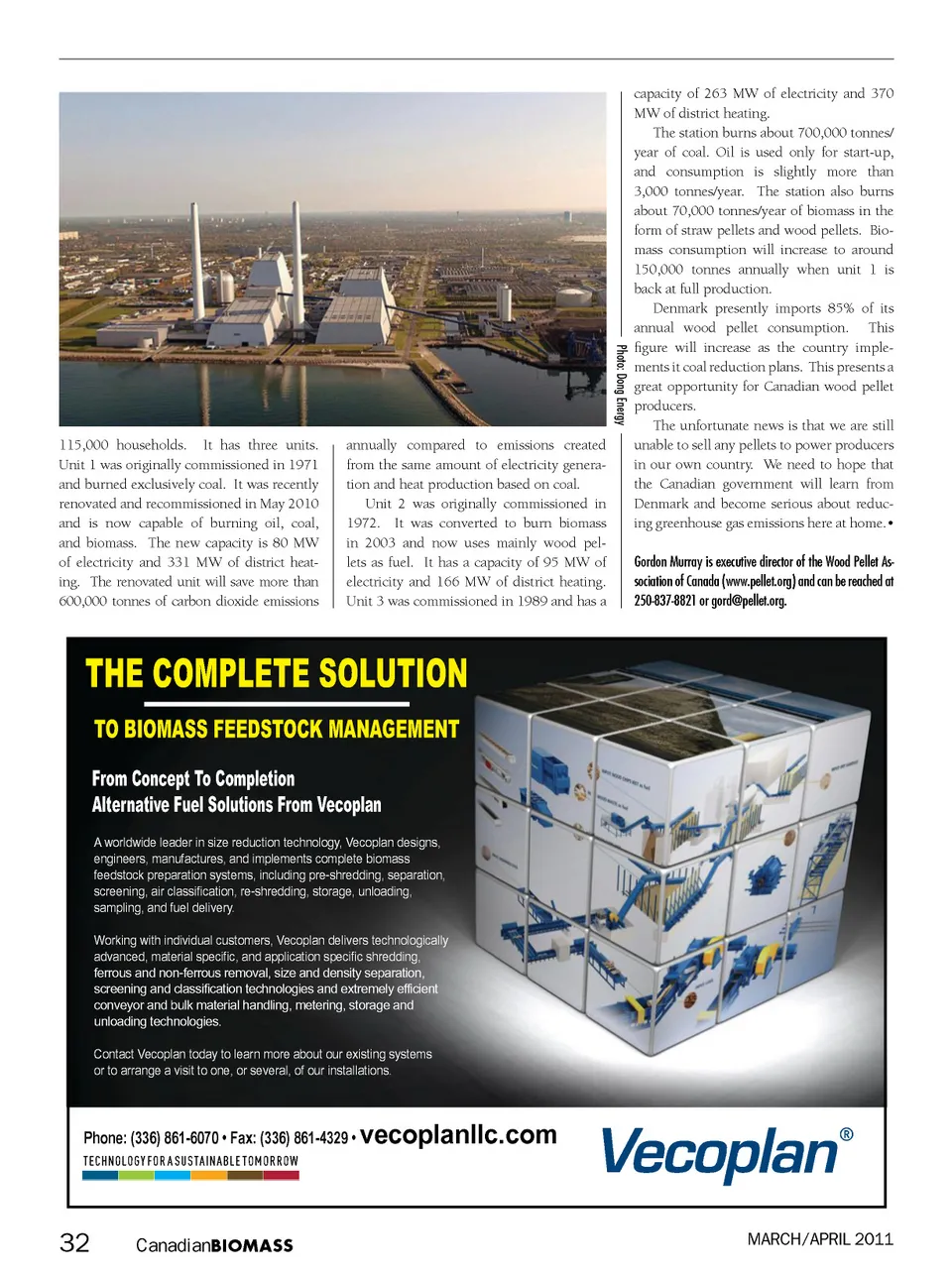
115,000 households. It has three units. Unit 1 was originally commissioned in 1971 and burned exclusively coal. It was recently renovated and recommissioned in May 2010 and is now capable of burning oil, coal, and biomass. The new capacity is 80 MW of electricity and 331 MW of district heat-ing. The renovated unit will save more than 600,000 tonnes of carbon dioxide emissions annually compared to emissions created from the same amount of electricity genera-tion and heat production based on coal. Unit 2 was originally commissioned in 1972. It was converted to burn biomass in 2003 and now uses mainly wood pel-lets as fuel. It has a capacity of 95 MW of electricity and 166 MW of district heating. Unit 3 was commissioned in 1989 and has a capacity of 263 MW of electricity and 370 MW of district heating. The station burns about 700,000 tonnes/ year of coal. Oil is used only for start-up, and consumption is slightly more than 3,000 tonnes/year. The station also burns about 70,000 tonnes/year of biomass in the form of straw pellets and wood pellets. Bio-mass consumption will increase to around 150,000 tonnes annually when unit 1 is back at full production. Denmark presently imports 85% of its annual wood pellet consumption. This figure will increase as the country imple-ments it coal reduction plans. This presents a great opportunity for Canadian wood pellet producers. The unfortunate news is that we are still unable to sell any pellets to power producers in our own country. We need to hope that the Canadian government will learn from Denmark and become serious about reduc-ing greenhouse gas emissions here at home. • Gordon Murray is executive director of the Wood Pellet As-sociation of Canada (www.pellet.org) and can be reached at 250-837-8821 or [email protected]. Photo: dong Energy THE COMPLETE SOLUTION TO BIOMASS FEEDSTOCK MANAGEMENT From Concept To Completion Alternative Fuel Solutions From Vecoplan A worldwide leader in size reduction technology, Vecoplan designs, engineers, manufactures, and implements complete biomass feedstock preparation systems, including pre-shredding, separation, screening, air classification, re-shredding, storage, unloading, sampling, and fuel delivery. Working with individual customers, Vecoplan delivers technologically advanced, material specific, and application specific shredding, ferrous and non-ferrous removal, size and density separation, screening and classification technologies and extremely efficient conveyor and bulk material handling, metering, storage and unloading technologies. Contact Vecoplan today to learn more about our existing systems or to arrange a visit to one, or several, of our installations. Phone: (336) 861-6070 • Fax: (336) 861-4329 • vecoplanllc.com 32 Canadian BIOMASS MarCh/april 2011
Canadian Biomass April 2011: Page 32