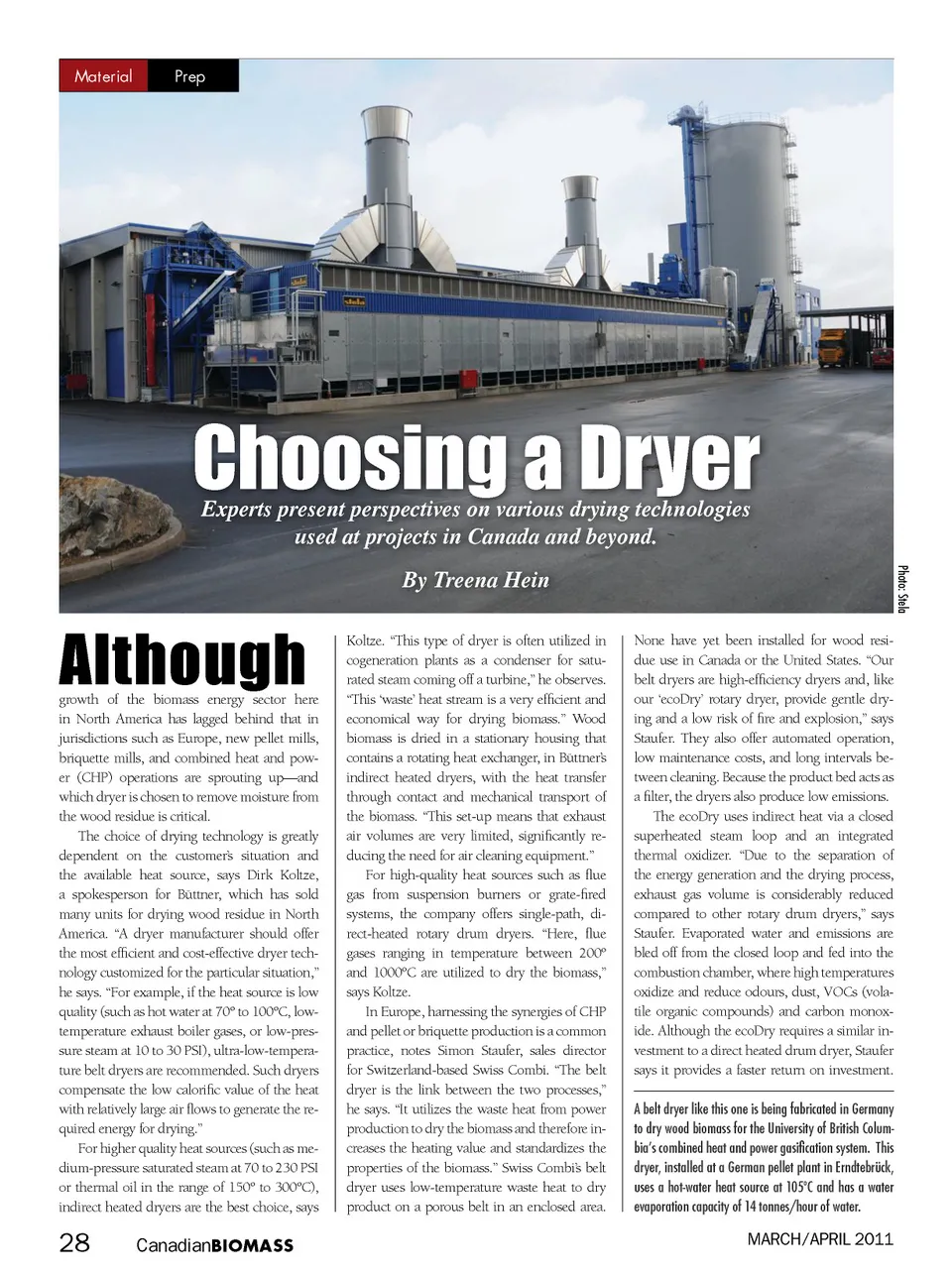
Swiss Combi hasn’t yet sold an ecoDry unit in North America for the purpose of drying wood biomass, but has sold about 10 here for drying other materials. Andritz is another major company that has yet to break into the North American market in terms of dryers handling wood residue (the firm sells drum, pneumatic, and belt dryers), but spokesperson Joanne Turnell says they recently sold the belt dryers installed at the world’s largest pellet plant in Vyborg, Rus-sia. Constructed by pulp and paper producer Vyborgskaja Cellulosa, the facility will have the capacity to produce 125 tons/hour of pellets. Other equipment for the plant is also being provided by Andritz, including a chip handling system, debarking lines, hammermills, and pel-let mills. Kahl is also keen to make the first North American sale of its fabric belt dryers. “The product is turned over in the dryer so that a very uniform final moisture content is ob-tained,” says Rick MacArthur, president of Kahl distributor Sarj Equipment in Bradford, Ontario. “At the same time that the tightly wo-ven plastic fabric belt moves product along, it also filters dust, odour, and VOCs from the exhaust air.” In the Bruks bed dryer, material is passed into the dryer by a spreading screw and onto a smooth loading zone plate without holes. The mat of material is then moved to a punched plate, where air passes through holes from be-low into the mat. Moisture migrates out the top of the mat with the air, and at the end of the process, a skimming screw is used to scrape off the moist upper layer of material, so that Photo: Büttner The direct-heated rotary drum dryer at Société de Cogénération de Saint-Félicien in Saint-Félicien, Quebec, uses hot exhaust from the biomass boiler to pre-dry its own hog fuel. only the properly dried material is discharged. A moisture sensor is used to control the depth of cut of the skimming screw. Bruks has yet to sell a bed dryer in Canada or the United States. rOtary dryers at wOrk Steve Walker, owner of 18-year-old New England Wood Pellets in Jaffrey, New Hampshire, chose M-E-C rotary drum dry-ers for all three of his facilities. “Drum dry-ers are better if you’re creating your own heat on site, which we do using a fur nace,” opines Walker. He chose drum dryer tech-nology because it’s also well proven. “M-E-C is well established, and a good reputation was ver y important to us.” The raw materi-als for New England pellets come from saw-mills and low-grade logs, as well as from furniture and flooring mills. Most pellets are sold for the domestic residential heat-ing market. At the privately owned Société de Cogé-nération de Saint-Félicien in Saint-Félicien, Quebec (a subsidiary of Enel Green Power Canadian BIOMASS 29
Canadian Biomass April 2011: Page 29