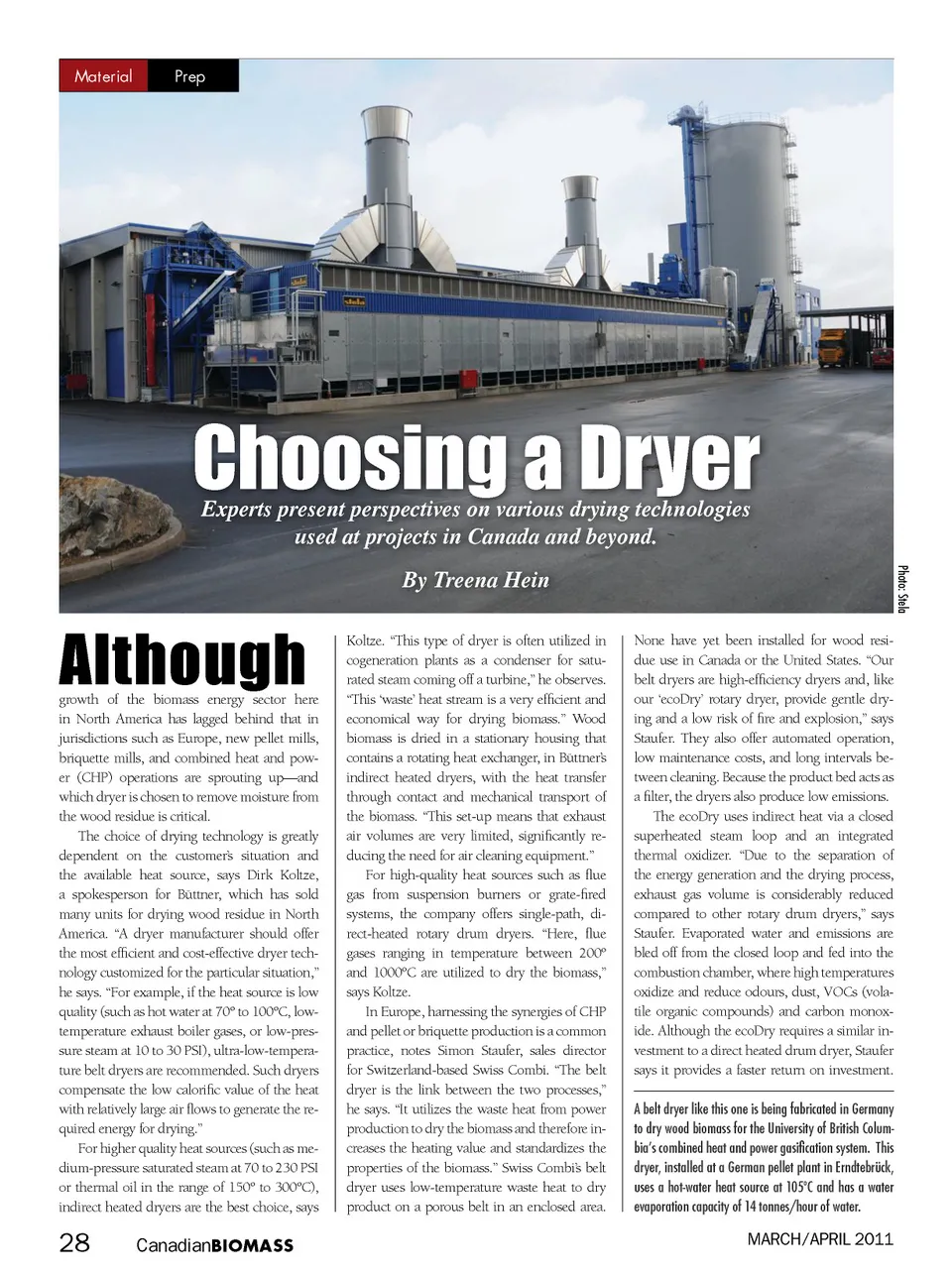
Material Prep Choosing a Dryer Experts present perspectives on various drying technologies used at projects in Canada and beyond. By Treena Hein Photo: Stela Although growth of the biomass energy sector here in North America has lagged behind that in jurisdictions such as Europe, new pellet mills, briquette mills, and combined heat and pow-er (CHP) operations are sprouting up—and which dryer is chosen to remove moisture from the wood residue is critical. The choice of drying technology is greatly dependent on the customer’s situation and the available heat source, says Dirk Koltze, a spokesperson for Büttner, which has sold many units for drying wood residue in North America. “A dryer manufacturer should offer the most efficient and cost-effective dryer tech-nology customized for the particular situation,” he says. “For example, if the heat source is low quality (such as hot water at 70º to 100ºC, low-temperature exhaust boiler gases, or low-pres-sure steam at 10 to 30 PSI), ultra-low-tempera-ture belt dryers are recommended. Such dryers compensate the low calorific value of the heat with relatively large air flows to generate the re-quired energy for drying.” For higher quality heat sources (such as me-dium-pressure saturated steam at 70 to 230 PSI or thermal oil in the range of 150º to 300ºC), indirect heated dryers are the best choice, says Koltze. “This type of dryer is often utilized in cogeneration plants as a condenser for satu-rated steam coming off a turbine,” he observes. “This ‘waste’ heat stream is a very efficient and economical way for drying biomass.” Wood biomass is dried in a stationary housing that contains a rotating heat exchanger, in Büttner’s indirect heated dryers, with the heat transfer through contact and mechanical transport of the biomass. “This set-up means that exhaust air volumes are very limited, significantly re-ducing the need for air cleaning equipment.” For high-quality heat sources such as flue gas from suspension burners or grate-fired systems, the company offers single-path, di-rect-heated rotary drum dryers. “Here, flue gases ranging in temperature between 200º and 1000ºC are utilized to dry the biomass,” says Koltze. In Europe, harnessing the synergies of CHP and pellet or briquette production is a common practice, notes Simon Staufer, sales director for Switzerland-based Swiss Combi. “The belt dryer is the link between the two processes,” he says. “It utilizes the waste heat from power production to dry the biomass and therefore in-creases the heating value and standardizes the properties of the biomass.” Swiss Combi’s belt dryer uses low-temperature waste heat to dry product on a porous belt in an enclosed area. None have yet been installed for wood resi-due use in Canada or the United States. “Our belt dryers are high-efficiency dryers and, like our ‘ecoDry’ rotary dryer, provide gentle dry-ing and a low risk of fire and explosion,” says Staufer. They also offer automated operation, low maintenance costs, and long intervals be-tween cleaning. Because the product bed acts as a filter, the dryers also produce low emissions. The ecoDry uses indirect heat via a closed superheated steam loop and an integrated thermal oxidizer. “Due to the separation of the energy generation and the drying process, exhaust gas volume is considerably reduced compared to other rotary drum dryers,” says Staufer. Evaporated water and emissions are bled off from the closed loop and fed into the combustion chamber, where high temperatures oxidize and reduce odours, dust, VOCs (vola-tile organic compounds) and carbon monox-ide. Although the ecoDry requires a similar in-vestment to a direct heated drum dryer, Staufer says it provides a faster return on investment. A belt dryer like this one is being fabricated in Germany to dry wood biomass for the University of British Colum-bia’s combined heat and power gasification system. This dryer, installed at a German pellet plant in Erndtebrück, uses a hot-water heat source at 105 o C and has a water evaporation capacity of 14 tonnes/hour of water. MarCh/april 2011 28 Canadian BIOMASS
Canadian Biomass April 2011: Page 28