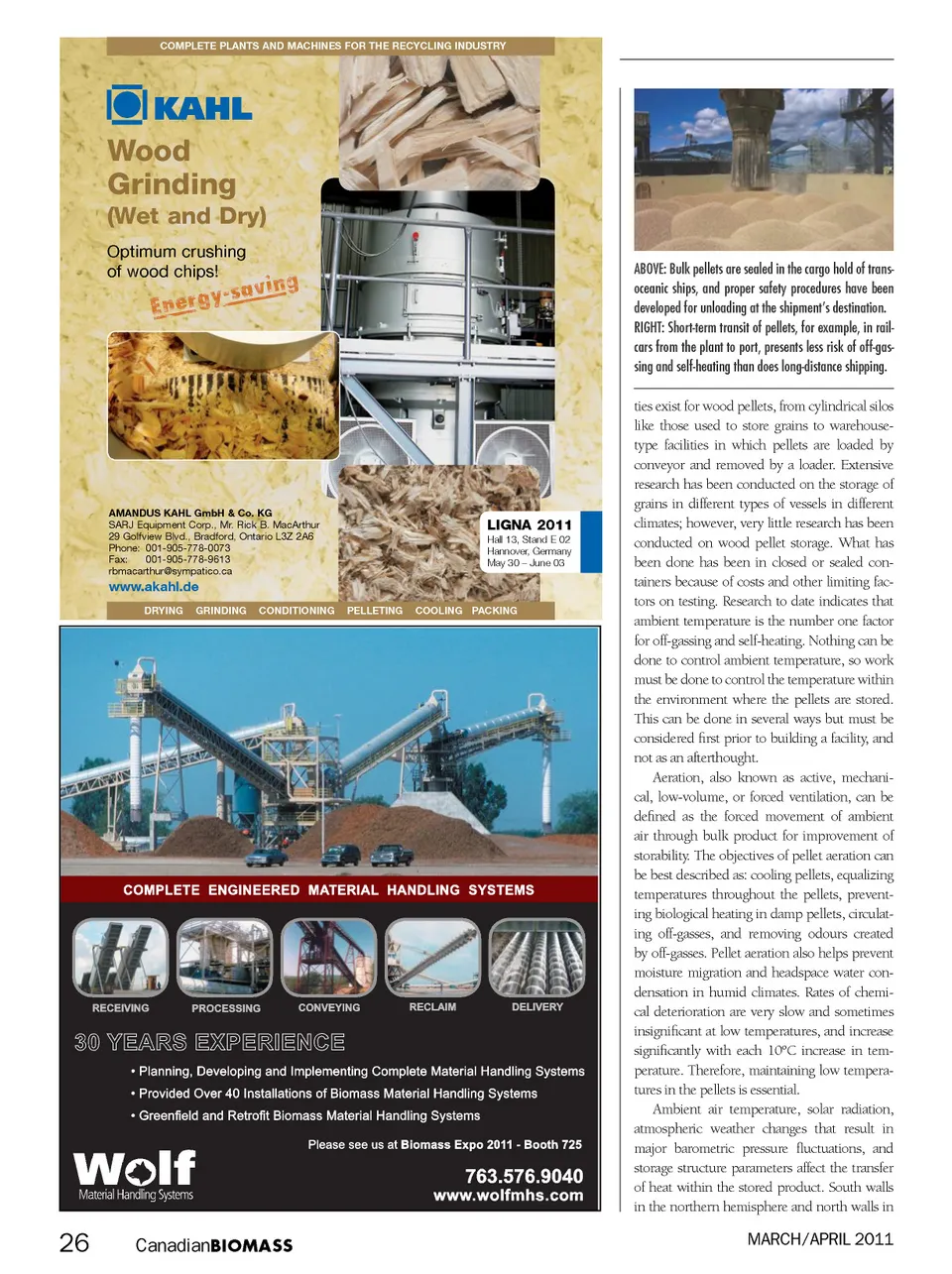
ch a i r o f t h e Pe l l e t Fu e l s I n s t i t u t e C o m m e r c i a l Fu e l Committee. Footnotes: 1. Springer, E.L. and G.J. Hajny. 1970. Spontaneous heating in piled wood chips. TAPPI 53:85-86. 2. Kelley, S., T. Elder, and L. Groom. 2005. Changes in the chemical composition and spectroscopy of loblolly pine medium density fiberboard furnish as a function of age and refining pressure. Wood and Fiber Science 37(1):14-22. 3. Arshadi, M., and R. Gref. 2005. Emission of vola-tile organic compounds from softwood pellets during storage. Forest Products Journal 55:132-135. 4. Svedberg, U., H.-E. Högberg, J. Högberg, and B. Galle. 2004. Emission of hexanal and carbon monox-ide from storage of wood pellets, a potential occupa-tional and domestic hazard. Annals of Occupational Hygiene 48(4):339-349. 5. Kuang, X., T. Shankar, X. Bi, S. Sokhansanj, C. Lim, and S. Melin. 2008. Characterization and kinet-ics study of off-gas emissions from stored wood pel-lets. Annals of Occupational Hygiene 52(8):675-683. 6. Yaciuk, G., W .E. Muir, and R.N. Sinha, R.N. 1975. A simulation model of temperatures in stored grain. Journal of Agricultural Engineering Research 20:254-258. Photo: Pacific Bioenergy the southern hemisphere intercept most of the solar radiation, so rectangular bins should be placed with their longer axes running north to south to help keep pellets cooler. Depending on the thermal absorptivity and emissivity of the structural material and the surface tempera-ture, solar radiation may result in heat gain or loss from stored pellets. From the aspect of bin wall temperatures and product warming from solar radiation, insulated galvanized steel and galvanized steel are the first and second worst materials to use for bin walls. 6 The easiest and most economical way to control pellet temperatures and off-gassing may be to control it within the storage facility itself. The initial capital of building a storage facility that has aeration will be significantly cheaper in the long run than having port union stevedores constantly moving product to disperse heat within piles, like some wood chip manage-ment practices. By managing temperature, we manage both pellet off-gassing and self-heating, ensuring staff safety and pellet quality. • M i ke C u r c i i s p l a n t s u p e r i n t e n d e n t a t I n d e c k l a d y -smith Biofuel Center in lady smith, W isconsin, and New ! Bracke C16.b silviculture and biomass head. The fastest head on the market is now even faster! Silvana Import Trading inc. Tel.: 514 939-3523 Fax: 514 939-3863 [email protected] www.silvanatrading.com www.brackeforest.ca Canadian BIOMASS 27
Canadian Biomass April 2011: Page 27