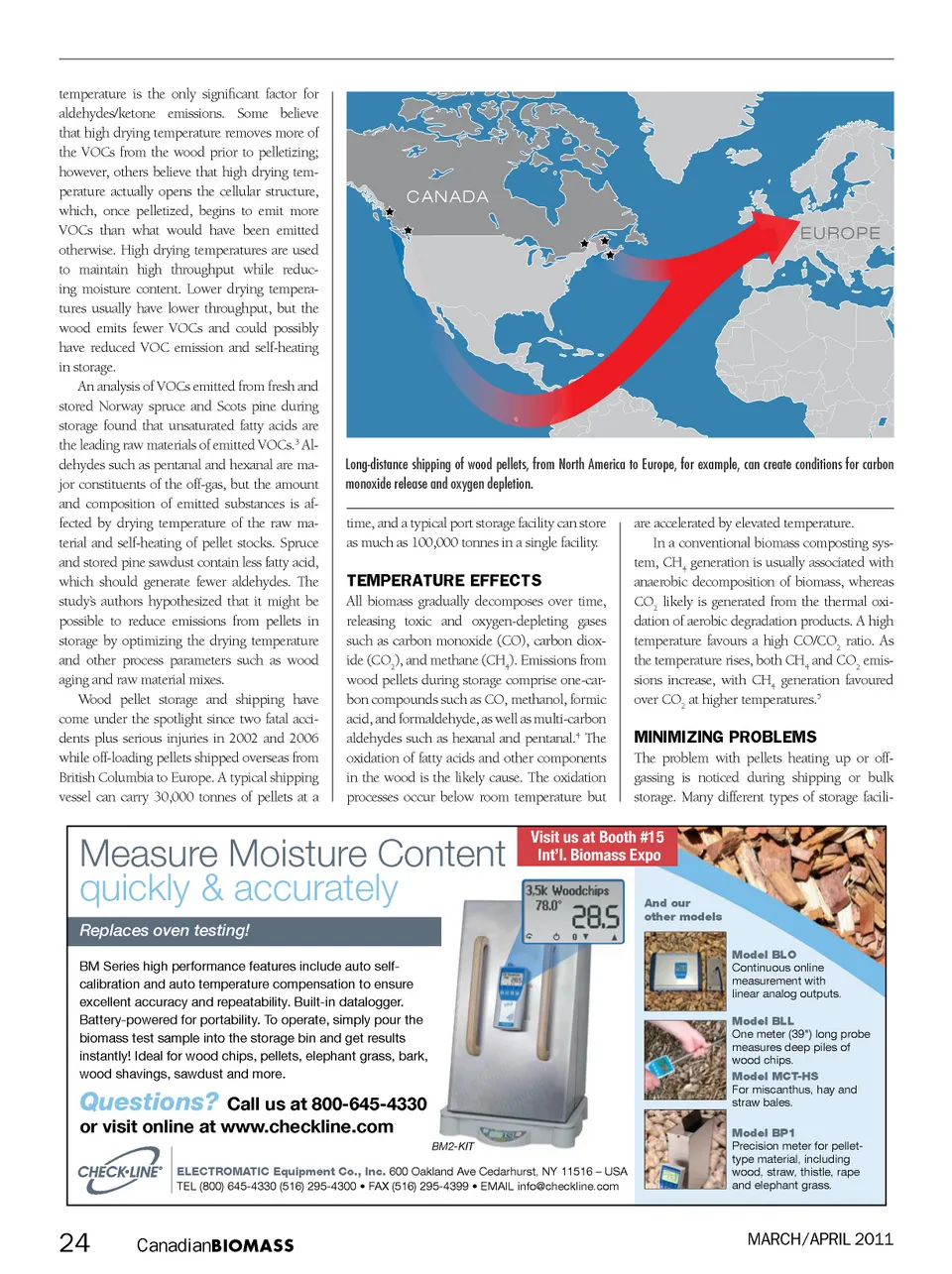
saFety & preventiOn FOr bulk pellet handling Wood pellets have been handled in bulk since the late 1980s in Scandinavia, but it was not until the mid-1990s when safety concerns were raised for pellets stored, han-dled, and transported in large quantities from Canada to Europe. The initial concern was in maintaining the me-chanical and chemical integrity of pellets during months of containment in poorly ventilated spaces such as silos and cargo holds of large ocean vessels. Unexpected fatal accidents in the Port of Rotterdam in 2002 and the Port of Helsingborg in 2006 brought safety to the forefront. Subsequent fatal accidents in Finland and Germany accentuated the issue even further. Carbon-monoxide intoxication has killed five and caused severe brain injury to others. The accident in 2002 initiated serious research in Canada, followed by Sweden and Austria, to understand better the root causes of these accidents. The research revealed that wood pellets in bulk rapidly gen-erate large amounts of highly toxic carbon monoxide, as well as carbon dioxide and small amounts of methane gas. Carbon dioxide and methane are not toxic but act as simple as-phyxiants, meaning they displace oxygen in confined spaces, which can cause suffocation. Carbon monoxide blocks the transport of oxy-gen by the red blood cells, rapidly causing oxygen starvation, particu-larly in the brain, which is highly dependent on a continuous supply of oxygen. In an atmosphere of depleted oxygen in combination with the presence of carbon monoxide, the body responds with hyperventila-tion, which increases the intake of carbon monoxide, quickly causing unconsciousness. Many other woody products such as green lumber and other biotic substances such as agricultural products have similar characteristics and can also cause fatal accidents. Normally, we associate carbon monoxide build-up and oxygen depletion with wood smouldering and inadequate combustion of ker-osene, gasoline, and other fuels. Without combustion, carbon mon-oxide and other gases are generated by the decomposition of some of the cellular building blocks in the biomass. This also generates self-heating, which can escalate to the point of open fire if the process is left alone long enough and sufficient oxygen is present. The heat generation is particularly pronounced in material with higher moisture content such as wood chips, but also occurs in dry wood pellets. Because of these issues, the Wood Pellet Association of Canada (WPAC) developed Material Safety Data Sheets (MSDSs) for bulk and bagged pellets that provide advice related to the off-gassing issue, including formulas for predicting the amount of off-gassing and oxygen depletion. Additional information such as safe storage design and handling of pellets in large bulk is found in The Pellet Handbook, which has substantial information on material safety, developed through research at the University of British Columbia. Published by Earthscan, the text can be purchased through WPAC at www.pellet.org. One of the key recommendations is that all personnel working in areas where large amounts of pellets are handled and stored should at all times be equipped with a well-maintained combined oxy-gen/carbon-monoxide meter. Using only one or the other could easily generate a false sense of safety. Precautions are gradually being implemented, but much more work is needed to promote safe design and operating procedures. The pressure is on by insurance underwriters to have the wood pellet in-dustry comply with proven rules and recommendations, and a certifi-cation process is under development to introduce compliance-driven incentives for the industry, including regular audits, similar to those used in many other industries. -Staffan Melin Staffan Melin is president of delta Research Corp., faculty member of the Biomass and Bioenergy Research Group at the University of British Columbia in Vancouver, and research director for the Wood Pellet Association of Canada. He has studied pellet safety issues for many years and was instrumental in developing MSdSs and other regulations for transport and handling of pellets. YOuR TOTAL BIOMAss PELLETING sOLuTION Grinding—Pelleting—Cooling From start to finish, CPM specializes in total solutions for superior production levels of high-quality pellets. The latest technology. The highest-quality pellet mills and dies. Efficient and economical. Built to run 24/7 in the toughest conditions. For high-capacity wood and biomass pellet production, low energy consumption and superior pellet quality, look to Your Partner in Productivity. Look to CPM. 800-366-2563 | 319-232-8444 WWW.CPM.NET | WATERLOO, IOWA Canadian BIOMASS 25
Canadian Biomass April 2011: Page 25