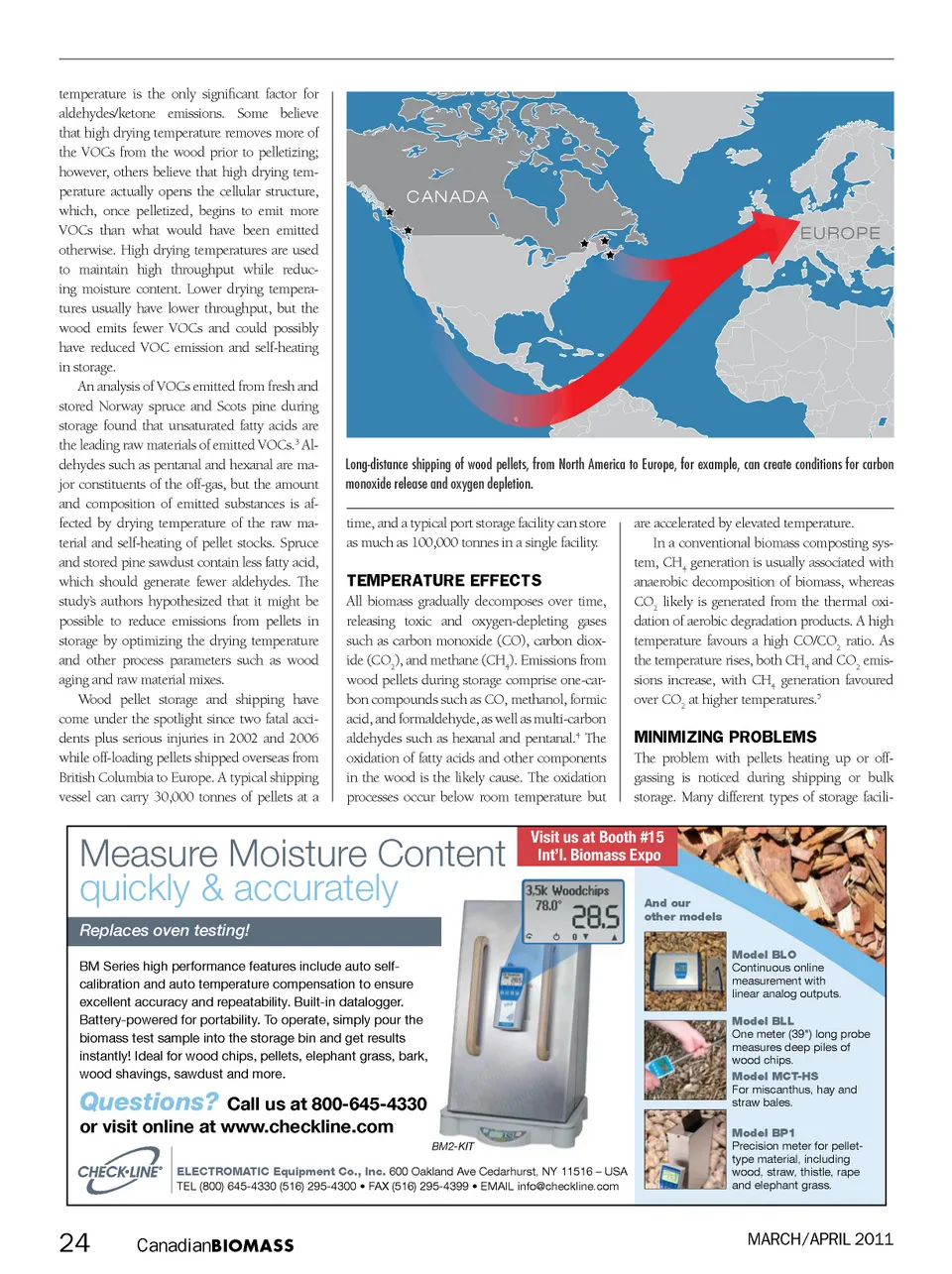
temperature is the only significant factor for aldehydes/ketone emissions. Some believe that high drying temperature removes more of the VOCs from the wood prior to pelletizing; however, others believe that high drying tem-perature actually opens the cellular structure, which, once pelletized, begins to emit more VOCs than what would have been emitted otherwise. High drying temperatures are used to maintain high throughput while reduc-ing moisture content. Lower drying tempera-tures usually have lower throughput, but the wood emits fewer VOCs and could possibly have reduced VOC emission and self-heating in storage. An analysis of VOCs emitted from fresh and stored Norway spruce and Scots pine during storage found that unsaturated fatty acids are the leading raw materials of emitted VOCs. 3 Al-dehydes such as pentanal and hexanal are ma-jor constituents of the off-gas, but the amount and composition of emitted substances is af-fected by drying temperature of the raw ma-terial and self-heating of pellet stocks. Spruce and stored pine sawdust contain less fatty acid, which should generate fewer aldehydes. The study’s authors hypothesized that it might be possible to reduce emissions from pellets in storage by optimizing the drying temperature and other process parameters such as wood aging and raw material mixes. Wood pellet storage and shipping have come under the spotlight since two fatal acci-dents plus serious injuries in 2002 and 2006 while off-loading pellets shipped overseas from British Columbia to Europe. A typical shipping vessel can carry 30,000 tonnes of pellets at a CANADA EUROPE long-distance shipping of wood pellets, from North America to Europe, for example, can create conditions for carbon monoxide release and oxygen depletion. time, and a typical port storage facility can store as much as 100,000 tonnes in a single facility. temperature eFFects All biomass gradually decomposes over time, releasing toxic and oxygen-depleting gases such as carbon monoxide (CO), carbon diox-ide (CO 2 ), and methane (CH 4 ). Emissions from wood pellets during storage comprise one-car-bon compounds such as CO, methanol, formic acid, and formaldehyde, as well as multi-carbon aldehydes such as hexanal and pentanal. 4 The oxidation of fatty acids and other components in the wood is the likely cause. The oxidation processes occur below room temperature but are accelerated by elevated temperature. In a conventional biomass composting sys-tem, CH 4 generation is usually associated with anaerobic decomposition of biomass, whereas CO 2 likely is generated from the thermal oxi-dation of aerobic degradation products. A high temperature favours a high CO/CO 2 ratio. As the temperature rises, both CH 4 and CO 2 emis-sions increase, with CH 4 generation favoured over CO 2 at higher temperatures. 5 minimizing prOblems The problem with pellets heating up or off-gassing is noticed during shipping or bulk storage. Many different types of storage facili-Measure Moisture Content quickly & accurately Replaces oven testing! BM Series high performance features include auto self-calibration and auto temperature compensation to ensure excellent accuracy and repeatability. Built-in datalogger. Battery-powered for portability. To operate, simply pour the biomass test sample into the storage bin and get results instantly! Ideal for wood chips, pellets, elephant grass, bark, wood shavings, sawdust and more. Visit us at Booth #15 Int’l. Biomass Expo And our other models Model BLO Continuous online measurement with linear analog outputs. Model BLL One meter (39") long probe measures deep piles of wood chips. Model MCT-HS For miscanthus, hay and straw bales. Model BP1 Precision meter for pellet-type material, including wood, straw, thistle, rape and elephant grass. Questions? Call us at 800-645-4330 or visit online at www.checkline.com BM2-KIT ELECTROMATIC Equipment Co., Inc. 600 Oakland Ave Cedarhurst, NY 11516 – USA TEL (800) 645-4330 (516) 295-4300 • FAX (516) 295-4399 • EMAIL [email protected] 24 Canadian BIOMASS MarCh/april 2011
Canadian Biomass April 2011: Page 24