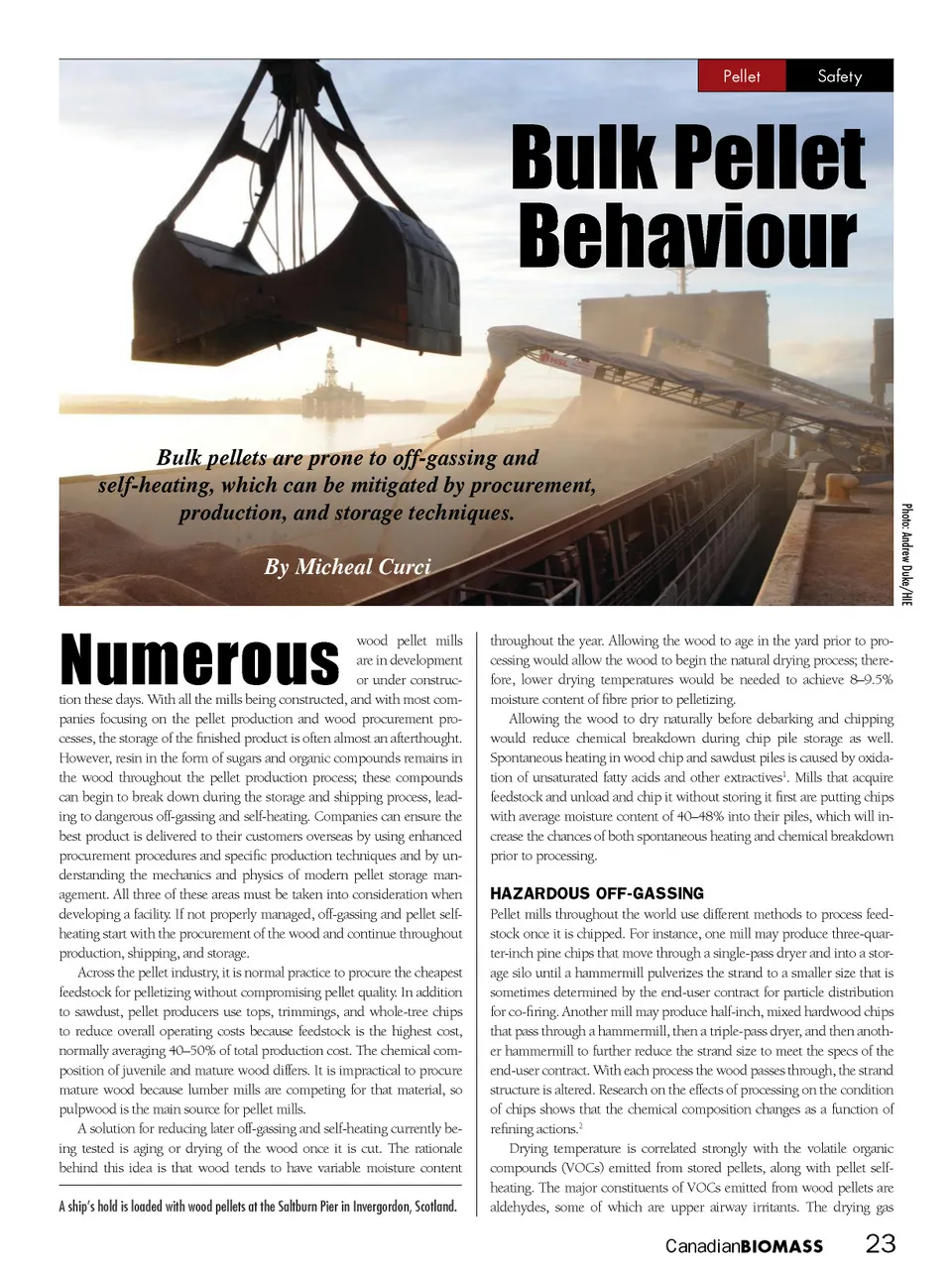
Pellet Safety Bulk Pellet Behaviour Bulk pellets are prone to off-gassing and self-heating, which can be mitigated by procurement, production, and storage techniques. By Micheal Curci wood pellet mills are in development or under construc-tion these days. With all the mills being constructed, and with most com-panies focusing on the pellet production and wood procurement pro-cesses, the storage of the finished product is often almost an afterthought. However, resin in the form of sugars and organic compounds remains in the wood throughout the pellet production process; these compounds can begin to break down during the storage and shipping process, lead-ing to dangerous off-gassing and self-heating. Companies can ensure the best product is delivered to their customers overseas by using enhanced procurement procedures and specific production techniques and by un-derstanding the mechanics and physics of modern pellet storage man-agement. All three of these areas must be taken into consideration when developing a facility. If not properly managed, off-gassing and pellet self-heating start with the procurement of the wood and continue throughout production, shipping, and storage. Across the pellet industry, it is normal practice to procure the cheapest feedstock for pelletizing without compromising pellet quality. In addition to sawdust, pellet producers use tops, trimmings, and whole-tree chips to reduce overall operating costs because feedstock is the highest cost, normally averaging 40–50% of total production cost. The chemical com-position of juvenile and mature wood differs. It is impractical to procure mature wood because lumber mills are competing for that material, so pulpwood is the main source for pellet mills. A solution for reducing later off-gassing and self-heating currently be-ing tested is aging or drying of the wood once it is cut. The rationale behind this idea is that wood tends to have variable moisture content A ship’s hold is loaded with wood pellets at the Saltburn Pier in Invergordon, Scotland. Photo: Andrew duke/HIE Numerous throughout the year. Allowing the wood to age in the yard prior to pro-cessing would allow the wood to begin the natural drying process; there-fore, lower drying temperatures would be needed to achieve 8–9.5% moisture content of fibre prior to pelletizing. Allowing the wood to dry naturally before debarking and chipping would reduce chemical breakdown during chip pile storage as well. Spontaneous heating in wood chip and sawdust piles is caused by oxida-tion of unsaturated fatty acids and other extractives 1 . Mills that acquire feedstock and unload and chip it without storing it first are putting chips with average moisture content of 40–48% into their piles, which will in-crease the chances of both spontaneous heating and chemical breakdown prior to processing. hazardOus OFF-gassing Pellet mills throughout the world use different methods to process feed-stock once it is chipped. For instance, one mill may produce three-quar-ter-inch pine chips that move through a single-pass dryer and into a stor-age silo until a hammermill pulverizes the strand to a smaller size that is sometimes determined by the end-user contract for particle distribution for co-firing. Another mill may produce half-inch, mixed hardwood chips that pass through a hammermill, then a triple-pass dryer, and then anoth-er hammermill to further reduce the strand size to meet the specs of the end-user contract. With each process the wood passes through, the strand structure is altered. Research on the effects of processing on the condition of chips shows that the chemical composition changes as a function of refining actions. 2 Drying temperature is correlated strongly with the volatile organic compounds (VOCs) emitted from stored pellets, along with pellet self-heating. The major constituents of VOCs emitted from wood pellets are aldehydes, some of which are upper airway irritants. The drying gas Canadian BIOMASS 23
Canadian Biomass April 2011: Page 23