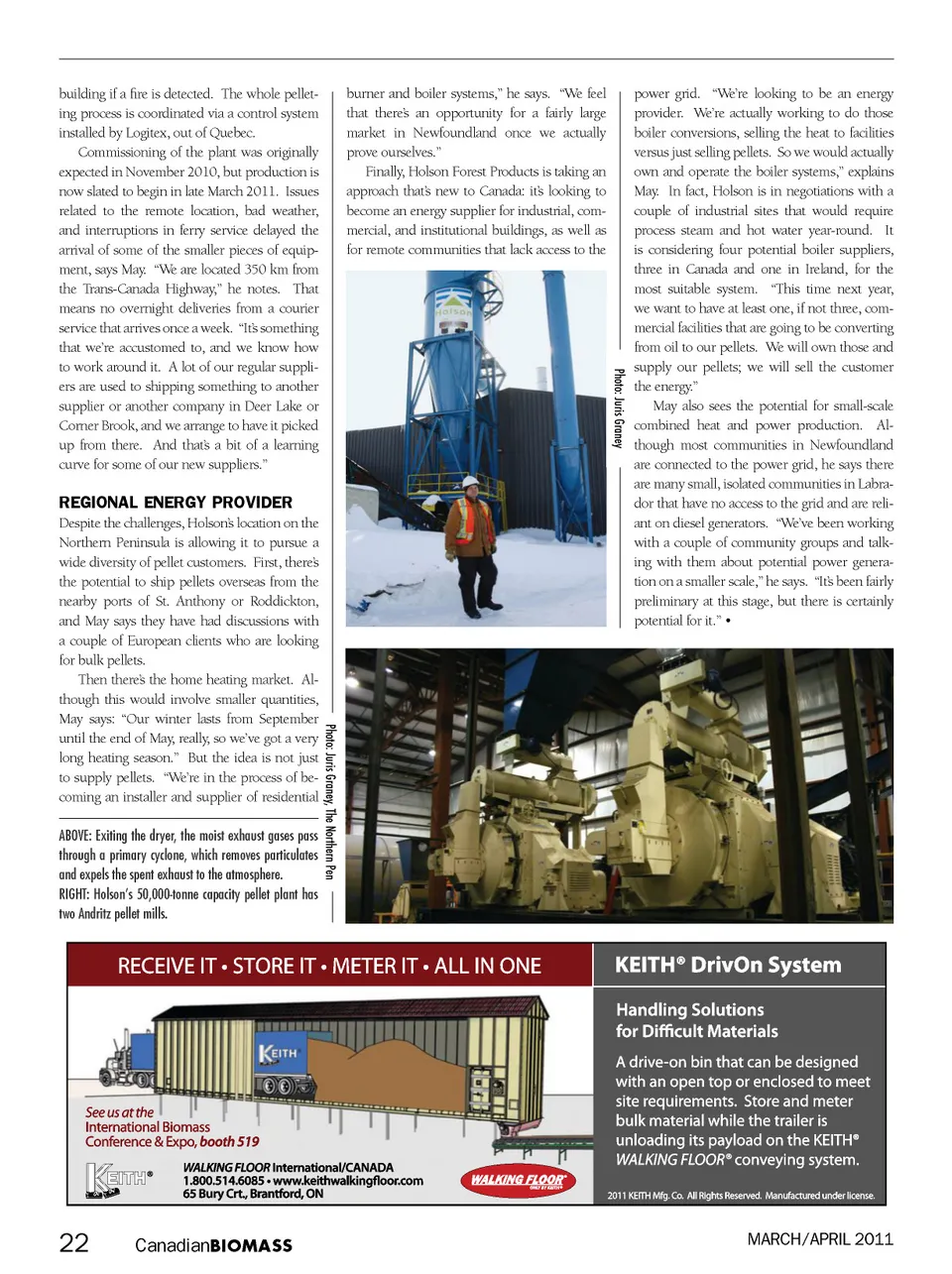
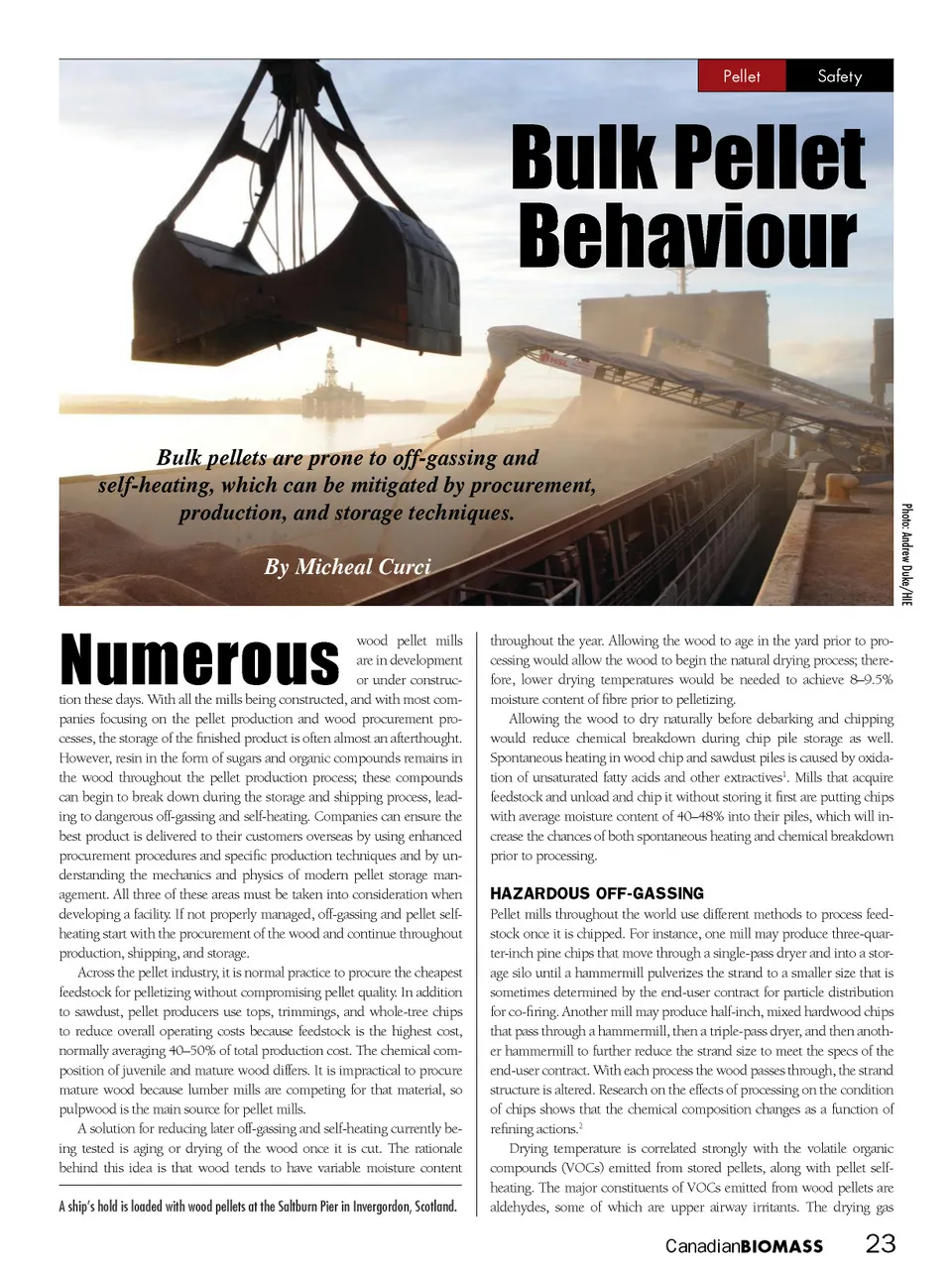
building if a fire is detected. The whole pellet-ing process is coordinated via a control system installed by Logitex, out of Quebec. Commissioning of the plant was originally expected in November 2010, but production is now slated to begin in late March 2011. Issues related to the remote location, bad weather, and interruptions in ferry service delayed the arrival of some of the smaller pieces of equip-ment, says May. “We are located 350 km from the Trans-Canada Highway,” he notes. That means no overnight deliveries from a courier service that arrives once a week. “It’s something that we’re accustomed to, and we know how to work around it. A lot of our regular suppli-ers are used to shipping something to another supplier or another company in Deer Lake or Corner Brook, and we arrange to have it picked up from there. And that’s a bit of a learning curve for some of our new suppliers.” regiOnal energy prOvider Despite the challenges, Holson’s location on the Northern Peninsula is allowing it to pursue a wide diversity of pellet customers. First, there’s the potential to ship pellets overseas from the nearby ports of St. Anthony or Roddickton, and May says they have had discussions with a couple of European clients who are looking for bulk pellets. Then there’s the home heating market. Al-though this would involve smaller quantities, May says: “Our winter lasts from September until the end of May, really, so we’ve got a very long heating season.” But the idea is not just to supply pellets. “We’re in the process of be-coming an installer and supplier of residential ABOVE: Exiting the dryer, the moist exhaust gases pass through a primary cyclone, which removes particulates and expels the spent exhaust to the atmosphere. RIGHT: Holson’s 50,000-tonne capacity pellet plant has two Andritz pellet mills. burner and boiler systems,” he says. “We feel that there’s an opportunity for a fairly large market in Newfoundland once we actually prove ourselves.” Finally, Holson Forest Products is taking an approach that’s new to Canada: it’s looking to become an energy supplier for industrial, com-mercial, and institutional buildings, as well as for remote communities that lack access to the power grid. “We’re looking to be an energy provider. We’re actually working to do those boiler conversions, selling the heat to facilities versus just selling pellets. So we would actually own and operate the boiler systems,” explains May. In fact, Holson is in negotiations with a couple of industrial sites that would require process steam and hot water year-round. It is considering four potential boiler suppliers, three in Canada and one in Ireland, for the most suitable system. “This time next year, we want to have at least one, if not three, com-mercial facilities that are going to be converting from oil to our pellets. We will own those and supply our pellets; we will sell the customer the energy.” May also sees the potential for small-scale combined heat and power production. Al-though most communities in Newfoundland are connected to the power grid, he says there are many small, isolated communities in Labra-dor that have no access to the grid and are reli-ant on diesel generators. “We’ve been working with a couple of community groups and talk-ing with them about potential power genera-tion on a smaller scale,” he says. “It’s been fairly preliminary at this stage, but there is certainly potential for it.” • Photo: Juris Graney Photo: Juris Graney, The Northern Pen 22 Canadian BIOMASS MarCh/april 2011
Canadian Biomass April 2011: Page 22