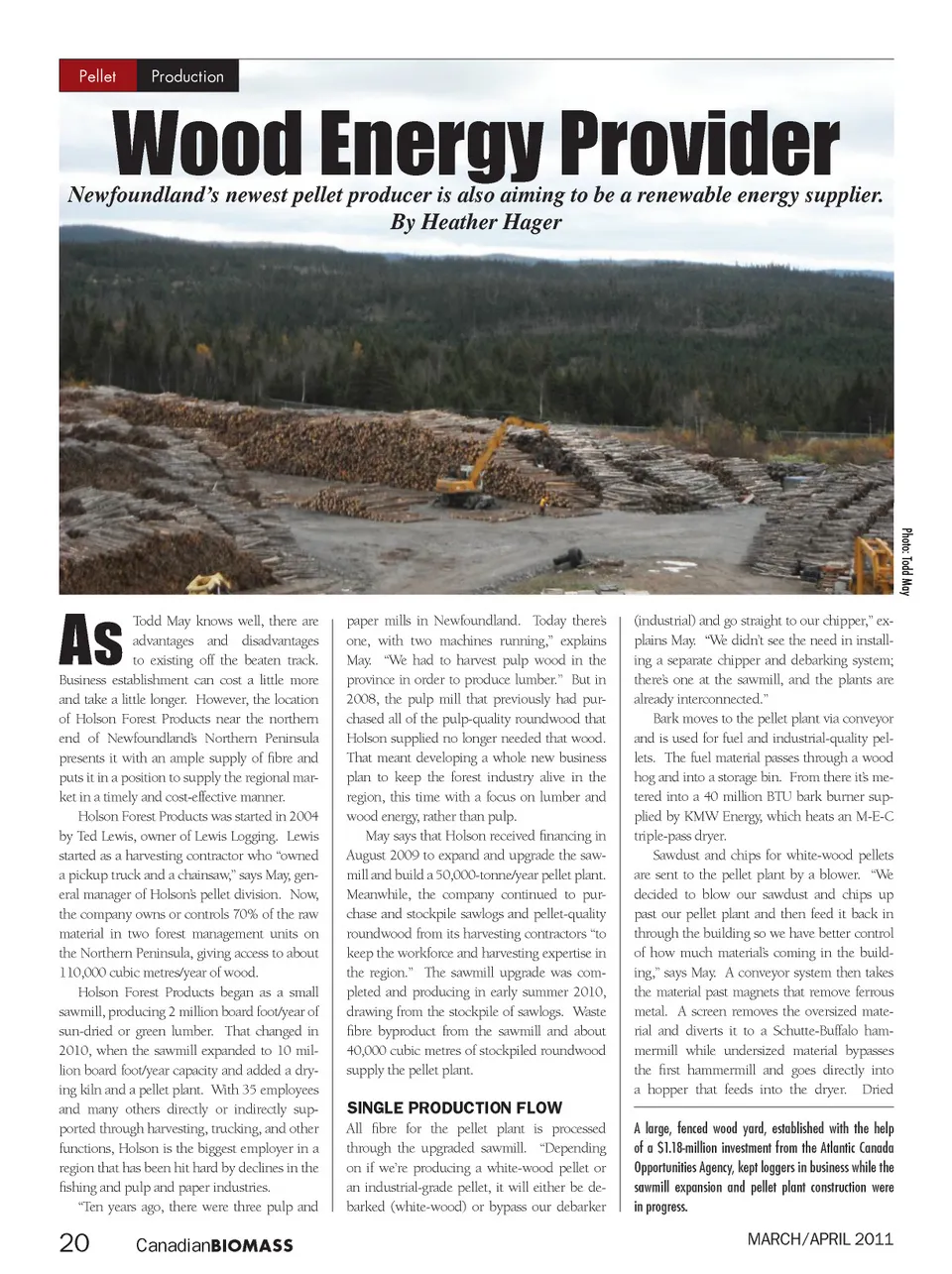
material passes through the primary cyclone to a second Schutte-Buffalo hammermill and then into another hopper that feeds two Andritz pel-letizers. The newly formed pellets move to a Geelen cooler and then a BM&M screen, which removes fines. Finished pellets are either sent for bulk shipments or for bagging on a form-fill-seal bagging line from Premier Tech. There’s plenty of storage space for bagged pellets on skids, says May. He admits that there isn’t much bulk storage space, a challenge that he’s looking to address in the spring. The plant was designed by engineer Van Wall of Projitech, out of St.-Georges, Quebec. “All the way through the design process, we’ve been very cognizant of fire and explosion and ensuring that we’re protected, either through venting or detection/suppression systems wherever there’s risk of fire,” states May. That includes Firefly spark detection/suppression and a reversing screw at the primary cyclone that can divert the material to a bin outside the At an earlier stage of construction, the M-E-C dryer was one of the first components to be installed. D E H Y D R AT I O N S YS TEMS R O TA R Y D R U M D R Y E R S Baker-Rullman Triple-Pass Technology remains the superior dehydration system by optimizing operating costs, efficiency, and end product consistency. n n n n Photo: Todd May Wood Pellets Ag Products Municipal Waste Bio Mass Call: (920) 261-8107 email: [email protected] www.baker-rullman.com Baker-Rullman Manufacturing, Inc. 4 East Main Street • P.O. Box 67 Watertown, WI 53094 Canadian BIOMASS 21
Canadian Biomass April 2011: Page 21