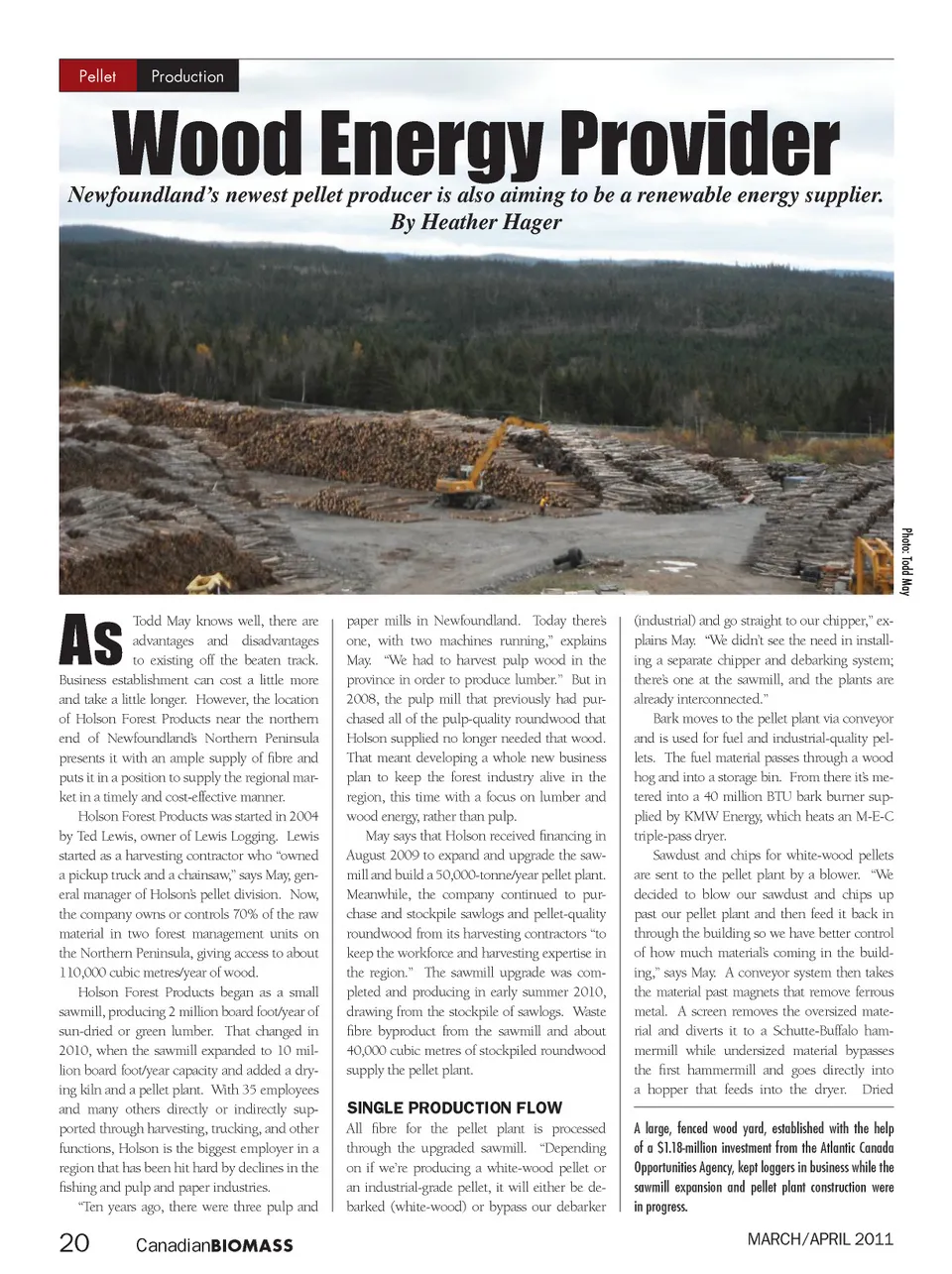
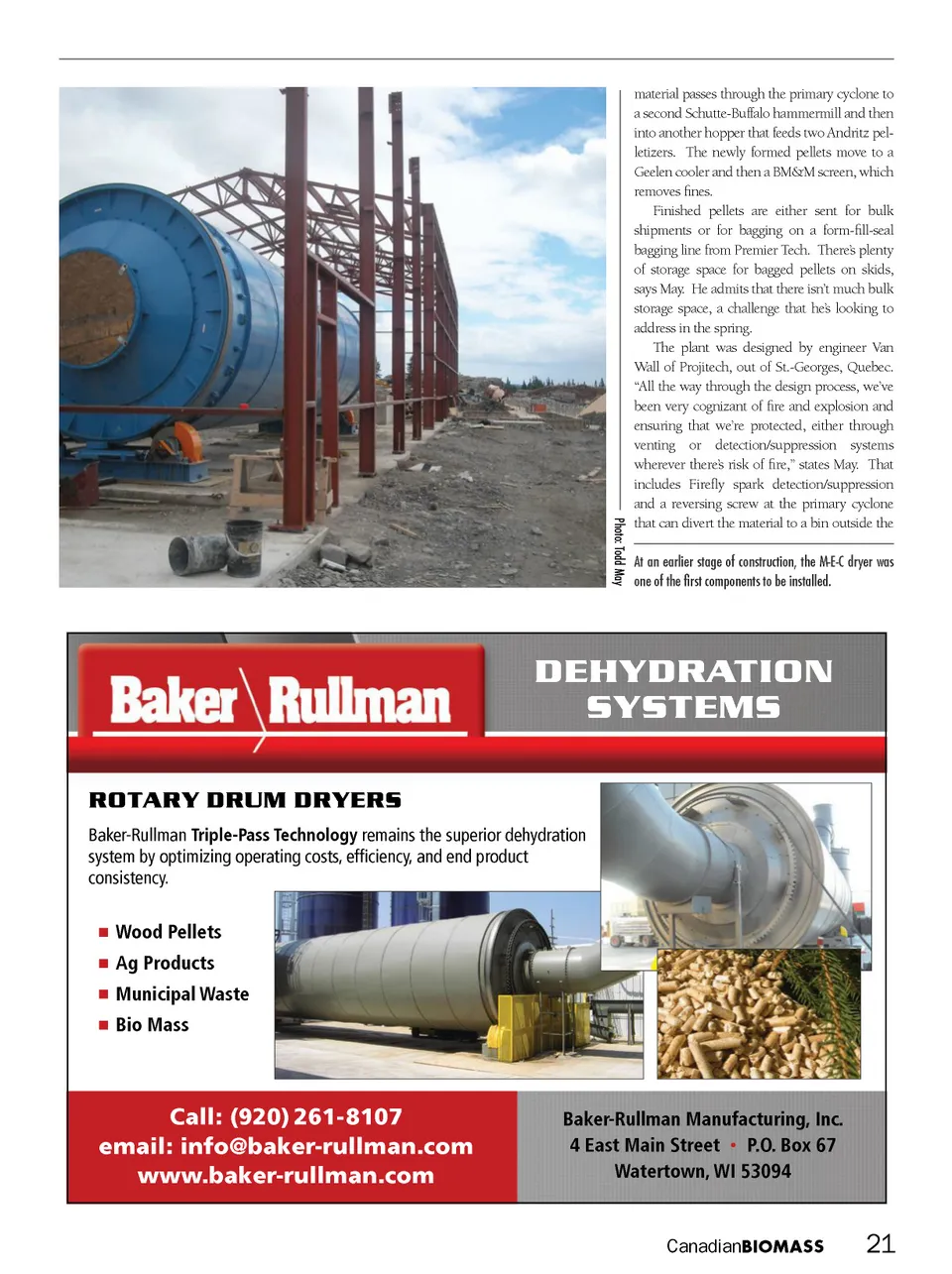
Pellet Newfoundland’s newest pellet producer is also aiming to be a renewable energy supplier. By Heather Hager Wood Energy Provider Production Photo: Todd May Todd May knows well, there are advantages and disadvantages to existing off the beaten track. Business establishment can cost a little more and take a little longer. However, the location of Holson Forest Products near the northern end of Newfoundland’s Northern Peninsula presents it with an ample supply of fibre and puts it in a position to supply the regional mar-ket in a timely and cost-effective manner. Holson Forest Products was started in 2004 by Ted Lewis, owner of Lewis Logging. Lewis started as a harvesting contractor who “owned a pickup truck and a chainsaw,” says May, gen-eral manager of Holson’s pellet division. Now, the company owns or controls 70% of the raw material in two forest management units on the Northern Peninsula, giving access to about 110,000 cubic metres/year of wood. Holson Forest Products began as a small sawmill, producing 2 million board foot/year of sun-dried or green lumber. That changed in 2010, when the sawmill expanded to 10 mil-lion board foot/year capacity and added a dry-ing kiln and a pellet plant. With 35 employees and many others directly or indirectly sup-ported through harvesting, trucking, and other functions, Holson is the biggest employer in a region that has been hit hard by declines in the fishing and pulp and paper industries. “Ten years ago, there were three pulp and As paper mills in Newfoundland. Today there’s one, with two machines running,” explains May. “We had to harvest pulp wood in the province in order to produce lumber.” But in 2008, the pulp mill that previously had pur-chased all of the pulp-quality roundwood that Holson supplied no longer needed that wood. That meant developing a whole new business plan to keep the forest industry alive in the region, this time with a focus on lumber and wood energy, rather than pulp. May says that Holson received financing in August 2009 to expand and upgrade the saw-mill and build a 50,000-tonne/year pellet plant. Meanwhile, the company continued to pur-chase and stockpile sawlogs and pellet-quality roundwood from its harvesting contractors “to keep the workforce and harvesting expertise in the region.” The sawmill upgrade was com-pleted and producing in early summer 2010, drawing from the stockpile of sawlogs. Waste fibre byproduct from the sawmill and about 40,000 cubic metres of stockpiled roundwood supply the pellet plant. single prOductiOn FlOw All fibre for the pellet plant is processed through the upgraded sawmill. “Depending on if we’re producing a white-wood pellet or an industrial-grade pellet, it will either be de-barked (white-wood) or bypass our debarker (industrial) and go straight to our chipper,” ex-plains May. “We didn’t see the need in install-ing a separate chipper and debarking system; there’s one at the sawmill, and the plants are already interconnected.” Bark moves to the pellet plant via conveyor and is used for fuel and industrial-quality pel-lets. The fuel material passes through a wood hog and into a storage bin. From there it’s me-tered into a 40 million BTU bark burner sup-plied by KMW Energy, which heats an M-E-C triple-pass dryer. Sawdust and chips for white-wood pellets are sent to the pellet plant by a blower. “We decided to blow our sawdust and chips up past our pellet plant and then feed it back in through the building so we have better control of how much material’s coming in the build-ing,” says May. A conveyor system then takes the material past magnets that remove ferrous metal. A screen removes the oversized mate-rial and diverts it to a Schutte-Buffalo ham-mermill while undersized material bypasses the first hammermill and goes directly into a hopper that feeds into the dryer. Dried A large, fenced wood yard, established with the help of a $1.18-million investment from the Atlantic Canada Opportunities Agency, kept loggers in business while the sawmill expansion and pellet plant construction were in progress. MarCh/april 2011 20 Canadian BIOMASS
Canadian Biomass April 2011: Page 20