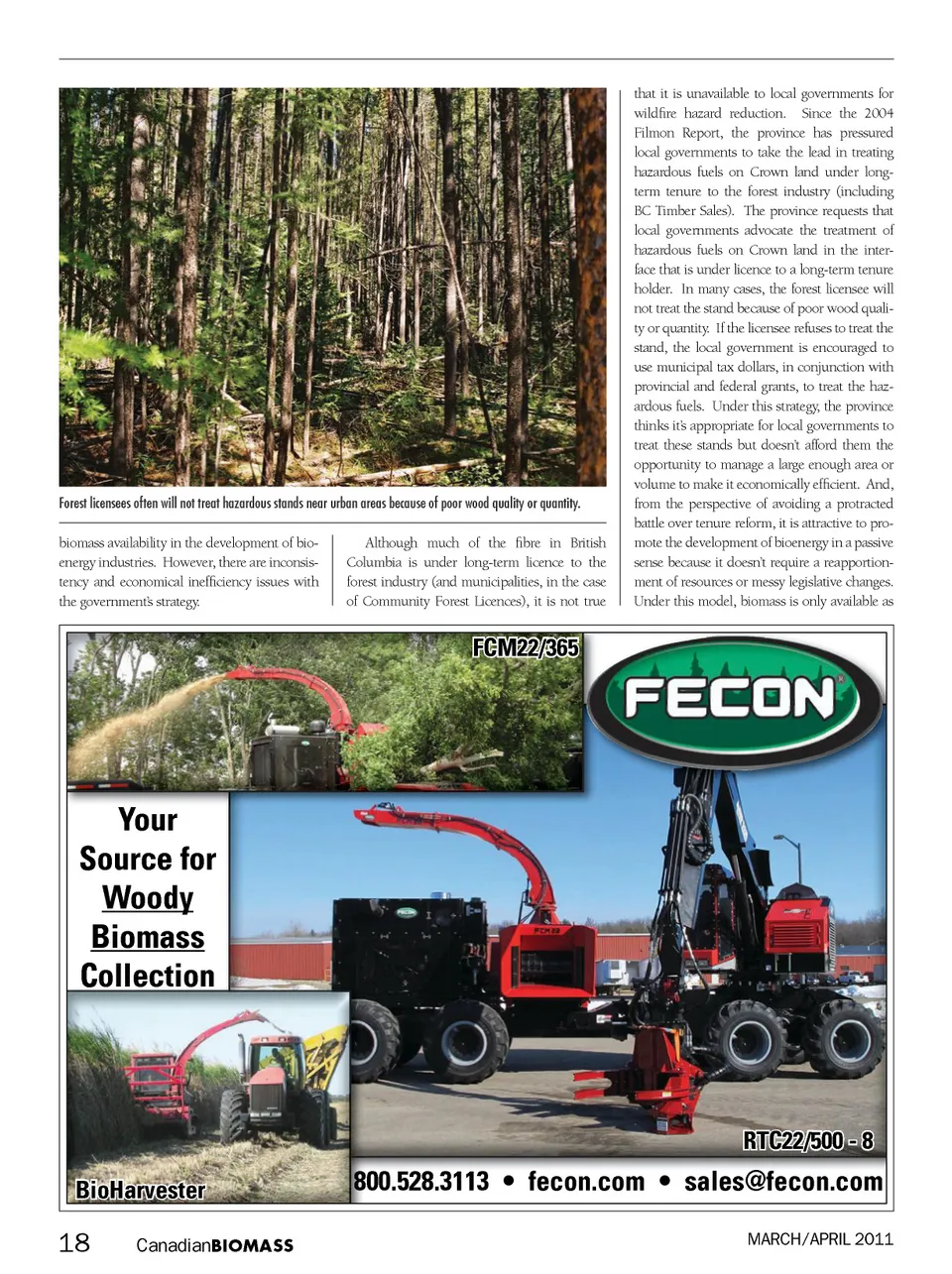
the opportunity arises. The difficulty with this approach is that there is no predictability of feedstock avail-ability, and the use of biomass is not tied to a larger economic goal or landscape management strategy. The small-scale licences and environ-mental legislation that free up small amounts of biomass are insufficient to stimulate bioenergy industries for two key reasons: the volumes are too small to support business planning and in-vestment, and the volumes are not predictable from year to year. Opportunity biomass is tied directly to positive economic opportunities for sawtimber or pulpwood; if market conditions aren’t right for those commodities, the waste component that goes to bioenergy won’t be produced. In short, reliable biomass for energy can’t be a byproduct of harvest for other com-modities. many beneFits However, the development of bioenergy op-portunities also should not be the sole means to an end. It should be tied to meeting other social, environmental, or economic objectives such as WUI hazard reduction, as in the case of communities in southeastern British Colum-Mechanical thinning near forest communities can help reduce the risk of dangerous wildfires. bia. Unlike other forms of bioenergy, failure to exploit the biomass resource comes with sig-nificant environmental, social, and economic consequences. If we don’t deal with the ac-cumulated biomass proactively, we will have to deal with it during and after a wildfire at a sig-nificant cost to taxpayers, human health (e.g., smoke, direct threat to human lives), business, etc. It is therefore in the province’s interest to create and support the biomass-to-energy sector as a means of solving other problems. Direct government intervention in the timber supply and tenure arena is not without prec-edent. The government has amended tenures and licences in a number of locations over time to lessen the economic effects on a community or industry during periods of market instabil-ity (e.g., for the Skeena Cellulose pulp mill in Prince Rupert, the MacKenzie pulp mill, and others). Currently there exists an unfortunate state of inertia as it relates to solving the WUI threat as well as the development of local, viable bio-energy enterprises. The interface fuels issue is quite simply a biomass issue: there is too much of it surrounding our communities and it con-stitutes a very real fire hazard. Ironically, the outstanding issue preventing the development of local-level, viable bioenergy enterprises is access to the biomass that creates this threat. The simplest solution is to amend the tenure system, allowing local governments and First Nations access to the biomass in strategic lo-cations so they can address the wildfire hazard issue economically, encourage the development of local and viable bioenergy enterprises, and diversify the local energy and forest resource industries. • Rober t W. Gray is a fire ecologist and principal of R.W. Gray Consulting ltd., based in Chilliwack , British Columbia. Material Handling for Woody Biomass Biomass Handling Equipment Complete Engineered Systems Pulverized Coal Boiler Conversions CFB Boiler Feed Systems U D S S T T A ES U N ITED A T T ES C A A C A N N A DA SW ED E E N N SW ED Silos Wood Hogs Disc Screens Open Storage Closed Storage Truck Dumpers Chain Conveyors Bucket Elevators Screw Conveyors Screw Reclaimers Pneumatic Conveying SWEDEN: Stockholm Jeffrey Rader AB Domnarvsgatan 11, 163 53 SPÅNGA Stockholm, Sweden Phone: +46 8 56 47 57 47 Fax: +46 8 56 47 57 48 See our Biomass video at www.jeffreyrader.com/videoB USA: CORPORATE HEADQUARTERS Jeffrey Rader Corporation 398 Willis Road Woodruff, SC, USA 29388 Phone: 864.476.7523 Fax: 864.476.7510 CANADA: Montreal, Quebec Jeffrey Rader Canada 2350 Place Trans-Canadienne Dorval, Quebec H9P 2X5 Canada Phone: 514.822.2660 Fax: 514.822.2699 CANADA: Vancouver, BC Jeffrey Rader Canada Unit 2, 62 Fawcett Road Coquitlam, BC V3K 6V5 Canada Phone: 604.299.0241 Fax: 604.299.1491 For information on how Jeffrey Rader Corporation can solve your Biomass Handling needs, visit us at www.jeffreyrader.com/bio2 Canadian BIOMASS 19
Canadian Biomass April 2011: Page 19