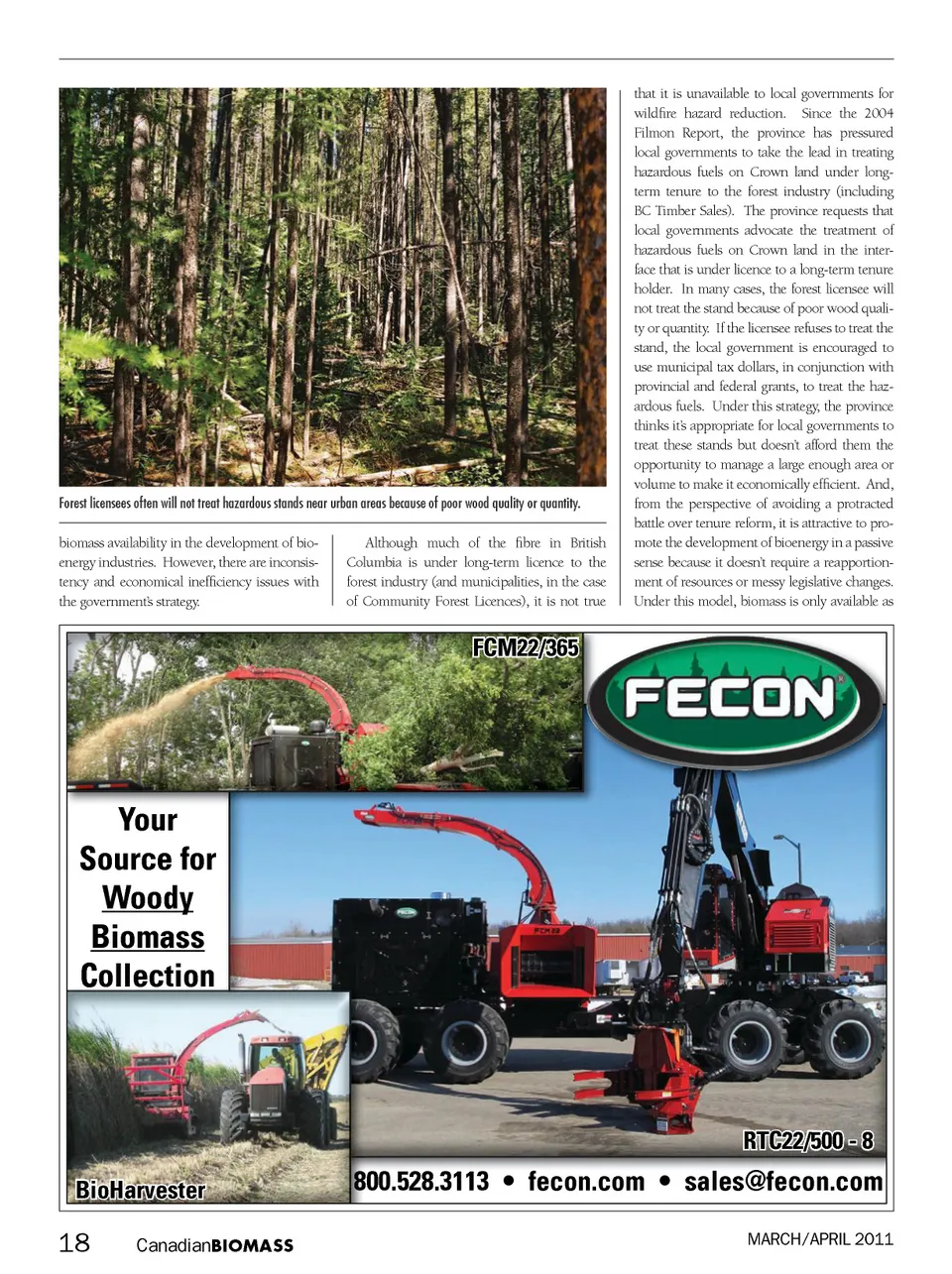
Forest licensees often will not treat hazardous stands near urban areas because of poor wood quality or quantity. biomass availability in the development of bio-energy industries. However, there are inconsis-tency and economical inefficiency issues with the government’s strategy. Although much of the fibre in British Columbia is under long-term licence to the forest industry (and municipalities, in the case of Community Forest Licences), it is not true that it is unavailable to local governments for wildfire hazard reduction. Since the 2004 Filmon Report, the province has pressured local governments to take the lead in treating hazardous fuels on Crown land under long-term tenure to the forest industry (including BC Timber Sales). The province requests that local governments advocate the treatment of hazardous fuels on Crown land in the inter-face that is under licence to a long-term tenure holder. In many cases, the forest licensee will not treat the stand because of poor wood quali-ty or quantity. If the licensee refuses to treat the stand, the local government is encouraged to use municipal tax dollars, in conjunction with provincial and federal grants, to treat the haz-ardous fuels. Under this strategy, the province thinks it’s appropriate for local governments to treat these stands but doesn’t afford them the opportunity to manage a large enough area or volume to make it economically efficient. And, from the perspective of avoiding a protracted battle over tenure reform, it is attractive to pro-mote the development of bioenergy in a passive sense because it doesn’t require a reapportion-ment of resources or messy legislative changes. Under this model, biomass is only available as FCM22/365 Your Source for Woody Biomass Collection RTC22/500 - 8 BioHarvester 18 Canadian BIOMASS 800.528.3113 • fecon.com • [email protected] MarCh/april 2011
Canadian Biomass April 2011: Page 18