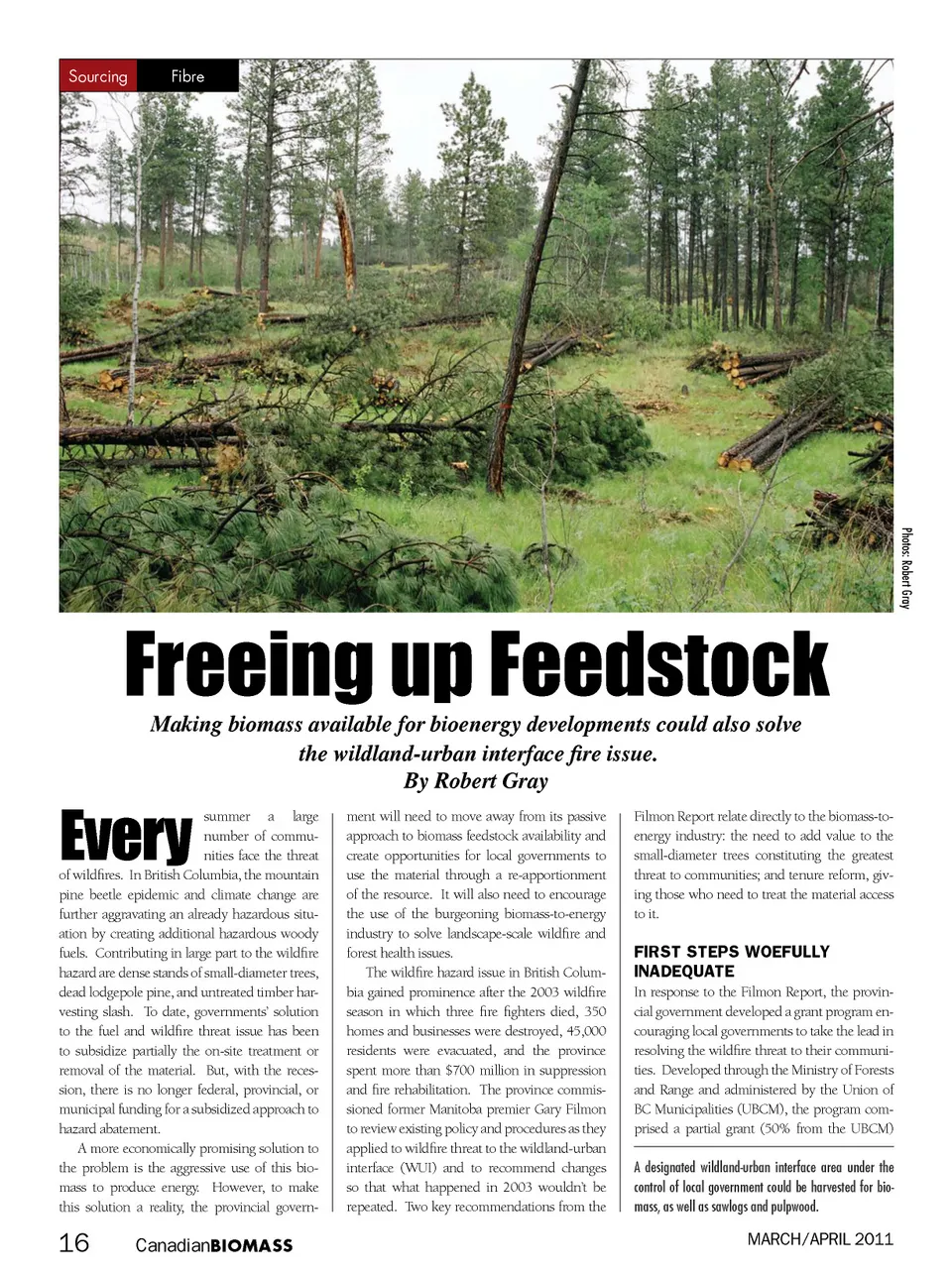
Sourcing Fibre Photos: Robert Gray Freeing up Feedstock Every Making biomass available for bioenergy developments could also solve the wildland-urban interface fire issue. By Robert Gray ment will need to move away from its passive approach to biomass feedstock availability and create opportunities for local governments to use the material through a re-apportionment of the resource. It will also need to encourage the use of the burgeoning biomass-to-energy industry to solve landscape-scale wildfire and forest health issues. The wildfire hazard issue in British Colum-bia gained prominence after the 2003 wildfire season in which three fire fighters died, 350 homes and businesses were destroyed, 45,000 residents were evacuated, and the province spent more than $700 million in suppression and fire rehabilitation. The province commis-sioned former Manitoba premier Gary Filmon to review existing policy and procedures as they applied to wildfire threat to the wildland-urban interface (WUI) and to recommend changes so that what happened in 2003 wouldn’t be repeated. Two key recommendations from the summer a large number of commu-nities face the threat of wildfires. In British Columbia, the mountain pine beetle epidemic and climate change are further aggravating an already hazardous situ-ation by creating additional hazardous woody fuels. Contributing in large part to the wildfire hazard are dense stands of small-diameter trees, dead lodgepole pine, and untreated timber har-vesting slash. To date, governments’ solution to the fuel and wildfire threat issue has been to subsidize partially the on-site treatment or removal of the material. But, with the reces-sion, there is no longer federal, provincial, or municipal funding for a subsidized approach to hazard abatement. A more economically promising solution to the problem is the aggressive use of this bio-mass to produce energy. However, to make this solution a reality, the provincial govern-Filmon Report relate directly to the biomass-to-energy industry: the need to add value to the small-diameter trees constituting the greatest threat to communities; and tenure reform, giv-ing those who need to treat the material access to it. First steps wOeFully inadequate In response to the Filmon Report, the provin-cial government developed a grant program en-couraging local governments to take the lead in resolving the wildfire threat to their communi-ties. Developed through the Ministry of Forests and Range and administered by the Union of BC Municipalities (UBCM), the program com-prised a partial grant (50% from the UBCM) A designated wildland-urban interface area under the control of local government could be harvested for bio-mass, as well as sawlogs and pulpwood. MarCh/april 2011 16 Canadian BIOMASS
Canadian Biomass April 2011: Page 16