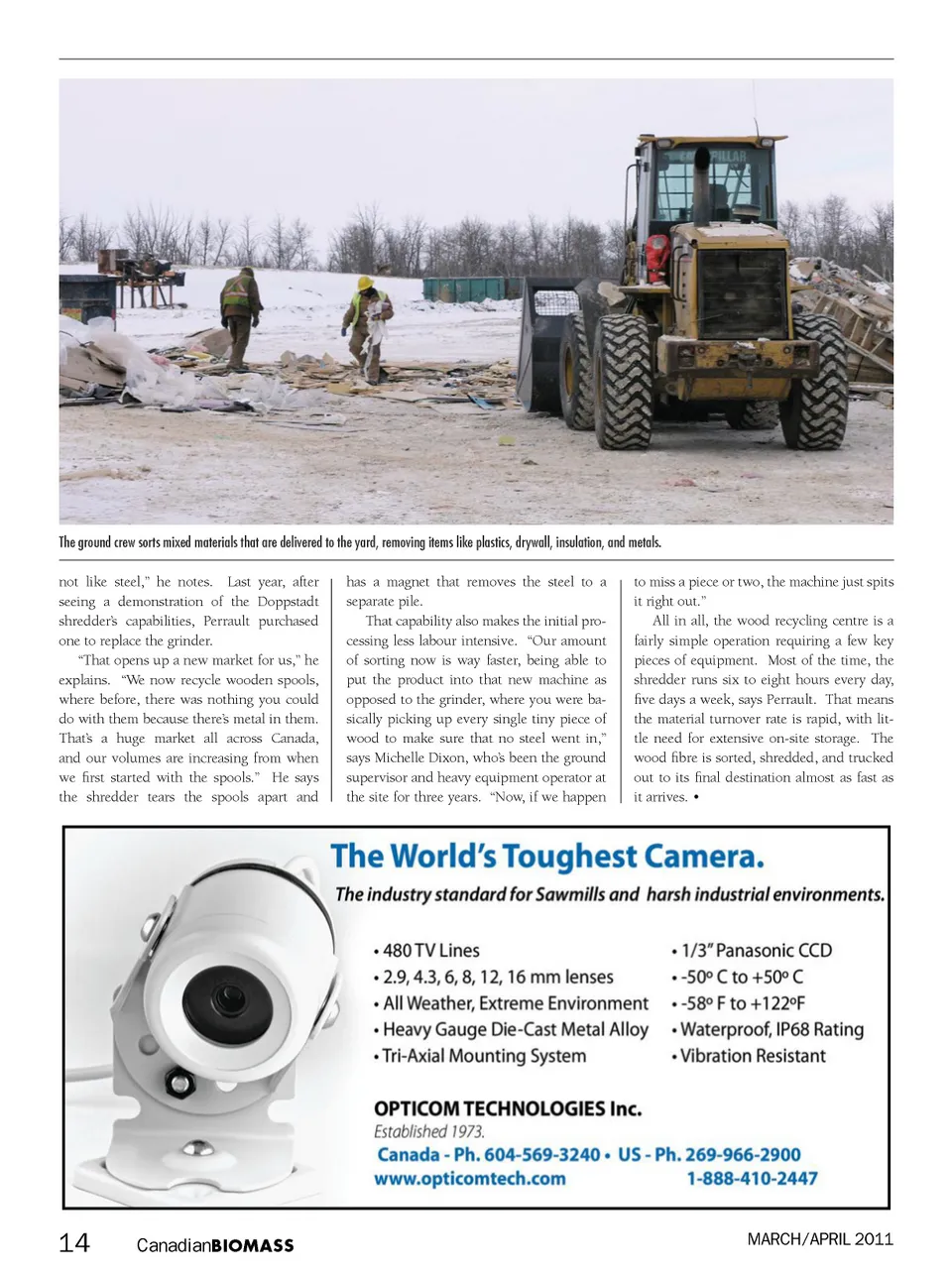
The ground crew sorts mixed materials that are delivered to the yard, removing items like plastics, drywall, insulation, and metals. not like steel,” he notes. Last year, after seeing a demonstration of the Doppstadt shredder’s capabilities, Perrault purchased one to replace the grinder. “That opens up a new market for us,” he explains. “We now recycle wooden spools, where before, there was nothing you could do with them because there’s metal in them. That’s a huge market all across Canada, and our volumes are increasing from when we first started with the spools.” He says the shredder tears the spools apart and has a magnet that removes the steel to a separate pile. That capability also makes the initial pro-cessing less labour intensive. “Our amount of sorting now is way faster, being able to put the product into that new machine as opposed to the grinder, where you were ba-sically picking up every single tiny piece of wood to make sure that no steel went in,” says Michelle Dixon, who’s been the ground supervisor and heavy equipment operator at the site for three years. “Now, if we happen to miss a piece or two, the machine just spits it right out.” All in all, the wood recycling centre is a fairly simple operation requiring a few key pieces of equipment. Most of the time, the shredder runs six to eight hours every day, five days a week, says Perrault. That means the material turnover rate is rapid, with lit-tle need for extensive on-site storage. The wood fibre is sorted, shredded, and trucked out to its final destination almost as fast as it arrives. • 14 Canadian BIOMASS MarCh/april 2011
Canadian Biomass April 2011: Page 14