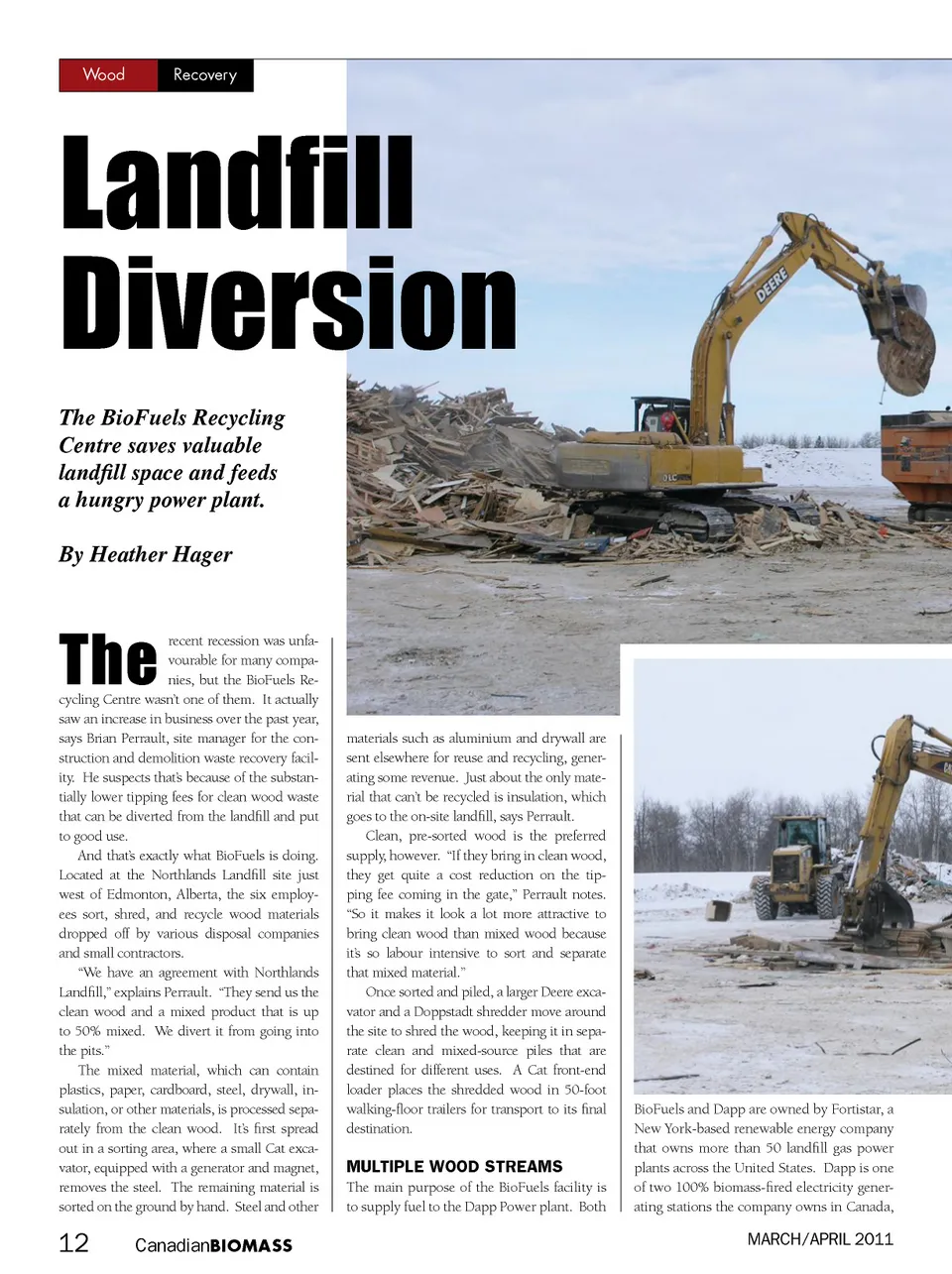
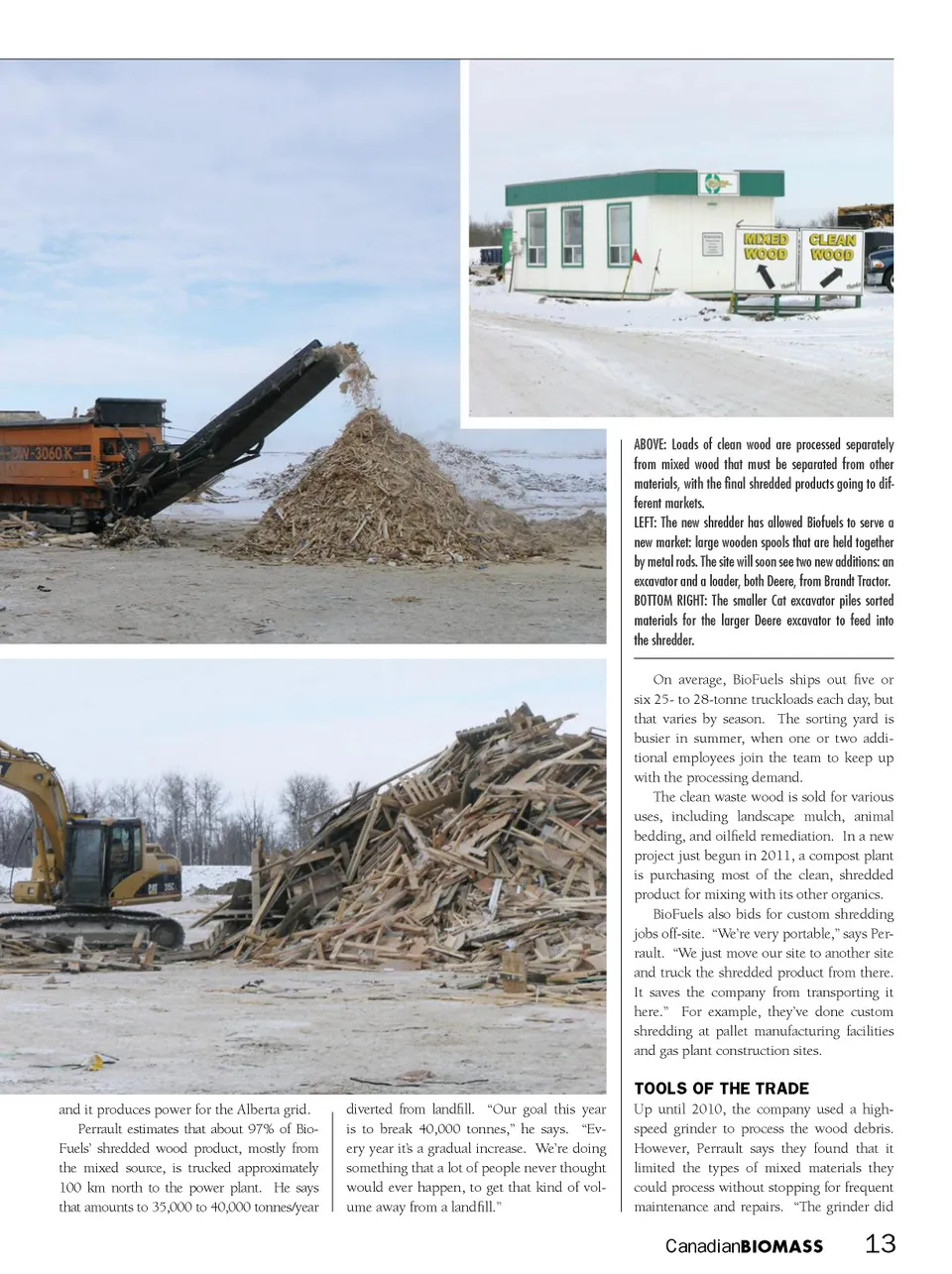
Wood Recovery Landfill Diversion The BioFuels Recycling Centre saves valuable landfill space and feeds a hungry power plant. By Heather Hager recent recession was unfa-vourable for many compa-nies, but the BioFuels Re-cycling Centre wasn’t one of them. It actually saw an increase in business over the past year, says Brian Perrault, site manager for the con-struction and demolition waste recovery facil-ity. He suspects that’s because of the substan-tially lower tipping fees for clean wood waste that can be diverted from the landfill and put to good use. And that’s exactly what BioFuels is doing. Located at the Northlands Landfill site just west of Edmonton, Alberta, the six employ-ees sort, shred, and recycle wood materials dropped off by various disposal companies and small contractors. “We have an agreement with Northlands Landfill,” explains Perrault. “They send us the clean wood and a mixed product that is up to 50% mixed. We divert it from going into the pits.” The mixed material, which can contain plastics, paper, cardboard, steel, drywall, in-sulation, or other materials, is processed sepa-rately from the clean wood. It’s first spread out in a sorting area, where a small Cat exca-vator, equipped with a generator and magnet, removes the steel. The remaining material is sorted on the ground by hand. Steel and other The materials such as aluminium and drywall are sent elsewhere for reuse and recycling, gener-ating some revenue. Just about the only mate-rial that can’t be recycled is insulation, which goes to the on-site landfill, says Perrault. Clean, pre-sorted wood is the preferred supply, however. “If they bring in clean wood, they get quite a cost reduction on the tip-ping fee coming in the gate,” Perrault notes. “So it makes it look a lot more attractive to bring clean wood than mixed wood because it’s so labour intensive to sort and separate that mixed material.” Once sorted and piled, a larger Deere exca-vator and a Doppstadt shredder move around the site to shred the wood, keeping it in sepa-rate clean and mixed-source piles that are destined for different uses. A Cat front-end loader places the shredded wood in 50-foot walking-floor trailers for transport to its final destination. multiple wOOd streams The main purpose of the BioFuels facility is to supply fuel to the Dapp Power plant. Both BioFuels and Dapp are owned by Fortistar, a New York-based renewable energy company that owns more than 50 landfill gas power plants across the United States. Dapp is one of two 100% biomass-fired electricity gener-ating stations the company owns in Canada, MarCh/april 2011 12 Canadian BIOMASS
Canadian Biomass April 2011: Page 12