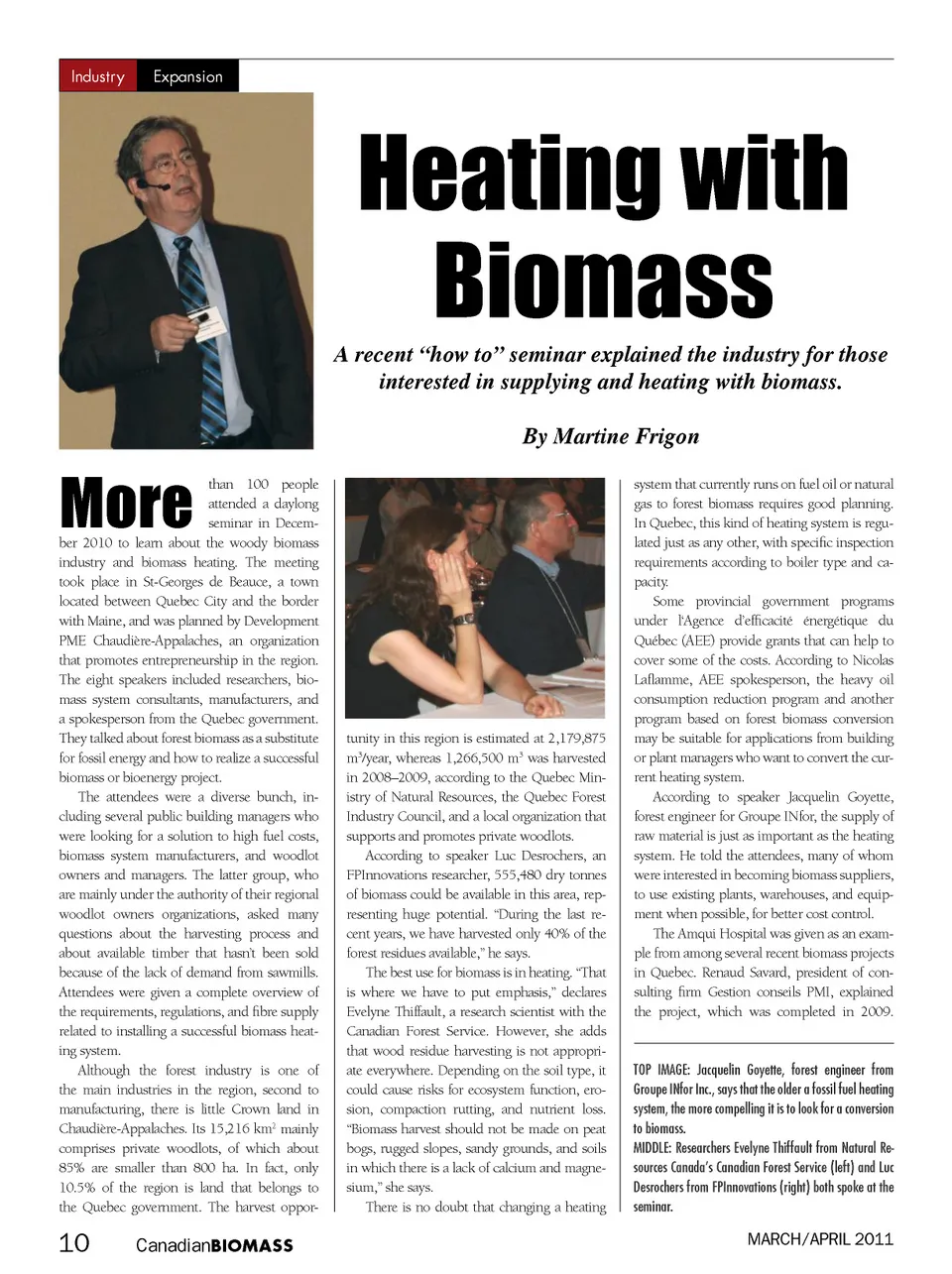
Industry Expansion A recent “how to” seminar explained the industry for those interested in supplying and heating with biomass. By Martine Frigon than 100 people attended a daylong seminar in Decem-ber 2010 to learn about the woody biomass industry and biomass heating. The meeting took place in St-Georges de Beauce, a town located between Quebec City and the border with Maine, and was planned by Development PME Chaudière-Appalaches, an organization that promotes entrepreneurship in the region. The eight speakers included researchers, bio-mass system consultants, manufacturers, and a spokesperson from the Quebec government. They talked about forest biomass as a substitute for fossil energy and how to realize a successful biomass or bioenergy project. The attendees were a diverse bunch, in-cluding several public building managers who were looking for a solution to high fuel costs, biomass system manufacturers, and woodlot owners and managers. The latter group, who are mainly under the authority of their regional woodlot owners organizations, asked many questions about the harvesting process and about available timber that hasn’t been sold because of the lack of demand from sawmills. Attendees were given a complete overview of the requirements, regulations, and fibre supply related to installing a successful biomass heat-ing system. Although the forest industry is one of the main industries in the region, second to manufacturing, there is little Crown land in Chaudière-Appalaches. Its 15,216 km 2 mainly comprises private woodlots, of which about 85% are smaller than 800 ha. In fact, only 10.5% of the region is land that belongs to the Quebec government. The harvest oppor-Heating with Biomass More tunity in this region is estimated at 2,179,875 m 3 /year, whereas 1,266,500 m 3 was harvested in 2008–2009, according to the Quebec Min-istry of Natural Resources, the Quebec Forest Industry Council, and a local organization that supports and promotes private woodlots. According to speaker Luc Desrochers, an FPInnovations researcher, 555,480 dry tonnes of biomass could be available in this area, rep-resenting huge potential. “During the last re-cent years, we have harvested only 40% of the forest residues available,” he says. The best use for biomass is in heating. “That is where we have to put emphasis,” declares Evelyne Thiffault, a research scientist with the Canadian Forest Service. However, she adds that wood residue harvesting is not appropri-ate everywhere. Depending on the soil type, it could cause risks for ecosystem function, ero-sion, compaction rutting, and nutrient loss. “Biomass harvest should not be made on peat bogs, rugged slopes, sandy grounds, and soils in which there is a lack of calcium and magne-sium,” she says. There is no doubt that changing a heating system that currently runs on fuel oil or natural gas to forest biomass requires good planning. In Quebec, this kind of heating system is regu-lated just as any other, with specific inspection requirements according to boiler type and ca-pacity. Some provincial government programs under l‘Agence d’efficacité énergétique du Québec (AEE) provide grants that can help to cover some of the costs. According to Nicolas Laflamme, AEE spokesperson, the heavy oil consumption reduction program and another program based on forest biomass conversion may be suitable for applications from building or plant managers who want to convert the cur-rent heating system. According to speaker Jacquelin Goyette, forest engineer for Groupe INfor, the supply of raw material is just as important as the heating system. He told the attendees, many of whom were interested in becoming biomass suppliers, to use existing plants, warehouses, and equip-ment when possible, for better cost control. The Amqui Hospital was given as an exam-ple from among several recent biomass projects in Quebec. Renaud Savard, president of con-sulting firm Gestion conseils PMI, explained the project, which was completed in 2009. TOP IMAGE: Jacquelin Goyette, forest engineer from Groupe INfor Inc., says that the older a fossil fuel heating system, the more compelling it is to look for a conversion to biomass. MIddlE: Researchers Evelyne Thiffault from Natural Re-sources Canada’s Canadian Forest Service (left) and luc desrochers from FPInnovations (right) both spoke at the seminar. MarCh/april 2011 10 Canadian BIOMASS
Canadian Biomass April 2011: Page 10