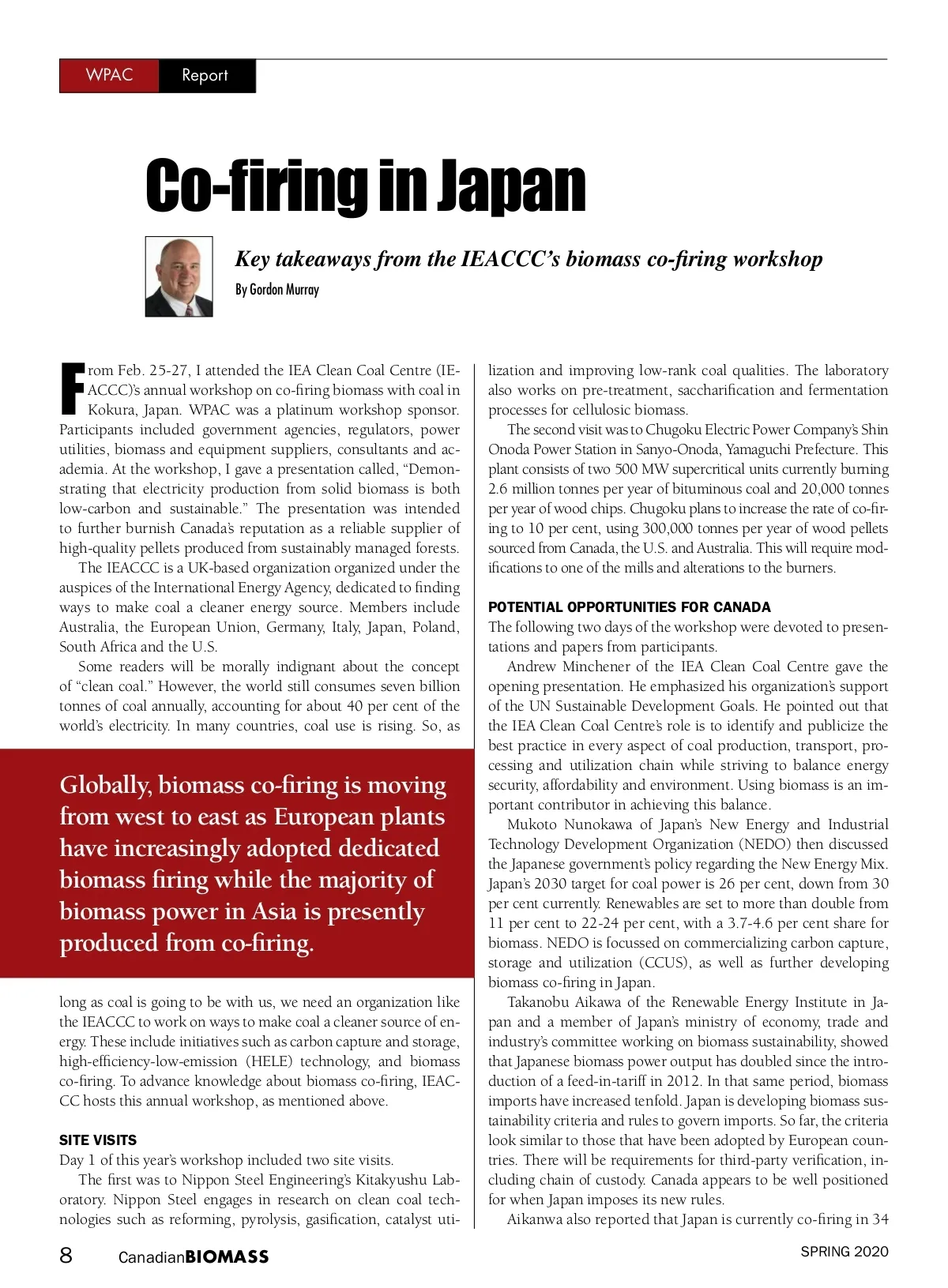
Biomass co-firing power plants in Japan. plants for a total of 1,500 MW of bio-mass power capacity. Dedicated biomass firing is taking place in just six plants with a total capacity of 700 MW. At the workshop, Hu Wenping of the China Electric Power Planning and Engineering Institute, described China’s biomass co-firing experience. Chinese co-firing has not progressed due to a lack of government support policies. But, the Chinese have been able to make co-firing of sludge work by charging municipali-ties a fee for sludge disposal. Wenping reviewed numerous examples of conventional agricultural and forest-ry-related co-firing projects, but none were profitable. There is a preference in China for co-firing by pre-gasifying the biomass and injecting the syngas into the boiler as opposed to the conventional method of co-firing by feeding pulverized biomass power into the boilers. This preference is due to China’s high proportion of agricul-tural feedstock, which is prone to causing slagging and corrosion if fed directly into the boiler as powder. This means there is no prospect of China becoming a market for Canadian wood pellets any time soon. Finally, Debo Adams of the IEA Clean Coal Centre gave a presentation on tech-nologies for biomass co-firing. The pre-sentation had been prepared by her col-league Xing Zhang, but she had to cancel her attendance at the last minute. Globally, biomass co-firing is moving from west to east as European plants have increasingly adopted dedicated biomass firing while the majority of biomass power in Asia is presently produced from co-fir-ing. The majority of Japan’s power plants are co-firing at a ratio of just two to four per cent biomass, with six plants co-firing at ratios between 20 to 40 per cent. Most power plants burning woody biomass are using direct co-firing technol-ogy. Plants with agricultural biomass use indirect co-firing where biomass is gas-ified into syngas, which is then fed into the coal boiler, or parallel co-firing where biomass and coal are each fed into their own boilers and steam from both boilers is combined to power a turbine. Indirect and parallel co-firing are very expensive. There are also numerous operating is-sues related to co-firing that must be con-sidered by operators, Adams explained. Some of these include: fire and explosion risk during biomass handling and prepara-tion, pulverizer capacity and performance, burner blockage and ignition characteris-tics, boiler slagging, fouling and corrosion, improved flue gas emissions, and changes to the characteristics of fly ash. There were numerous other excellent presentations at the workshop focussed on relevant topics including: torrefac-tion, fuel preparation, fire and explosion prevention, carbon capture and storage, optimizing pellet handling and transpor-tation, and many other highly technical issues related to biomass performance within power plants. All in all, the workshop presented WPAC with an excellent opportunity to network with Japanese utilities, govern-ment and regulators to promote Can-ada as a source of high-quality, sustain-ably produced wood pellets. I was able to present the Canadian perspective on demonstrating that electricity production from solid biomass is both low-carbon and sustainable. It was a great learning experience for all participants. Note: Gordon’s presentation can be down-loaded at https://tinyurl.com/vorgyxr. • Gordon Murray is the executive director of the Wood Pellet Association of Canada. Canadian BIOMASS allied blower biomass novdec14.indd 1 9 2014-11-18 2:22 PM
Canadian Biomass Spring 2020: Page 9