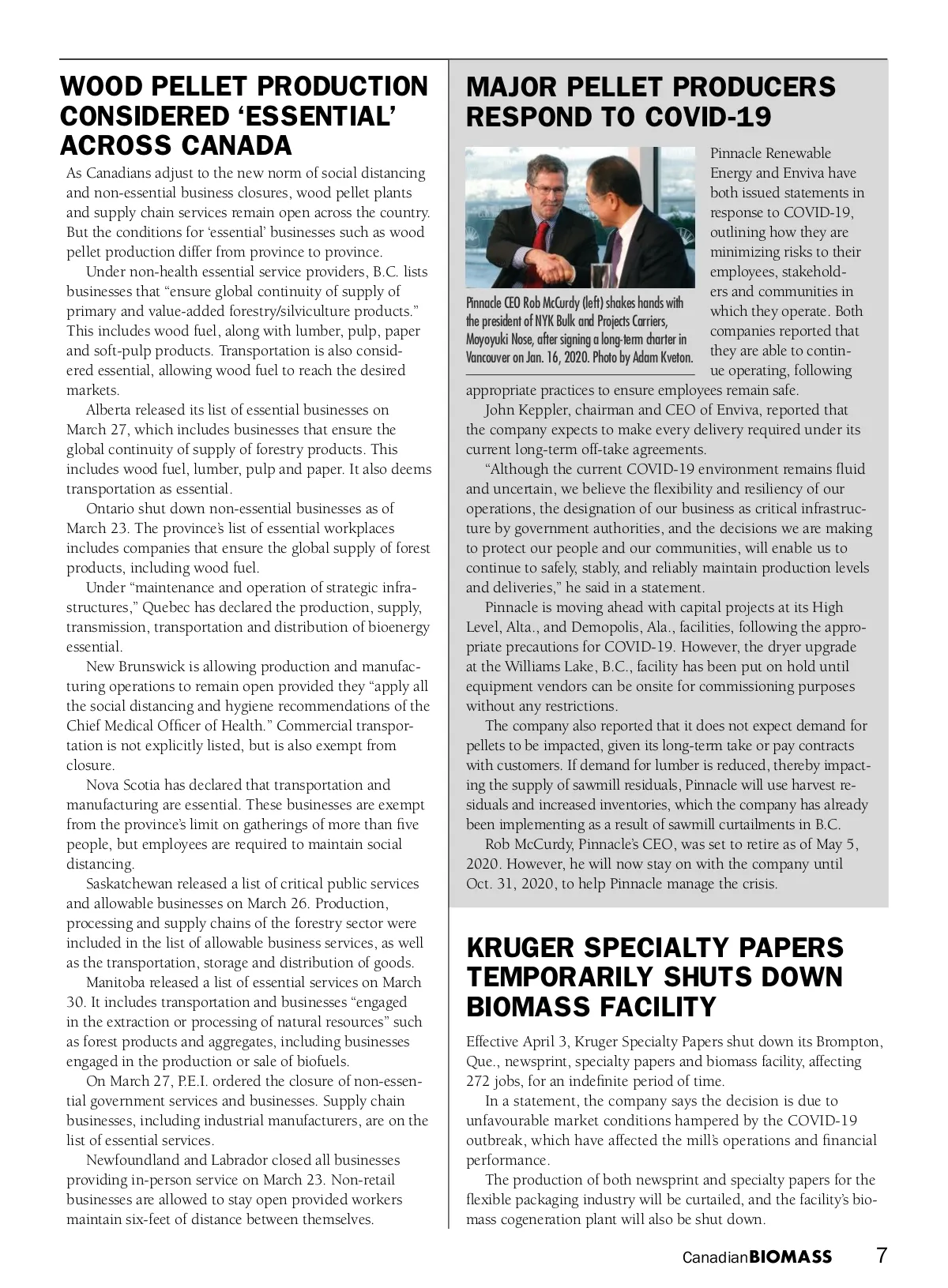
WOOD PELLET PRODUCTION CONSIDERED ‘ESSENTIAL’ ACROSS CANADA As Canadians adjust to the new norm of social distancing and non-essential business closures, wood pellet plants and supply chain services remain open across the country. But the conditions for ‘essential’ businesses such as wood pellet production differ from province to province. Under non-health essential service providers, B.C. lists businesses that “ensure global continuity of supply of primary and value-added forestry/silviculture products.” This includes wood fuel, along with lumber, pulp, paper and soft-pulp products. Transportation is also consid-ered essential, allowing wood fuel to reach the desired markets. Alberta released its list of essential businesses on March 27, which includes businesses that ensure the global continuity of supply of forestry products. This includes wood fuel, lumber, pulp and paper. It also deems transportation as essential. Ontario shut down non-essential businesses as of March 23. The province’s list of essential workplaces includes companies that ensure the global supply of forest products, including wood fuel. Under “maintenance and operation of strategic infra-structures,” Quebec has declared the production, supply, transmission, transportation and distribution of bioenergy essential. New Brunswick is allowing production and manufac-turing operations to remain open provided they “apply all the social distancing and hygiene recommendations of the Chief Medical Officer of Health.” Commercial transpor-tation is not explicitly listed, but is also exempt from closure. Nova Scotia has declared that transportation and manufacturing are essential. These businesses are exempt from the province’s limit on gatherings of more than five people, but employees are required to maintain social distancing. Saskatchewan released a list of critical public services and allowable businesses on March 26. Production, processing and supply chains of the forestry sector were included in the list of allowable business services, as well as the transportation, storage and distribution of goods. Manitoba released a list of essential services on March 30. It includes transportation and businesses “engaged in the extraction or processing of natural resources” such as forest products and aggregates, including businesses engaged in the production or sale of biofuels. On March 27, P.E.I. ordered the closure of non-essen-tial government services and businesses. Supply chain businesses, including industrial manufacturers, are on the list of essential services. Newfoundland and Labrador closed all businesses providing in-person service on March 23. Non-retail businesses are allowed to stay open provided workers maintain six-feet of distance between themselves. MAJOR PELLET PRODUCERS RESPOND TO COVID-19 Pinnacle Renewable Energy and Enviva have both issued statements in response to COVID-19, outlining how they are minimizing risks to their employees, stakehold-ers and communities in Pinnacle CEO Rob McCurdy (left) shakes hands with which they operate. Both the president of NYK Bulk and Projects Carriers, companies reported that Moyoyuki Nose, after signing a long-term charter in Vancouver on Jan. 16, 2020. Photo by Adam Kveton. they are able to contin-ue operating, following appropriate practices to ensure employees remain safe. John Keppler, chairman and CEO of Enviva, reported that the company expects to make every delivery required under its current long-term off-take agreements. “Although the current COVID-19 environment remains fluid and uncertain, we believe the flexibility and resiliency of our operations, the designation of our business as critical infrastruc-ture by government authorities, and the decisions we are making to protect our people and our communities, will enable us to continue to safely, stably, and reliably maintain production levels and deliveries,” he said in a statement. Pinnacle is moving ahead with capital projects at its High Level, Alta., and Demopolis, Ala., facilities, following the appro-priate precautions for COVID-19. However, the dryer upgrade at the Williams Lake, B.C., facility has been put on hold until equipment vendors can be onsite for commissioning purposes without any restrictions. The company also reported that it does not expect demand for pellets to be impacted, given its long-term take or pay contracts with customers. If demand for lumber is reduced, thereby impact-ing the supply of sawmill residuals, Pinnacle will use harvest re-siduals and increased inventories, which the company has already been implementing as a result of sawmill curtailments in B.C. Rob McCurdy, Pinnacle’s CEO, was set to retire as of May 5, 2020. However, he will now stay on with the company until Oct. 31, 2020, to help Pinnacle manage the crisis. KRUGER SPECIALTY PAPERS TEMPORARILY SHUTS DOWN BIOMASS FACILITY Effective April 3, Kruger Specialty Papers shut down its Brompton, Que., newsprint, specialty papers and biomass facility, affecting 272 jobs, for an indefinite period of time. In a statement, the company says the decision is due to unfavourable market conditions hampered by the COVID-19 outbreak, which have affected the mill’s operations and financial performance. The production of both newsprint and specialty papers for the flexible packaging industry will be curtailed, and the facility’s bio-mass cogeneration plant will also be shut down. Canadian BIOMASS 7
Canadian Biomass Spring 2020: Page 7