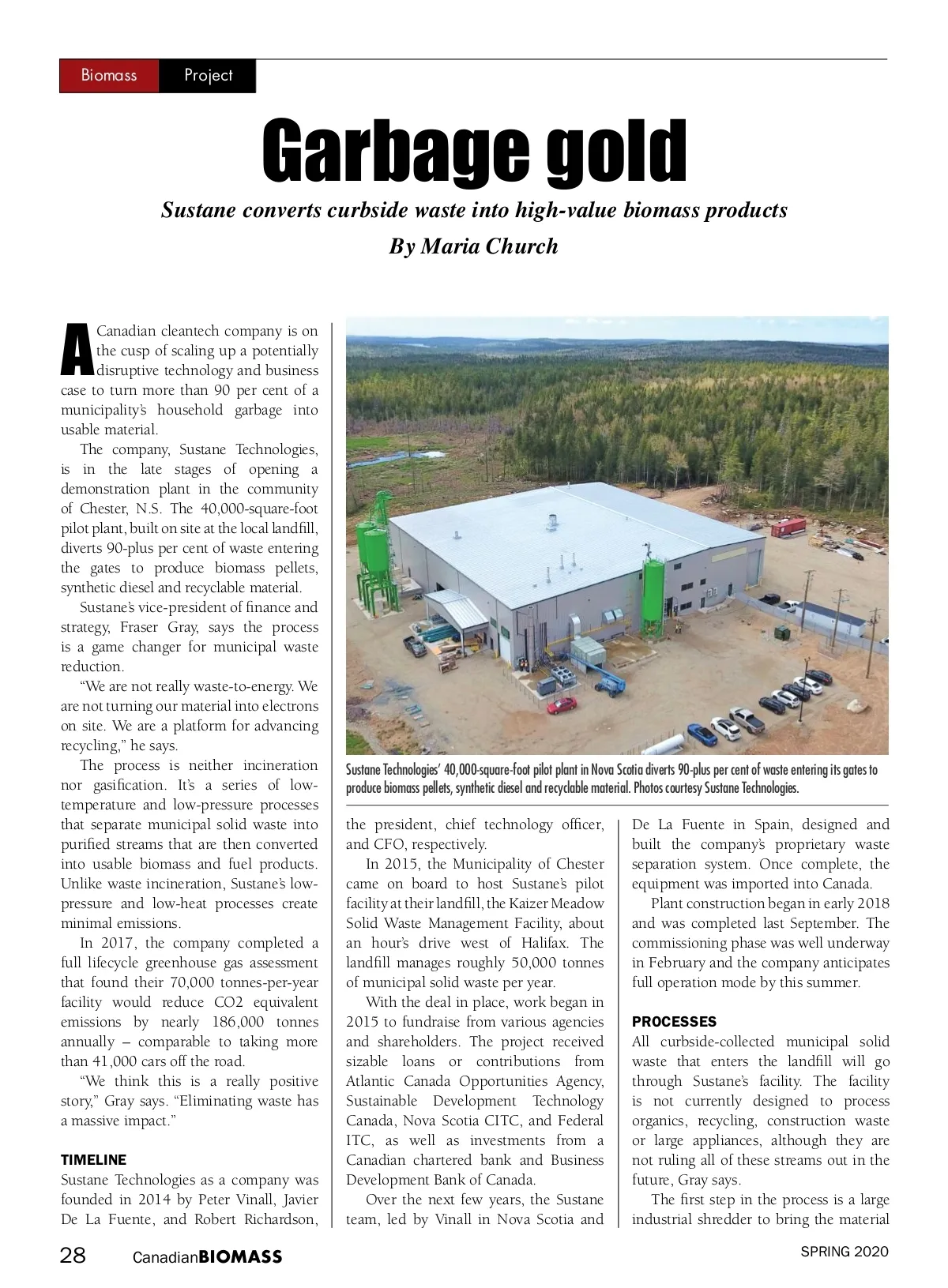
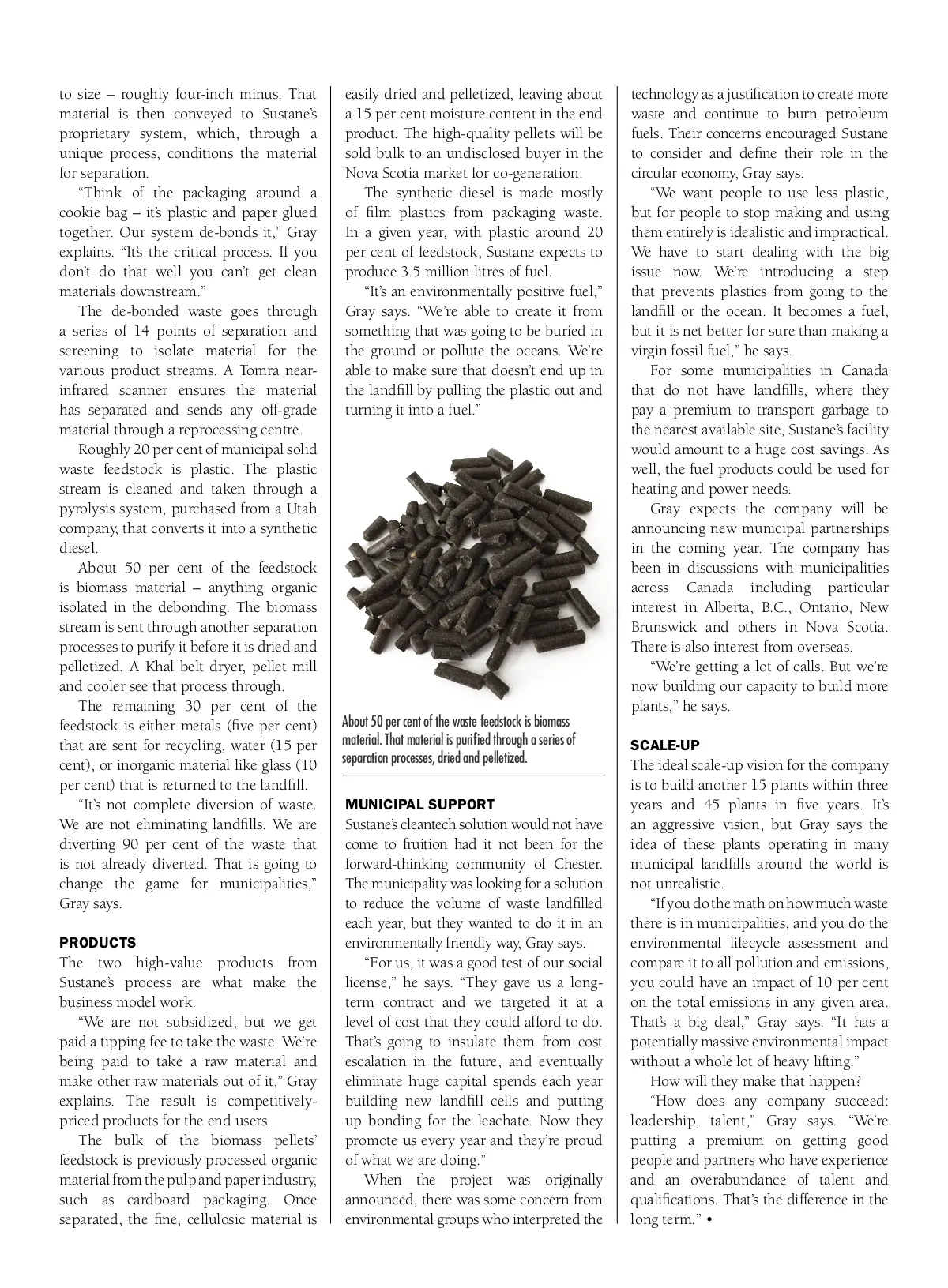
Biomass Project Sustane converts curbside waste into high-value biomass products By Maria Church Garbage gold A Canadian cleantech company is on the cusp of scaling up a potentially disruptive technology and business case to turn more than 90 per cent of a municipality’s household garbage into usable material. The company, Sustane Technologies, is in the late stages of opening a demonstration plant in the community of Chester, N.S. The 40,000-square-foot pilot plant, built on site at the local landfill, diverts 90-plus per cent of waste entering the gates to produce biomass pellets, synthetic diesel and recyclable material. Sustane’s vice-president of finance and strategy, Fraser Gray, says the process is a game changer for municipal waste reduction. “We are not really waste-to-energy. We are not turning our material into electrons on site. We are a platform for advancing recycling,” he says. The process is neither incineration nor gasification. It’s a series of low-temperature and low-pressure processes that separate municipal solid waste into purified streams that are then converted into usable biomass and fuel products. Unlike waste incineration, Sustane’s low-pressure and low-heat processes create minimal emissions. In 2017, the company completed a full lifecycle greenhouse gas assessment that found their 70,000 tonnes-per-year facility would reduce CO2 equivalent emissions by nearly 186,000 tonnes annually – comparable to taking more than 41,000 cars off the road. “We think this is a really positive story,” Gray says. “Eliminating waste has a massive impact.” Sustane Technologies’ 40,000-square-foot pilot plant in Nova Scotia diverts 90-plus per cent of waste entering its gates to produce biomass pellets, synthetic diesel and recyclable material. Photos courtesy Sustane Technologies. TIMELINE Sustane Technologies as a company was founded in 2014 by Peter Vinall, Javier De La Fuente, and Robert Richardson, the president, chief technology officer, and CFO, respectively. In 2015, the Municipality of Chester came on board to host Sustane’s pilot facility at their landfill, the Kaizer Meadow Solid Waste Management Facility, about an hour’s drive west of Halifax. The landfill manages roughly 50,000 tonnes of municipal solid waste per year. With the deal in place, work began in 2015 to fundraise from various agencies and shareholders. The project received sizable loans or contributions from Atlantic Canada Opportunities Agency, Sustainable Development Technology Canada, Nova Scotia CITC, and Federal ITC, as well as investments from a Canadian chartered bank and Business Development Bank of Canada. Over the next few years, the Sustane team, led by Vinall in Nova Scotia and De La Fuente in Spain, designed and built the company’s proprietary waste separation system. Once complete, the equipment was imported into Canada. Plant construction began in early 2018 and was completed last September. The commissioning phase was well underway in February and the company anticipates full operation mode by this summer. PROCESSES All curbside-collected municipal solid waste that enters the landfill will go through Sustane’s facility. The facility is not currently designed to process organics, recycling, construction waste or large appliances, although they are not ruling all of these streams out in the future, Gray says. The first step in the process is a large industrial shredder to bring the material SPRING 2020 28 Canadian BIOMASS
Canadian Biomass Spring 2020: Page 28