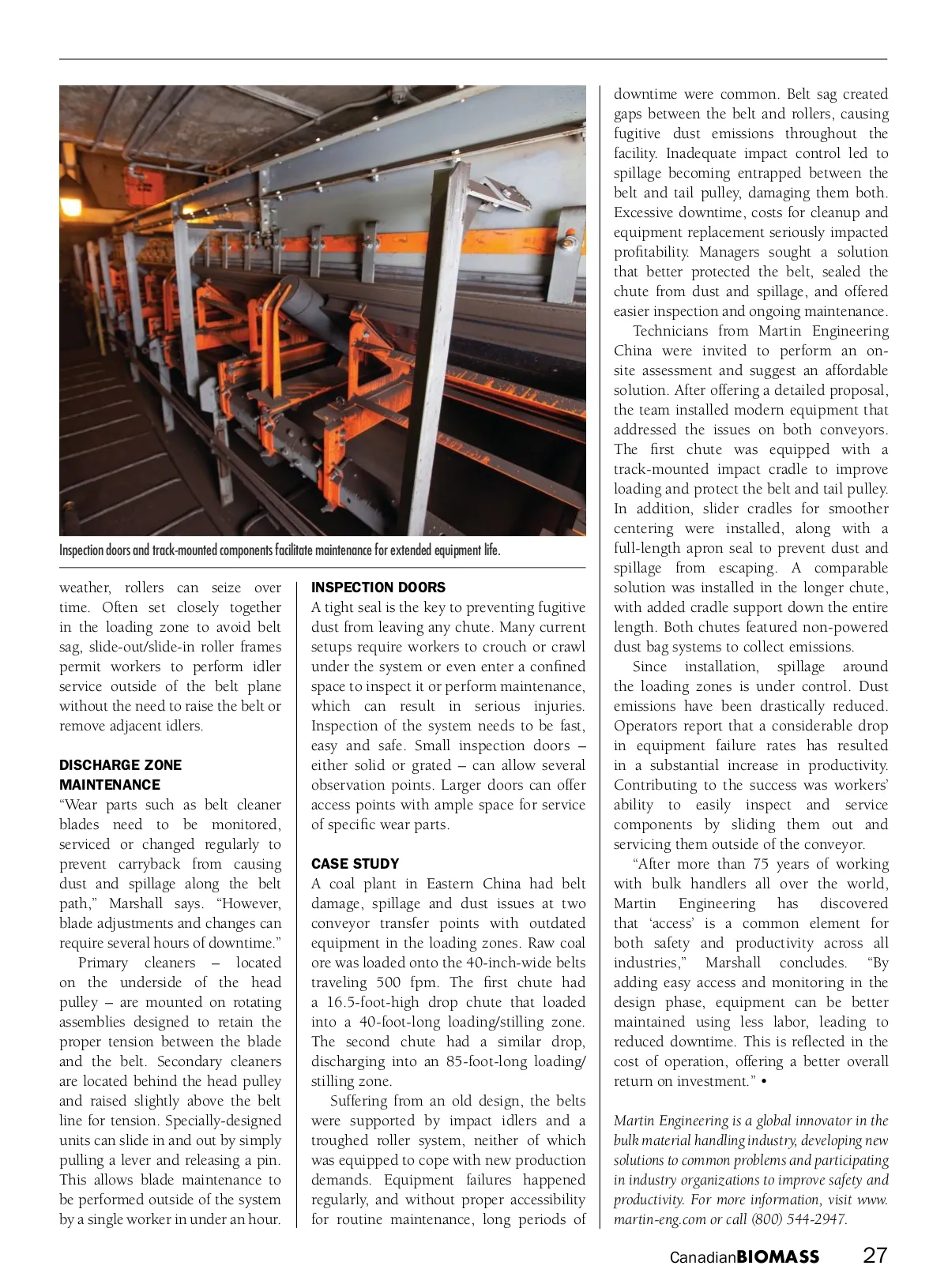
Inspection doors and track-mounted components facilitate maintenance for extended equipment life. weather, rollers can seize over time. Often set closely together in the loading zone to avoid belt sag, slide-out/slide-in roller frames permit workers to perform idler service outside of the belt plane without the need to raise the belt or remove adjacent idlers. DISCHARGE ZONE MAINTENANCE INSPECTION DOORS “Wear parts such as belt cleaner blades need to be monitored, serviced or changed regularly to prevent carryback from causing dust and spillage along the belt path,” Marshall says. “However, blade adjustments and changes can require several hours of downtime.” Primary cleaners – located on the underside of the head pulley – are mounted on rotating assemblies designed to retain the proper tension between the blade and the belt. Secondary cleaners are located behind the head pulley and raised slightly above the belt line for tension. Specially-designed units can slide in and out by simply pulling a lever and releasing a pin. This allows blade maintenance to be performed outside of the system by a single worker in under an hour. A tight seal is the key to preventing fugitive dust from leaving any chute. Many current setups require workers to crouch or crawl under the system or even enter a confined space to inspect it or perform maintenance, which can result in serious injuries. Inspection of the system needs to be fast, easy and safe. Small inspection doors – either solid or grated – can allow several observation points. Larger doors can offer access points with ample space for service of specific wear parts. CASE STUDY A coal plant in Eastern China had belt damage, spillage and dust issues at two conveyor transfer points with outdated equipment in the loading zones. Raw coal ore was loaded onto the 40-inch-wide belts traveling 500 fpm. The first chute had a 16.5-foot-high drop chute that loaded into a 40-foot-long loading/stilling zone. The second chute had a similar drop, discharging into an 85-foot-long loading/ stilling zone. Suffering from an old design, the belts were supported by impact idlers and a troughed roller system, neither of which was equipped to cope with new production demands. Equipment failures happened regularly, and without proper accessibility for routine maintenance, long periods of downtime were common. Belt sag created gaps between the belt and rollers, causing fugitive dust emissions throughout the facility. Inadequate impact control led to spillage becoming entrapped between the belt and tail pulley, damaging them both. Excessive downtime, costs for cleanup and equipment replacement seriously impacted profitability. Managers sought a solution that better protected the belt, sealed the chute from dust and spillage, and offered easier inspection and ongoing maintenance. Technicians from Martin Engineering China were invited to perform an on-site assessment and suggest an affordable solution. After offering a detailed proposal, the team installed modern equipment that addressed the issues on both conveyors. The first chute was equipped with a track-mounted impact cradle to improve loading and protect the belt and tail pulley. In addition, slider cradles for smoother centering were installed, along with a full-length apron seal to prevent dust and spillage from escaping. A comparable solution was installed in the longer chute, with added cradle support down the entire length. Both chutes featured non-powered dust bag systems to collect emissions. Since installation, spillage around the loading zones is under control. Dust emissions have been drastically reduced. Operators report that a considerable drop in equipment failure rates has resulted in a substantial increase in productivity. Contributing to the success was workers’ ability to easily inspect and service components by sliding them out and servicing them outside of the conveyor. “After more than 75 years of working with bulk handlers all over the world, Martin Engineering has discovered that ‘access’ is a common element for both safety and productivity across all industries,” Marshall concludes. “By adding easy access and monitoring in the design phase, equipment can be better maintained using less labor, leading to reduced downtime. This is reflected in the cost of operation, offering a better overall return on investment.” • Martin Engineering is a global innovator in the bulk material handling industry, developing new solutions to common problems and participating in industry organizations to improve safety and productivity. For more information, visit www. martin-eng.com or call (800) 544-2947. Canadian BIOMASS 27
Canadian Biomass Spring 2020: Page 27