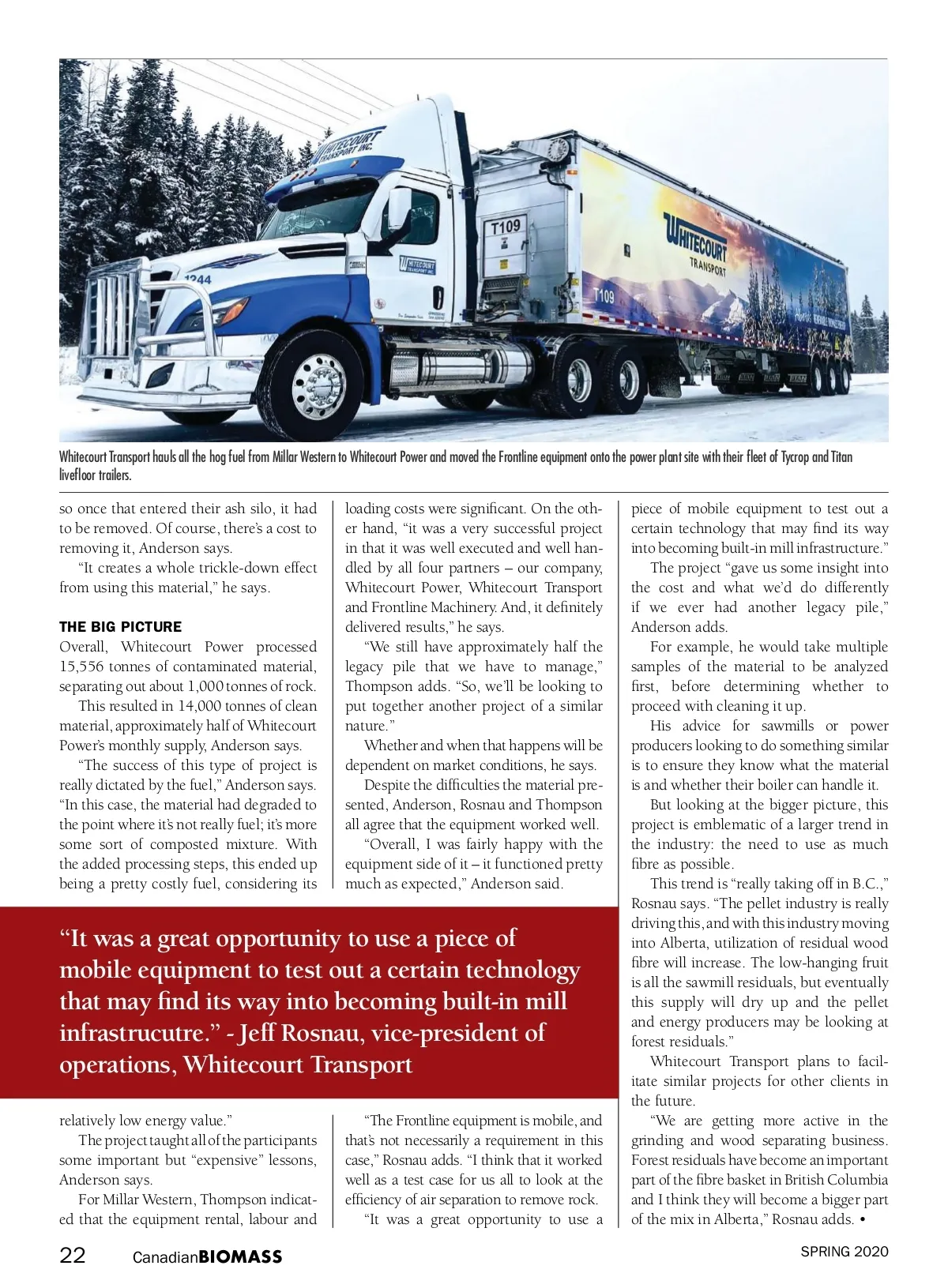
Whitecourt Transport hauls all the hog fuel from Millar Western to Whitecourt Power and moved the Frontline equipment onto the power plant site with their fleet of Tycrop and Titan livefloor trailers. so once that entered their ash silo, it had to be removed. Of course, there’s a cost to removing it, Anderson says. “It creates a whole trickle-down effect from using this material,” he says. THE BIG PICTURE Overall, Whitecourt Power processed 15,556 tonnes of contaminated material, separating out about 1,000 tonnes of rock. This resulted in 14,000 tonnes of clean material, approximately half of Whitecourt Power’s monthly supply, Anderson says. “The success of this type of project is really dictated by the fuel,” Anderson says. “In this case, the material had degraded to the point where it’s not really fuel; it’s more some sort of composted mixture. With the added processing steps, this ended up being a pretty costly fuel, considering its loading costs were significant. On the oth-er hand, “it was a very successful project in that it was well executed and well han-dled by all four partners – our company, Whitecourt Power, Whitecourt Transport and Frontline Machinery. And, it definitely delivered results,” he says. “We still have approximately half the legacy pile that we have to manage,” Thompson adds. “So, we’ll be looking to put together another project of a similar nature.” Whether and when that happens will be dependent on market conditions, he says. Despite the difficulties the material pre-sented, Anderson, Rosnau and Thompson all agree that the equipment worked well. “Overall, I was fairly happy with the equipment side of it – it functioned pretty much as expected,” Anderson said. “It was a great opportunity to use a piece of mobile equipment to test out a certain technology that may find its way into becoming built-in mill infrastrucutre.” -Jeff Rosnau, vice-president of operations, Whitecourt Transport relatively low energy value.” The project taught all of the participants some important but “expensive” lessons, Anderson says. For Millar Western, Thompson indicat-ed that the equipment rental, labour and “The Frontline equipment is mobile, and that’s not necessarily a requirement in this case,” Rosnau adds. “I think that it worked well as a test case for us all to look at the efficiency of air separation to remove rock. “It was a great opportunity to use a piece of mobile equipment to test out a certain technology that may find its way into becoming built-in mill infrastructure.” The project “gave us some insight into the cost and what we’d do differently if we ever had another legacy pile,” Anderson adds. For example, he would take multiple samples of the material to be analyzed first, before determining whether to proceed with cleaning it up. His advice for sawmills or power producers looking to do something similar is to ensure they know what the material is and whether their boiler can handle it. But looking at the bigger picture, this project is emblematic of a larger trend in the industry: the need to use as much fibre as possible. This trend is “really taking off in B.C.,” Rosnau says. “The pellet industry is really driving this, and with this industry moving into Alberta, utilization of residual wood fibre will increase. The low-hanging fruit is all the sawmill residuals, but eventually this supply will dry up and the pellet and energy producers may be looking at forest residuals.” Whitecourt Transport plans to facil-itate similar projects for other clients in the future. “We are getting more active in the grinding and wood separating business. Forest residuals have become an important part of the fibre basket in British Columbia and I think they will become a bigger part of the mix in Alberta,” Rosnau adds. • SPRING 2020 22 Canadian BIOMASS
Canadian Biomass Spring 2020: Page 22