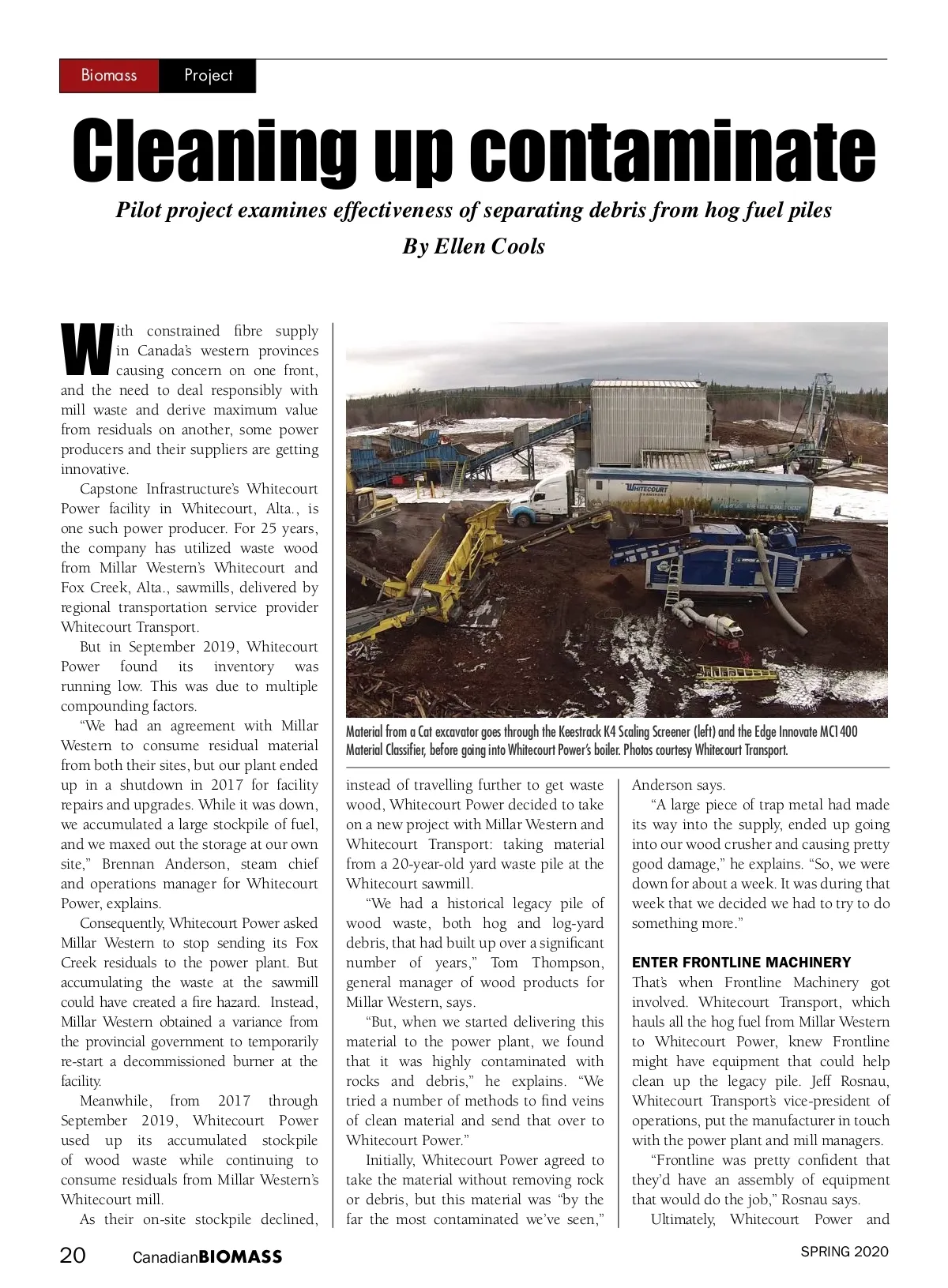
Biomass Project Cleaning up contaminate Pilot project examines effectiveness of separating debris from hog fuel piles By Ellen Cools W ith constrained fibre supply in Canada’s western provinces causing concern on one front, and the need to deal responsibly with mill waste and derive maximum value from residuals on another, some power producers and their suppliers are getting innovative. Capstone Infrastructure’s Whitecourt Power facility in Whitecourt, Alta., is one such power producer. For 25 years, the company has utilized waste wood from Millar Western’s Whitecourt and Fox Creek, Alta., sawmills, delivered by regional transportation service provider Whitecourt Transport. But in September 2019, Whitecourt Power found its inventory was running low. This was due to multiple compounding factors. “We had an agreement with Millar Western to consume residual material from both their sites, but our plant ended up in a shutdown in 2017 for facility repairs and upgrades. While it was down, we accumulated a large stockpile of fuel, and we maxed out the storage at our own site,” Brennan Anderson, steam chief and operations manager for Whitecourt Power, explains. Consequently, Whitecourt Power asked Millar Western to stop sending its Fox Creek residuals to the power plant. But accumulating the waste at the sawmill could have created a fire hazard. Instead, Millar Western obtained a variance from the provincial government to temporarily re-start a decommissioned burner at the facility. Meanwhile, from 2017 through September 2019, Whitecourt Power used up its accumulated stockpile of wood waste while continuing to consume residuals from Millar Western’s Whitecourt mill. As their on-site stockpile declined, Material from a Cat excavator goes through the Keestrack K4 Scaling Screener (left) and the Edge Innovate MC1400 Material Classifier, before going into Whitecourt Power’s boiler. Photos courtesy Whitecourt Transport. instead of travelling further to get waste wood, Whitecourt Power decided to take on a new project with Millar Western and Whitecourt Transport: taking material from a 20-year-old yard waste pile at the Whitecourt sawmill. “We had a historical legacy pile of wood waste, both hog and log-yard debris, that had built up over a significant number of years,” Tom Thompson, general manager of wood products for Millar Western, says. “But, when we started delivering this material to the power plant, we found that it was highly contaminated with rocks and debris,” he explains. “We tried a number of methods to find veins of clean material and send that over to Whitecourt Power.” Initially, Whitecourt Power agreed to take the material without removing rock or debris, but this material was “by the far the most contaminated we’ve seen,” Anderson says. “A large piece of trap metal had made its way into the supply, ended up going into our wood crusher and causing pretty good damage,” he explains. “So, we were down for about a week. It was during that week that we decided we had to try to do something more.” ENTER FRONTLINE MACHINERY That’s when Frontline Machinery got involved. Whitecourt Transport, which hauls all the hog fuel from Millar Western to Whitecourt Power, knew Frontline might have equipment that could help clean up the legacy pile. Jeff Rosnau, Whitecourt Transport’s vice-president of operations, put the manufacturer in touch with the power plant and mill managers. “Frontline was pretty confident that they’d have an assembly of equipment that would do the job,” Rosnau says. Ultimately, Whitecourt Power and SPRING 2020 20 Canadian BIOMASS
Canadian Biomass Spring 2020: Page 20