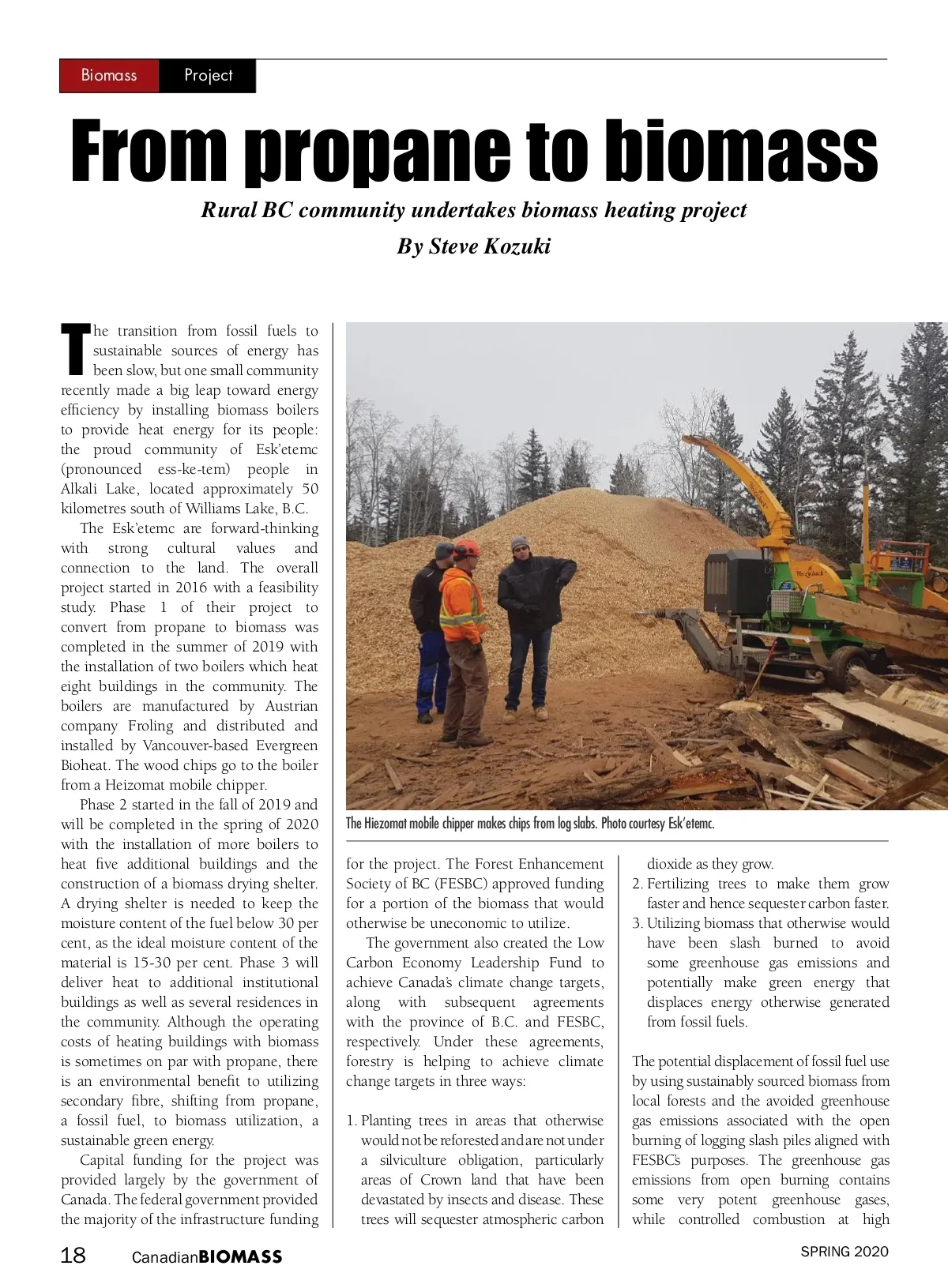
Biomass Project From propane to biomass Rural BC community undertakes biomass heating project By Steve Kozuki he transition from fossil fuels to sustainable sources of energy has been slow, but one small community recently made a big leap toward energy efficiency by installing biomass boilers to provide heat energy for its people: the proud community of Esk’etemc (pronounced ess-ke-tem) people in Alkali Lake, located approximately 50 kilometres south of Williams Lake, B.C. The Esk’etemc are forward-thinking with strong cultural values and connection to the land. The overall project started in 2016 with a feasibility study. Phase 1 of their project to convert from propane to biomass was completed in the summer of 2019 with the installation of two boilers which heat eight buildings in the community. The boilers are manufactured by Austrian company Froling and distributed and installed by Vancouver-based Evergreen Bioheat. The wood chips go to the boiler from a Heizomat mobile chipper. Phase 2 started in the fall of 2019 and will be completed in the spring of 2020 with the installation of more boilers to heat five additional buildings and the construction of a biomass drying shelter. A drying shelter is needed to keep the moisture content of the fuel below 30 per cent, as the ideal moisture content of the material is 15-30 per cent. Phase 3 will deliver heat to additional institutional buildings as well as several residences in the community. Although the operating costs of heating buildings with biomass is sometimes on par with propane, there is an environmental benefit to utilizing secondary fibre, shifting from propane, a fossil fuel, to biomass utilization, a sustainable green energy. Capital funding for the project was provided largely by the government of Canada. The federal government provided the majority of the infrastructure funding T The Hiezomat mobile chipper makes chips from log slabs. Photo courtesy Esk’etemc. for the project. The Forest Enhancement Society of BC (FESBC) approved funding for a portion of the biomass that would otherwise be uneconomic to utilize. The government also created the Low Carbon Economy Leadership Fund to achieve Canada’s climate change targets, along with subsequent agreements with the province of B.C. and FESBC, respectively. Under these agreements, forestry is helping to achieve climate change targets in three ways: 1. Planting trees in areas that otherwise would not be reforested and are not under a silviculture obligation, particularly areas of Crown land that have been devastated by insects and disease. These trees will sequester atmospheric carbon dioxide as they grow. 2. Fertilizing trees to make them grow faster and hence sequester carbon faster. 3. Utilizing biomass that otherwise would have been slash burned to avoid some greenhouse gas emissions and potentially make green energy that displaces energy otherwise generated from fossil fuels. The potential displacement of fossil fuel use by using sustainably sourced biomass from local forests and the avoided greenhouse gas emissions associated with the open burning of logging slash piles aligned with FESBC’s purposes. The greenhouse gas emissions from open burning contains some very potent greenhouse gases, while controlled combustion at high SPRING 2020 18 Canadian BIOMASS
Canadian Biomass Spring 2020: Page 18