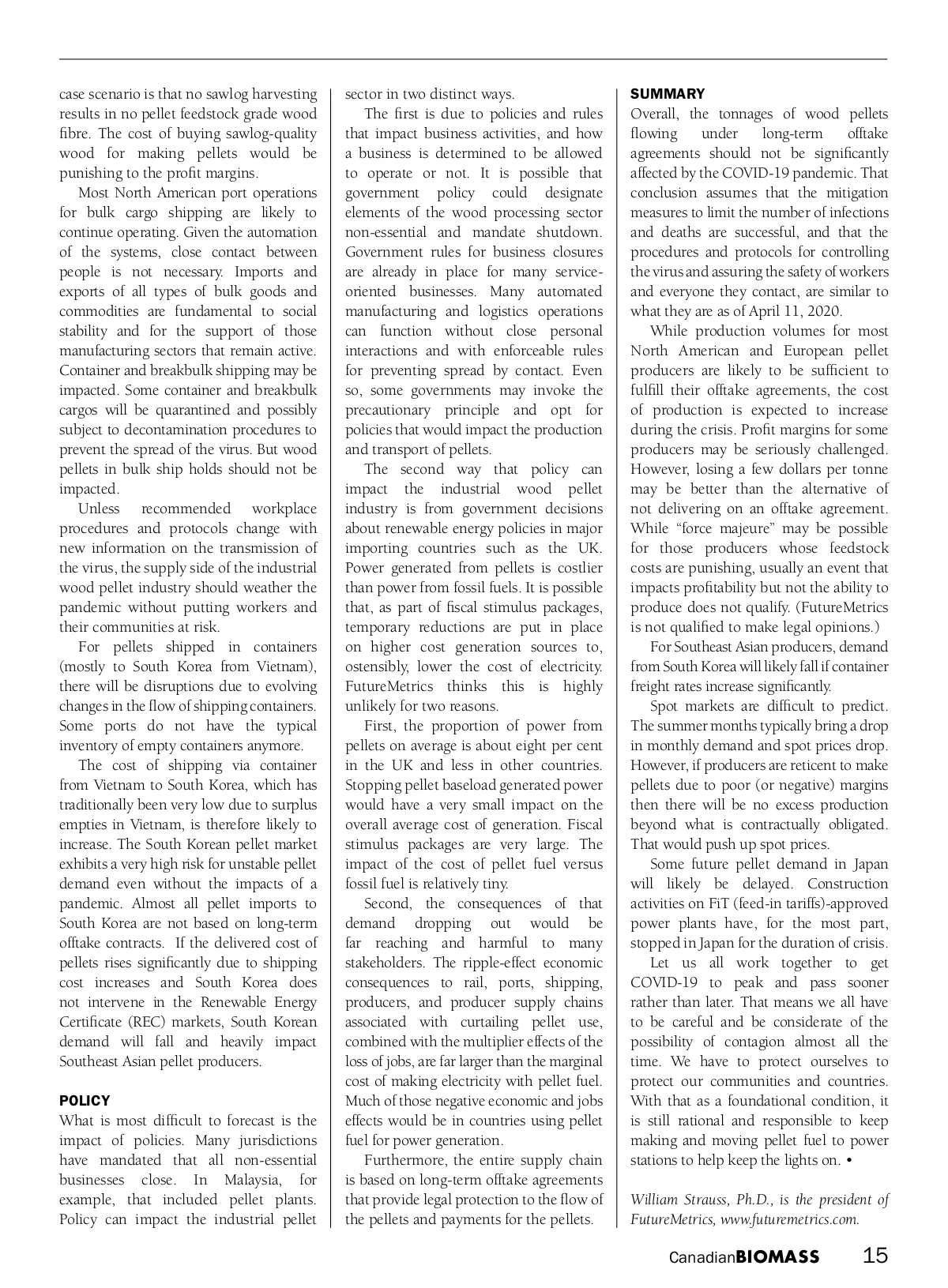
Markets Update COVID-19 unlikely to reduce demand for industrial wood pellets By William Strauss Pandemic pellets he COVID-19 pandemic is likely to cause a global economic depression. The magnitude and reach of this crisis are huge and will inevitably impact the industrial wood pellet industry. The two primary pathways for the evolution of this pandemic are: (1) The pandemic accelerates uncontrollably and millions of people die; or (2) The pandemic is attenuated by policies and rules restricting contact with other people that limits the spread of the disease and greatly reduces the number of deaths. Both pathways will shock national economies. If policies are aggressive and people are compliant, and if the rules are enforced, pathway 2 will limit the medical consequences. But there is no avoiding the economic consequences. DEMAND T However, the demand for industrial wood pellets is somewhat independent of drops in economic activity. Power demand will decline in a major economic slowdown, but the power generated by wood pellets in the key European, UK, and Japanese importing markets will have a place in the grid even if other sources such as natural gas have to turn down to meet lower aggregate electricity demand. The potential exception is South Korea (more below on South Korea). Backed by long-term offtake agreements, it is unlikely that fundamental demand for industrial wood pellets will decline significantly in the markets supplied by North American and European pellet producers as a result of the COVID-19 pandemic. However, as noted below, policy changes could impact demand. SUPPLY On the supply side, many highly automated wood processing plants such as sawmills and pellet mills should be able to operate without compromising worker safety or the safety of their families and their communities. FutureMetrics has spoken with several sawmills and pellet mills that have implemented protocols that allow operations to continue with no close personal contact and with comprehensive and continuous attention to working with and sanitizing at-risk surfaces. Lumber and wood pellet operations should be able to adapt to the current health guidelines and requirements with little impact on output and only a marginal increase in operational costs. The wood supply chain is dominated by machinery operated by single individuals. Sawmills and wood pellet plants are highly automated. For the operations and maintenance staff, social distancing and frequent hand sanitizing will be the new normal until the pandemic is quashed. Office staff may have to work remotely. In all cases, normal routines that include close social interaction will have to be changed. But it is likely that production of pellet fuel for export can continue. While the in-woods and transport logging operations should be able to continue to meet demand, many sawmilling operations will likely slow as lumber demand falls. Some pellet factories dependent on sawmill residuals will experience higher costs for alternative feedstocks or will have to move to lower production rates (or both). B.C. pellet mills are already using an increased proportion of forest residues due to unrelated changes in the sawmilling industry there. A drop in lumber demand will also impact the demand for sawlogs. Some of the roundwood on the upper part of the tree harvested for sawlogs is not suitable for conversion to lumber and typically goes to pulp and paper mills or pellet mills. A drop in sawlog demand will likely change the dynamics of supply and the cost of feedstock for pellet mills that depend on roundwood byproducts. The drop in sawlog demand may also impact the supply of forest residuals. A worst-SPRING 2020 14 Canadian BIOMASS
Canadian Biomass Spring 2020: Page 14