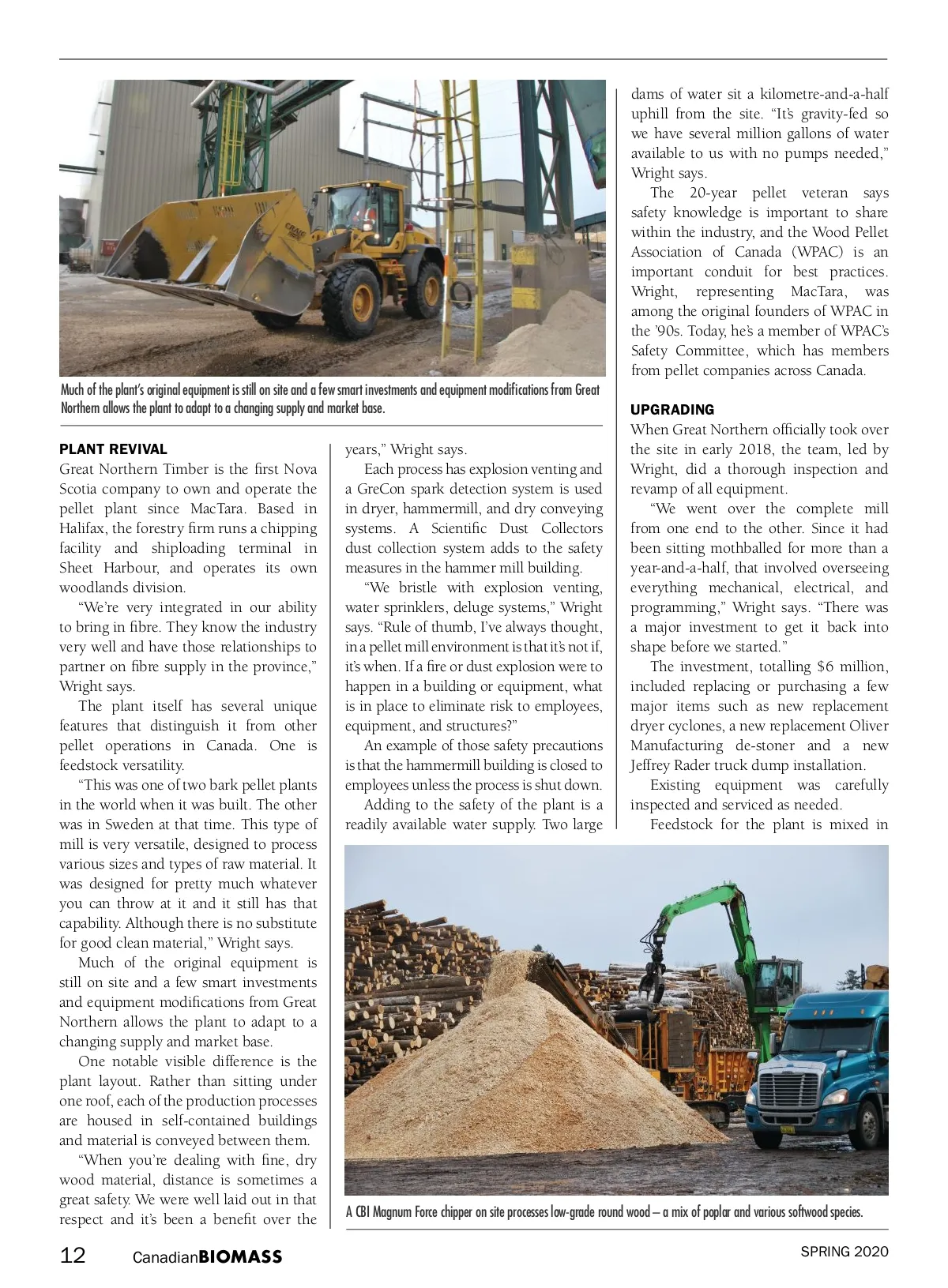
outdoor piles by Volvo wheel loaders and fed into a live floor infeed system. A separate infeed for hog fuel supplies bark to a GTS biomass burner (serviced by Sigma Thermal). Pellet feedstock is then fed up belt conveyors equipped with a belt magnet before heading to a Jeffery WB-66 hog. Homogenized fibre flows onto another conveyor which takes the material to the MEC drum dryer. Dried material passes through two de-stoners before it is processed through two 60-inch Andritz hammer mills. A series of screw conveyors transport the dry fibre to dry fibre bins over top of five Andritz pellet mills. Pellets are then conveyed by belt to the cooling building where a Law-Marot MilPro counter-flow cooler and screener are located. The final product is conveyed to overhead storage and loadout bins, ready for shipping. A CBI Magnum Force chipper on site is used to process low-grade round wood – a mix of poplar and various softwood species. Chips are then added to the pellet mix at the infeed. FUTURE PLANS Now that the plant is up and running at full capacity, with 27 staff members in place for a 24-hour operation, the team has been able to look at new ways to improve the process. A recent focus is lowering the pellet ash content to increase its production of premium pellets. “We’re in the middle of an ash reduction project on our furnace. We’re re-routing the air flow so we can better collect the dust and fines from the furnace,” Wright says. The equipment is already in place and the team was testing and measuring the results in February. Once the project is completed, the plant should be able to produce a much higher volume of premium wood pellets. The pellet plant is currently certified under ENplus/CANplus and SBP certification schemes. A fully equipped testing lab on site allows staff to continually check the quality of the pellets. That equipment includes two Ametek Max 5000XL ash analyzers, Ohaus moisture analyzers, and a test oven. Further plant improvements are on the horizon, Wright says. “There are always projects. We’re going to work at improving our process and our run time. We’ve done a good job on that already but there is always room for improvement,” he says. Support from Great Northern Timber Resources’ other branches – the woodlands division and the chipping and shipping facilities – is a huge component of the pellet plant’s new identity and will likely contribute to its future success. The company has deep roots in the province’s forestry community, and long-standing relationships with fibre suppliers such as sawmills and wood lot owners. In January, Nova Scotia’s forestry supply chain took a hit with the hibernation of Northern Pulp – a large pulp mill in Pictou County, N.S. In spite of this, Wright says he’s confident the supply chain will stabilize and Great Northern Timber will continue to play an important role in it. “I think we’re a good fit in the wider forestry industry here,” Wright says. • • 10’ x 45’ platform and 63° tilt • over-the-road transport • no foundation required 563-264-8066 airoflex.com • 45-ton lifting capacity • approximately 3 minute up-cycle time CB_Hoffman/Airoflex_Sprimg20_CSA.indd 1 Canadian BIOMASS 2020-03-27 3:13 PM 13
Canadian Biomass Spring 2020: Page 13