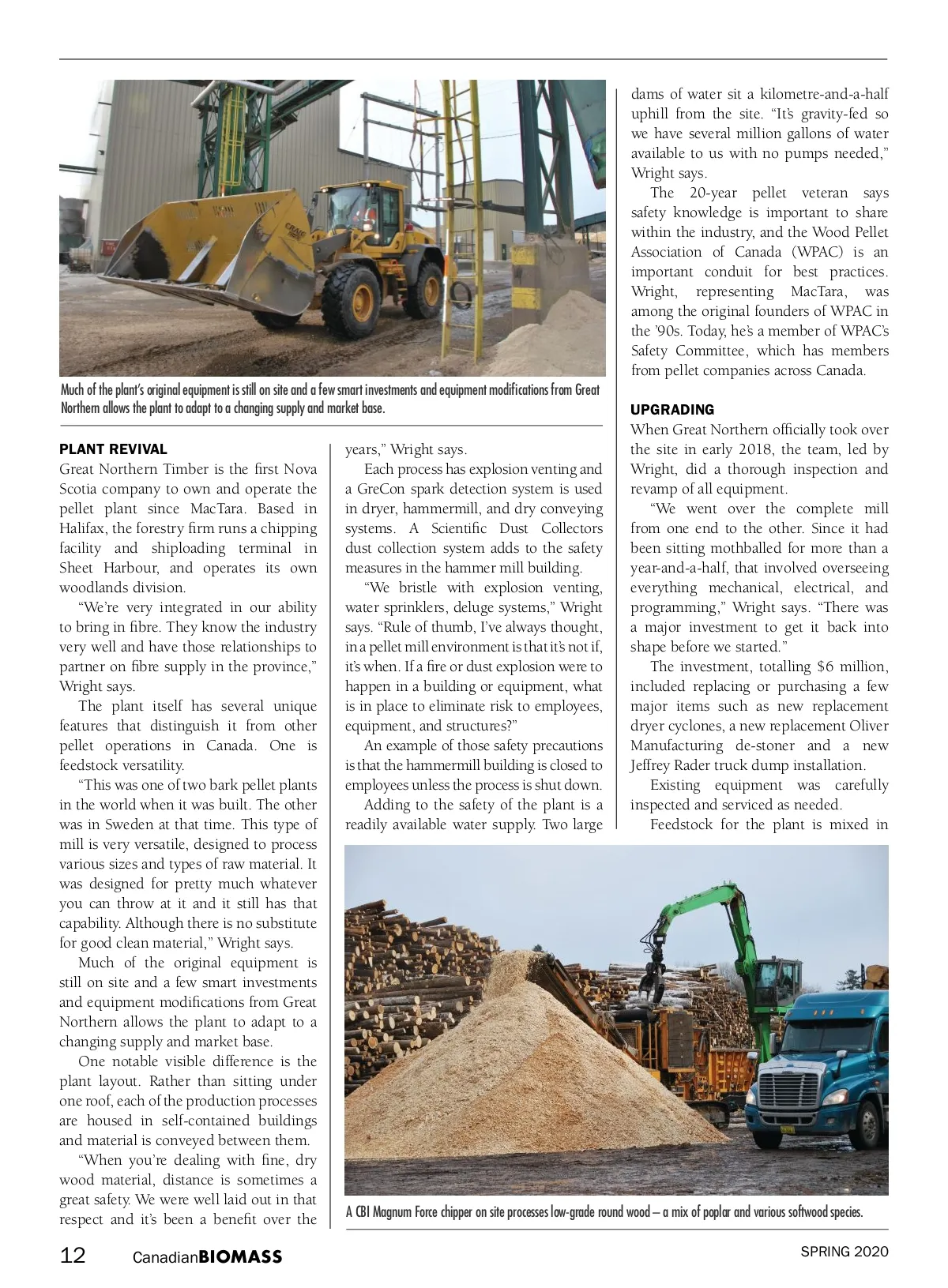
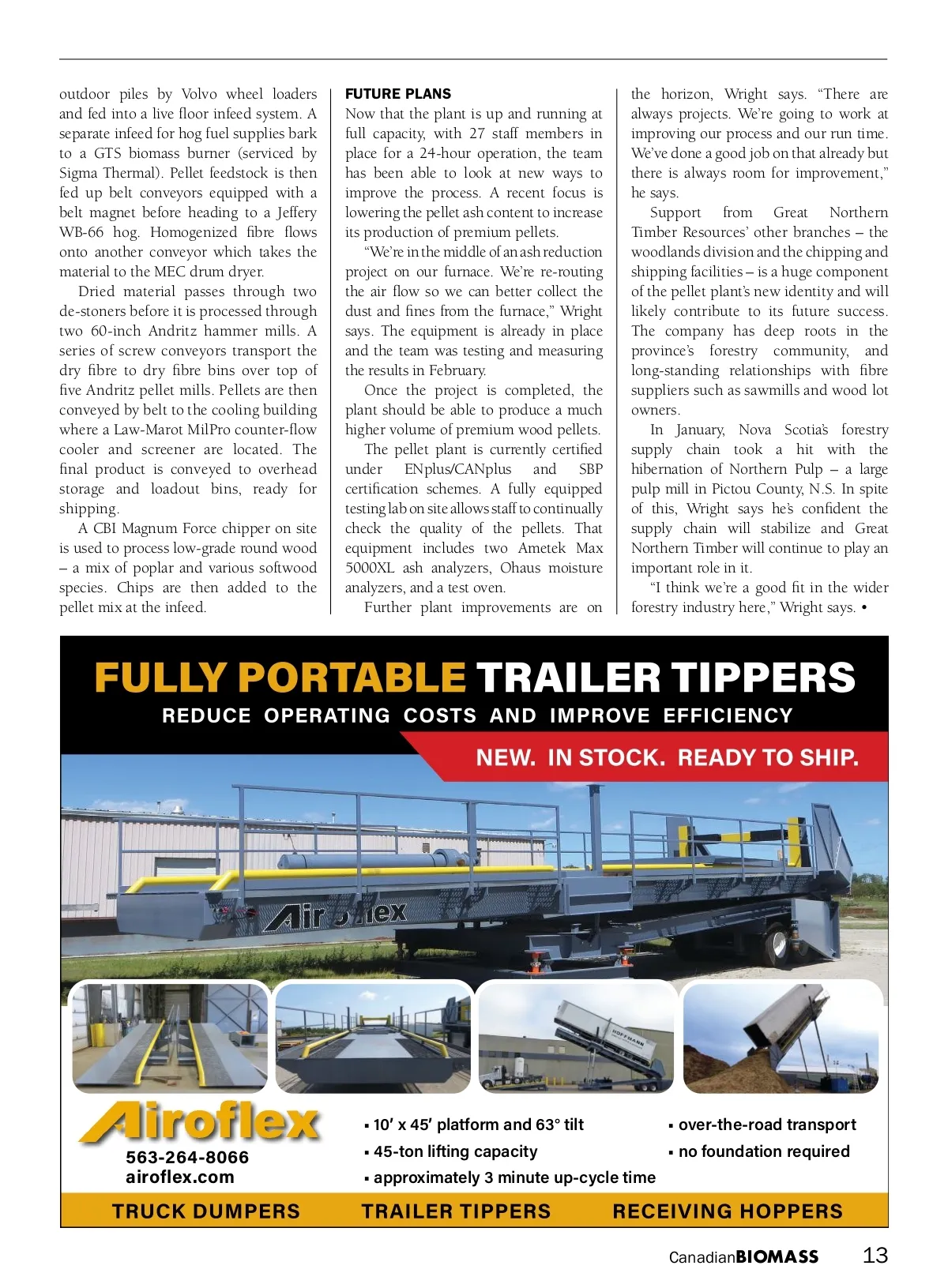
dams of water sit a kilometre-and-a-half uphill from the site. “It’s gravity-fed so we have several million gallons of water available to us with no pumps needed,” Wright says. The 20-year pellet veteran says safety knowledge is important to share within the industry, and the Wood Pellet Association of Canada (WPAC) is an important conduit for best practices. Wright, representing MacTara, was among the original founders of WPAC in the ’90s. Today, he’s a member of WPAC’s Safety Committee, which has members from pellet companies across Canada. Much of the plant’s original equipment is still on site and a few smart investments and equipment modifications from Great Northern allows the plant to adapt to a changing supply and market base. PLANT REVIVAL UPGRADING Great Northern Timber is the first Nova Scotia company to own and operate the pellet plant since MacTara. Based in Halifax, the forestry firm runs a chipping facility and shiploading terminal in Sheet Harbour, and operates its own woodlands division. “We’re very integrated in our ability to bring in fibre. They know the industry very well and have those relationships to partner on fibre supply in the province,” Wright says. The plant itself has several unique features that distinguish it from other pellet operations in Canada. One is feedstock versatility. “This was one of two bark pellet plants in the world when it was built. The other was in Sweden at that time. This type of mill is very versatile, designed to process various sizes and types of raw material. It was designed for pretty much whatever you can throw at it and it still has that capability. Although there is no substitute for good clean material,” Wright says. Much of the original equipment is still on site and a few smart investments and equipment modifications from Great Northern allows the plant to adapt to a changing supply and market base. One notable visible difference is the plant layout. Rather than sitting under one roof, each of the production processes are housed in self-contained buildings and material is conveyed between them. “When you’re dealing with fine, dry wood material, distance is sometimes a great safety. We were well laid out in that respect and it’s been a benefit over the years,” Wright says. Each process has explosion venting and a GreCon spark detection system is used in dryer, hammermill, and dry conveying systems. A Scientific Dust Collectors dust collection system adds to the safety measures in the hammer mill building. “We bristle with explosion venting, water sprinklers, deluge systems,” Wright says. “Rule of thumb, I’ve always thought, in a pellet mill environment is that it’s not if, it’s when. If a fire or dust explosion were to happen in a building or equipment, what is in place to eliminate risk to employees, equipment, and structures?” An example of those safety precautions is that the hammermill building is closed to employees unless the process is shut down. Adding to the safety of the plant is a readily available water supply. Two large When Great Northern officially took over the site in early 2018, the team, led by Wright, did a thorough inspection and revamp of all equipment. “We went over the complete mill from one end to the other. Since it had been sitting mothballed for more than a year-and-a-half, that involved overseeing everything mechanical, electrical, and programming,” Wright says. “There was a major investment to get it back into shape before we started.” The investment, totalling $6 million, included replacing or purchasing a few major items such as new replacement dryer cyclones, a new replacement Oliver Manufacturing de-stoner and a new Jeffrey Rader truck dump installation. Existing equipment was carefully inspected and serviced as needed. Feedstock for the plant is mixed in A CBI Magnum Force chipper on site processes low-grade round wood – a mix of poplar and various softwood species. SPRING 2020 12 Canadian BIOMASS
Canadian Biomass Spring 2020: Page 12