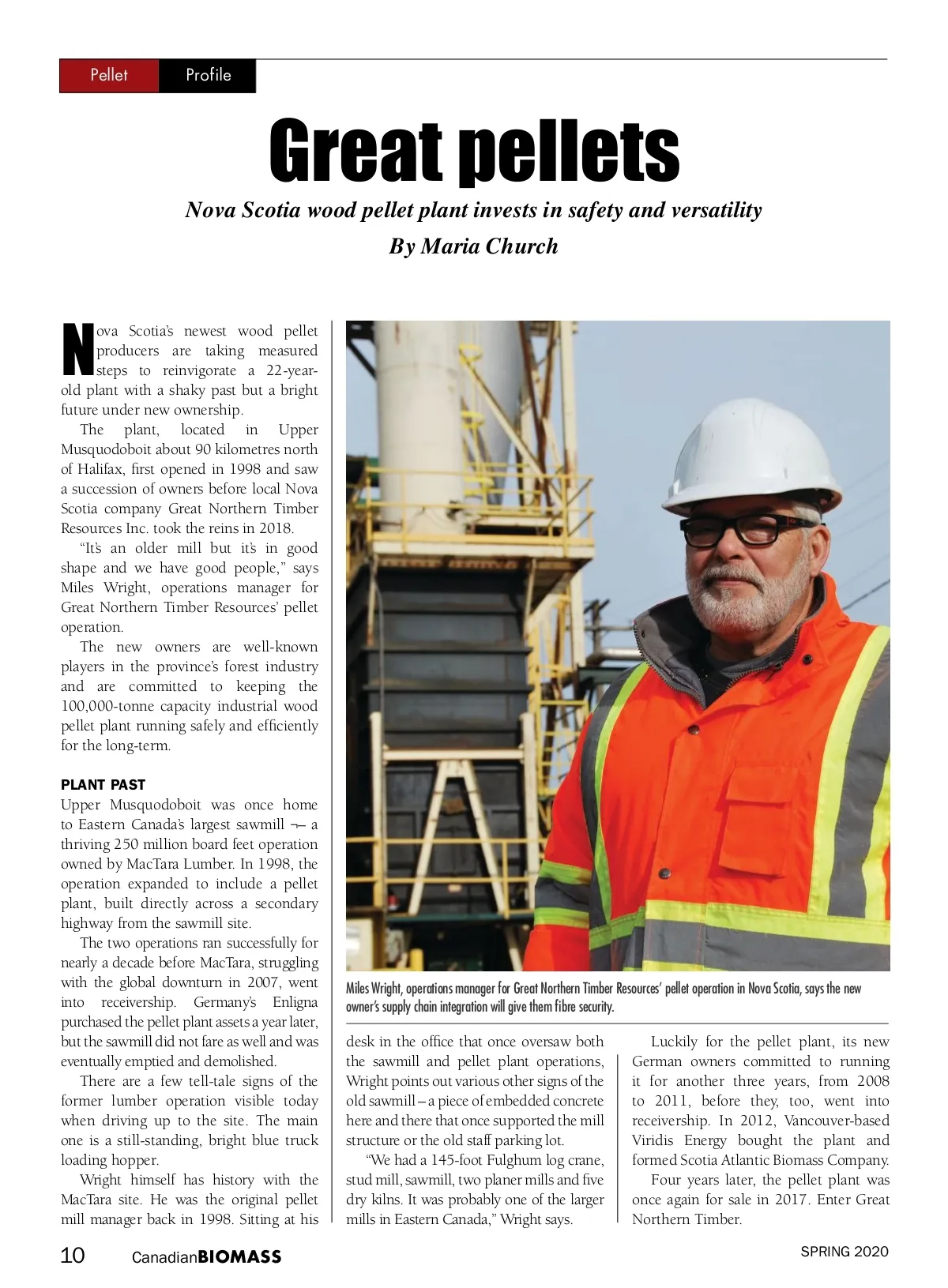
Pellet Profile Nova Scotia wood pellet plant invests in safety and versatility By Maria Church Great pellets N ova Scotia’s newest wood pellet producers are taking measured steps to reinvigorate a 22-year-old plant with a shaky past but a bright future under new ownership. The plant, located in Upper Musquodoboit about 90 kilometres north of Halifax, first opened in 1998 and saw a succession of owners before local Nova Scotia company Great Northern Timber Resources Inc. took the reins in 2018. “It’s an older mill but it’s in good shape and we have good people,” says Miles Wright, operations manager for Great Northern Timber Resources’ pellet operation. The new owners are well-known players in the province’s forest industry and are committed to keeping the 100,000-tonne capacity industrial wood pellet plant running safely and efficiently for the long-term. PLANT PAST Upper Musquodoboit was once home to Eastern Canada’s largest sawmill ¬– a thriving 250 million board feet operation owned by MacTara Lumber. In 1998, the operation expanded to include a pellet plant, built directly across a secondary highway from the sawmill site. The two operations ran successfully for nearly a decade before MacTara, struggling with the global downturn in 2007, went into receivership. Germany’s Enligna purchased the pellet plant assets a year later, but the sawmill did not fare as well and was eventually emptied and demolished. There are a few tell-tale signs of the former lumber operation visible today when driving up to the site. The main one is a still-standing, bright blue truck loading hopper. Wright himself has history with the MacTara site. He was the original pellet mill manager back in 1998. Sitting at his Miles Wright, operations manager for Great Northern Timber Resources’ pellet operation in Nova Scotia, says the new owner’s supply chain integration will give them fibre security. desk in the office that once oversaw both the sawmill and pellet plant operations, Wright points out various other signs of the old sawmill – a piece of embedded concrete here and there that once supported the mill structure or the old staff parking lot. “We had a 145-foot Fulghum log crane, stud mill, sawmill, two planer mills and five dry kilns. It was probably one of the larger mills in Eastern Canada,” Wright says. Luckily for the pellet plant, its new German owners committed to running it for another three years, from 2008 to 2011, before they, too, went into receivership. In 2012, Vancouver-based Viridis Energy bought the plant and formed Scotia Atlantic Biomass Company. Four years later, the pellet plant was once again for sale in 2017. Enter Great Northern Timber. SPRING 2020 10 Canadian BIOMASS
Canadian Biomass Spring 2020: Page 10