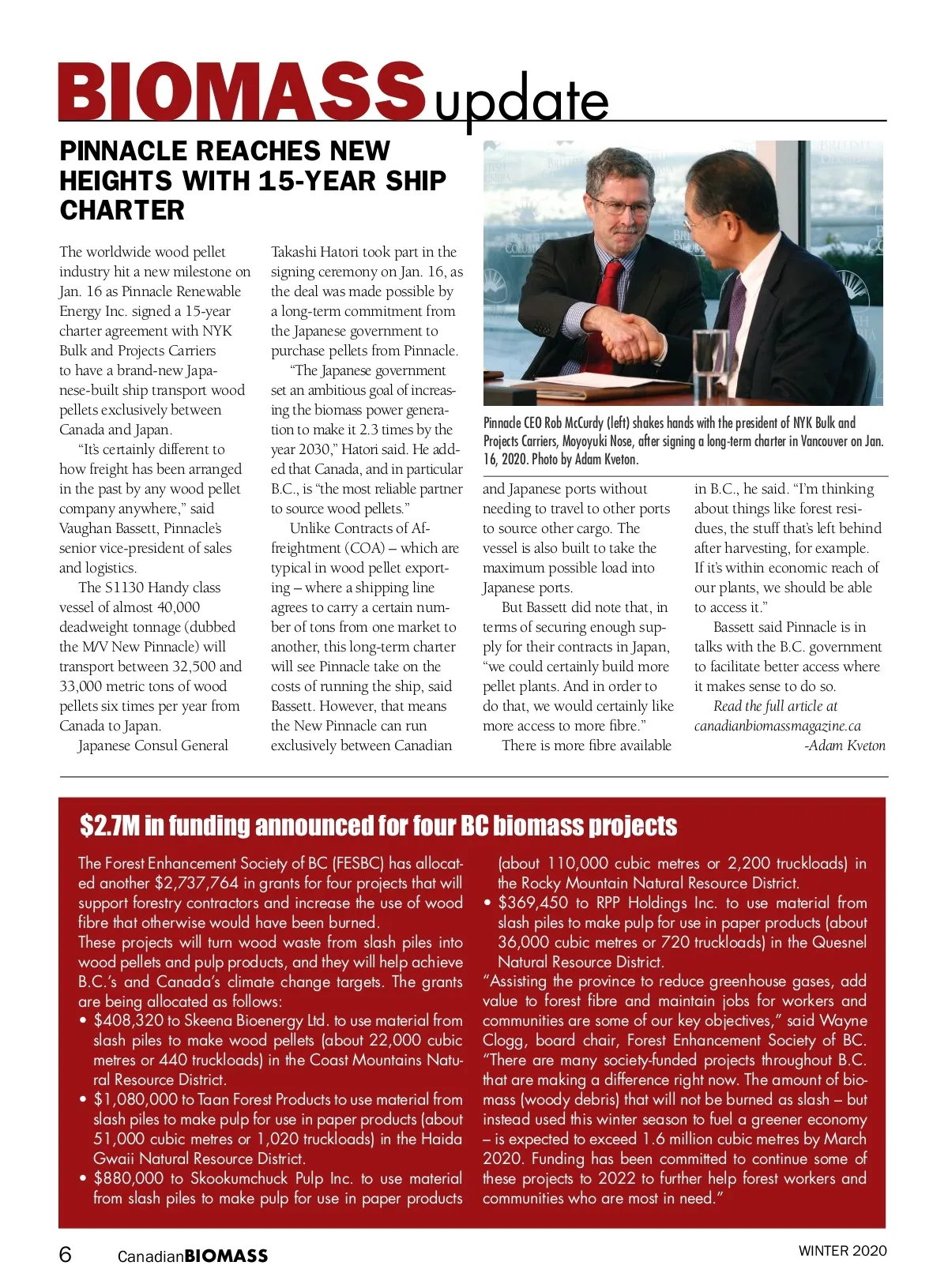
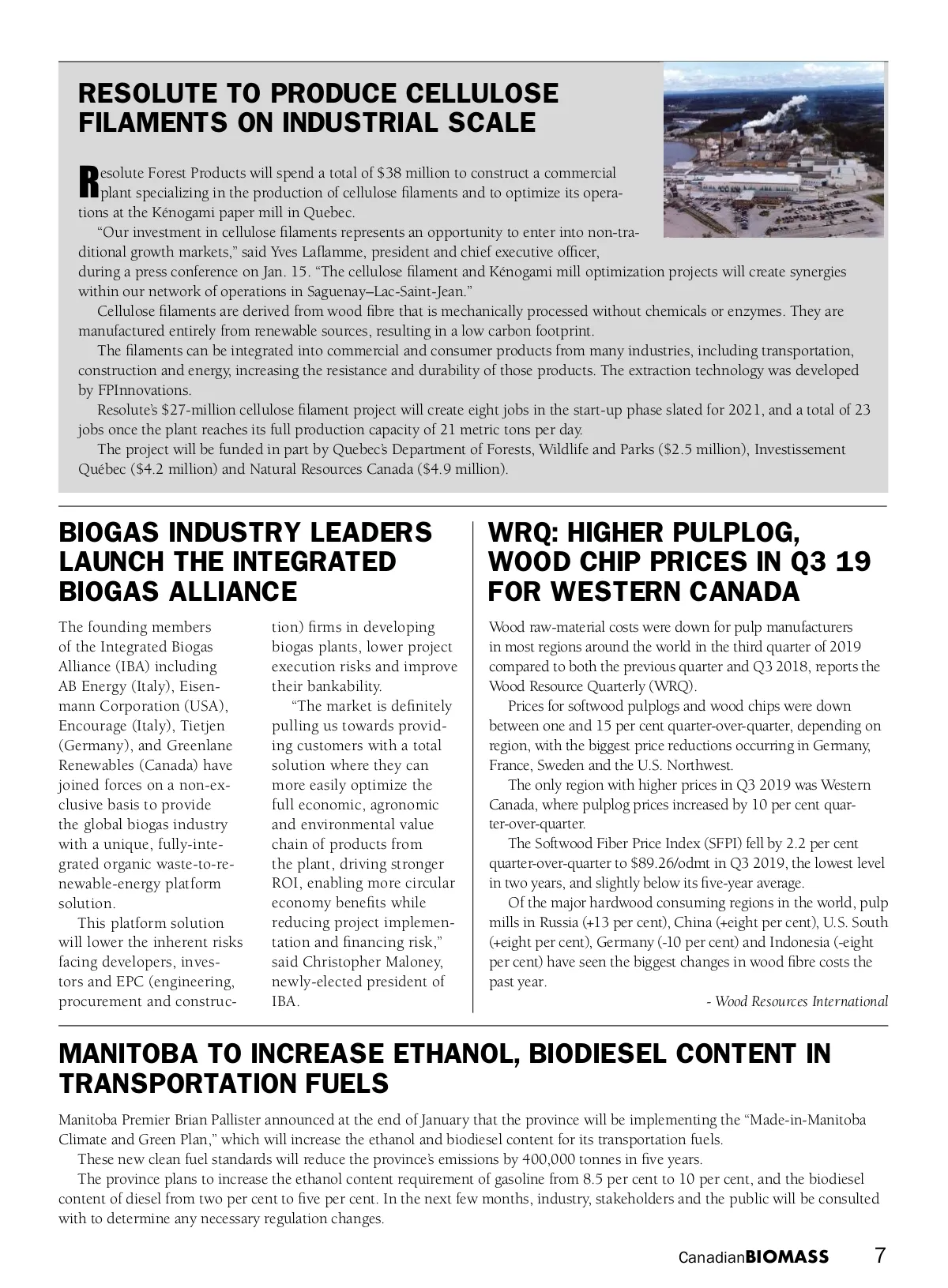
RESOLUTE TO PRODUCE CELLULOSE FILAMENTS ON INDUSTRIAL SCALE R esolute Forest Products will spend a total of $38 million to construct a commercial plant specializing in the production of cellulose filaments and to optimize its opera-tions at the Kénogami paper mill in Quebec. “Our investment in cellulose filaments represents an opportunity to enter into non-tra-ditional growth markets,” said Yves Laflamme, president and chief executive officer, during a press conference on Jan. 15. “The cellulose filament and Kénogami mill optimization projects will create synergies within our network of operations in Saguenay–Lac-Saint-Jean.” Cellulose filaments are derived from wood fibre that is mechanically processed without chemicals or enzymes. They are manufactured entirely from renewable sources, resulting in a low carbon footprint. The filaments can be integrated into commercial and consumer products from many industries, including transportation, construction and energy, increasing the resistance and durability of those products. The extraction technology was developed by FPInnovations. Resolute’s $27-million cellulose filament project will create eight jobs in the start-up phase slated for 2021, and a total of 23 jobs once the plant reaches its full production capacity of 21 metric tons per day. The project will be funded in part by Quebec’s Department of Forests, Wildlife and Parks ($2.5 million), Investissement Québec ($4.2 million) and Natural Resources Canada ($4.9 million). BIOGAS INDUSTRY LEADERS LAUNCH THE INTEGRATED BIOGAS ALLIANCE The founding members of the Integrated Biogas Alliance (IBA) including AB Energy (Italy), Eisen-mann Corporation (USA), Encourage (Italy), Tietjen (Germany), and Greenlane Renewables (Canada) have joined forces on a non-ex-clusive basis to provide the global biogas industry with a unique, fully-inte-grated organic waste-to-re-newable-energy platform solution. This platform solution will lower the inherent risks facing developers, inves-tors and EPC (engineering, procurement and construc-tion) firms in developing biogas plants, lower project execution risks and improve their bankability. “The market is definitely pulling us towards provid-ing customers with a total solution where they can more easily optimize the full economic, agronomic and environmental value chain of products from the plant, driving stronger ROI, enabling more circular economy benefits while reducing project implemen-tation and financing risk,” said Christopher Maloney, newly-elected president of IBA. WRQ: HIGHER PULPLOG, WOOD CHIP PRICES IN Q3 19 FOR WESTERN CANADA Wood raw-material costs were down for pulp manufacturers in most regions around the world in the third quarter of 2019 compared to both the previous quarter and Q3 2018, reports the Wood Resource Quarterly (WRQ). Prices for softwood pulplogs and wood chips were down between one and 15 per cent quarter-over-quarter, depending on region, with the biggest price reductions occurring in Germany, France, Sweden and the U.S. Northwest. The only region with higher prices in Q3 2019 was Western Canada, where pulplog prices increased by 10 per cent quar-ter-over-quarter. The Softwood Fiber Price Index (SFPI) fell by 2.2 per cent quarter-over-quarter to $89.26/odmt in Q3 2019, the lowest level in two years, and slightly below its five-year average. Of the major hardwood consuming regions in the world, pulp mills in Russia (+13 per cent), China (+eight per cent), U.S. South (+eight per cent), Germany (-10 per cent) and Indonesia (-eight per cent) have seen the biggest changes in wood fibre costs the past year. -Wood Resources International MANITOBA TO INCREASE ETHANOL, BIODIESEL CONTENT IN TRANSPORTATION FUELS Manitoba Premier Brian Pallister announced at the end of January that the province will be implementing the “Made-in-Manitoba Climate and Green Plan,” which will increase the ethanol and biodiesel content for its transportation fuels. These new clean fuel standards will reduce the province’s emissions by 400,000 tonnes in five years. The province plans to increase the ethanol content requirement of gasoline from 8.5 per cent to 10 per cent, and the biodiesel content of diesel from two per cent to five per cent. In the next few months, industry, stakeholders and the public will be consulted with to determine any necessary regulation changes. Canadian BIOMASS 7
Canadian Biomass Winter 2020: Page 7