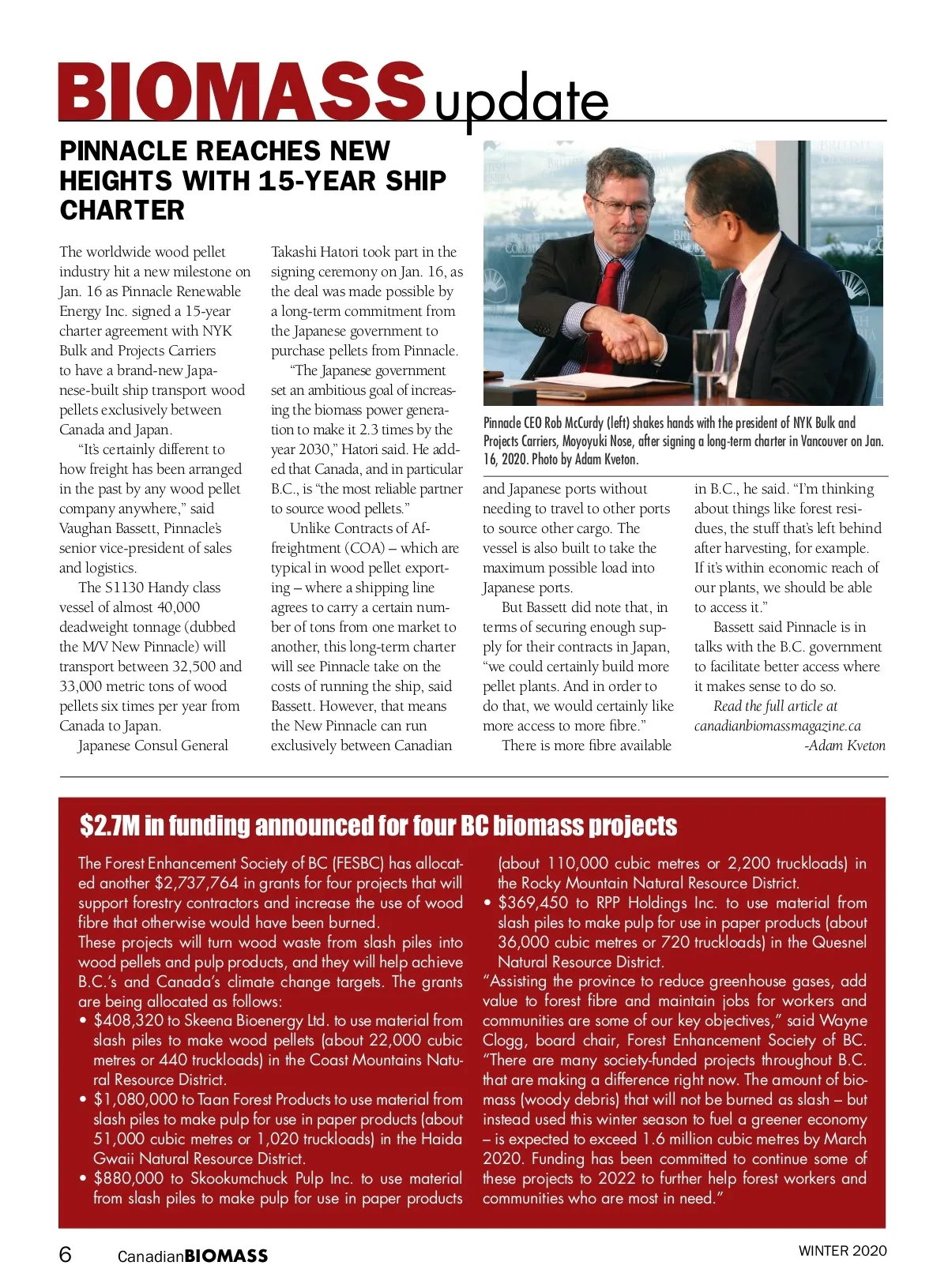
PINNACLE REACHES NEW HEIGHTS WITH 15-YEAR SHIP CHARTER The worldwide wood pellet industry hit a new milestone on Jan. 16 as Pinnacle Renewable Energy Inc. signed a 15-year charter agreement with NYK Bulk and Projects Carriers to have a brand-new Japa-nese-built ship transport wood pellets exclusively between Canada and Japan. “It’s certainly different to how freight has been arranged in the past by any wood pellet company anywhere,” said Vaughan Bassett, Pinnacle’s senior vice-president of sales and logistics. The S1130 Handy class vessel of almost 40,000 deadweight tonnage (dubbed the M/V New Pinnacle) will transport between 32,500 and 33,000 metric tons of wood pellets six times per year from Canada to Japan. Japanese Consul General Takashi Hatori took part in the signing ceremony on Jan. 16, as the deal was made possible by a long-term commitment from the Japanese government to purchase pellets from Pinnacle. “The Japanese government set an ambitious goal of increas-ing the biomass power genera-tion to make it 2.3 times by the year 2030,” Hatori said. He add-ed that Canada, and in particular B.C., is “the most reliable partner to source wood pellets.” Unlike Contracts of Af-freightment (COA) – which are typical in wood pellet export-ing – where a shipping line agrees to carry a certain num-ber of tons from one market to another, this long-term charter will see Pinnacle take on the costs of running the ship, said Bassett. However, that means the New Pinnacle can run exclusively between Canadian Pinnacle CEO Rob McCurdy (left) shakes hands with the president of NYK Bulk and Projects Carriers, Moyoyuki Nose, after signing a long-term charter in Vancouver on Jan. 16, 2020. Photo by Adam Kveton. and Japanese ports without needing to travel to other ports to source other cargo. The vessel is also built to take the maximum possible load into Japanese ports. But Bassett did note that, in terms of securing enough sup-ply for their contracts in Japan, “we could certainly build more pellet plants. And in order to do that, we would certainly like more access to more fibre.” There is more fibre available in B.C., he said. “I’m thinking about things like forest resi-dues, the stuff that’s left behind after harvesting, for example. If it’s within economic reach of our plants, we should be able to access it.” Bassett said Pinnacle is in talks with the B.C. government to facilitate better access where it makes sense to do so. Read the full article at canadianbiomassmagazine.ca -Adam Kveton $2.7M in funding announced for four BC biomass projects The Forest Enhancement Society of BC (FESBC) has allocat-ed another $2,737,764 in grants for four projects that will support forestry contractors and increase the use of wood fibre that otherwise would have been burned. These projects will turn wood waste from slash piles into wood pellets and pulp products, and they will help achieve B.C.’s and Canada’s climate change targets. The grants are being allocated as follows: • $408,320 to Skeena Bioenergy Ltd. to use material from slash piles to make wood pellets (about 22,000 cubic metres or 440 truckloads) in the Coast Mountains Natu-ral Resource District. • $1,080,000 to Taan Forest Products to use material from slash piles to make pulp for use in paper products (about 51,000 cubic metres or 1,020 truckloads) in the Haida Gwaii Natural Resource District. • $880,000 to Skookumchuck Pulp Inc. to use material from slash piles to make pulp for use in paper products (about 110,000 cubic metres or 2,200 truckloads) in the Rocky Mountain Natural Resource District. • $369,450 to RPP Holdings Inc. to use material from slash piles to make pulp for use in paper products (about 36,000 cubic metres or 720 truckloads) in the Quesnel Natural Resource District. “Assisting the province to reduce greenhouse gases, add value to forest fibre and maintain jobs for workers and communities are some of our key objectives,” said Wayne Clogg, board chair, Forest Enhancement Society of BC. “There are many society-funded projects throughout B.C. that are making a difference right now. The amount of bio-mass (woody debris) that will not be burned as slash – but instead used this winter season to fuel a greener economy – is expected to exceed 1.6 million cubic metres by March 2020. Funding has been committed to continue some of these projects to 2022 to further help forest workers and communities who are most in need.” WINTER 2020 6 Canadian BIOMASS
Canadian Biomass Winter 2020: Page 6