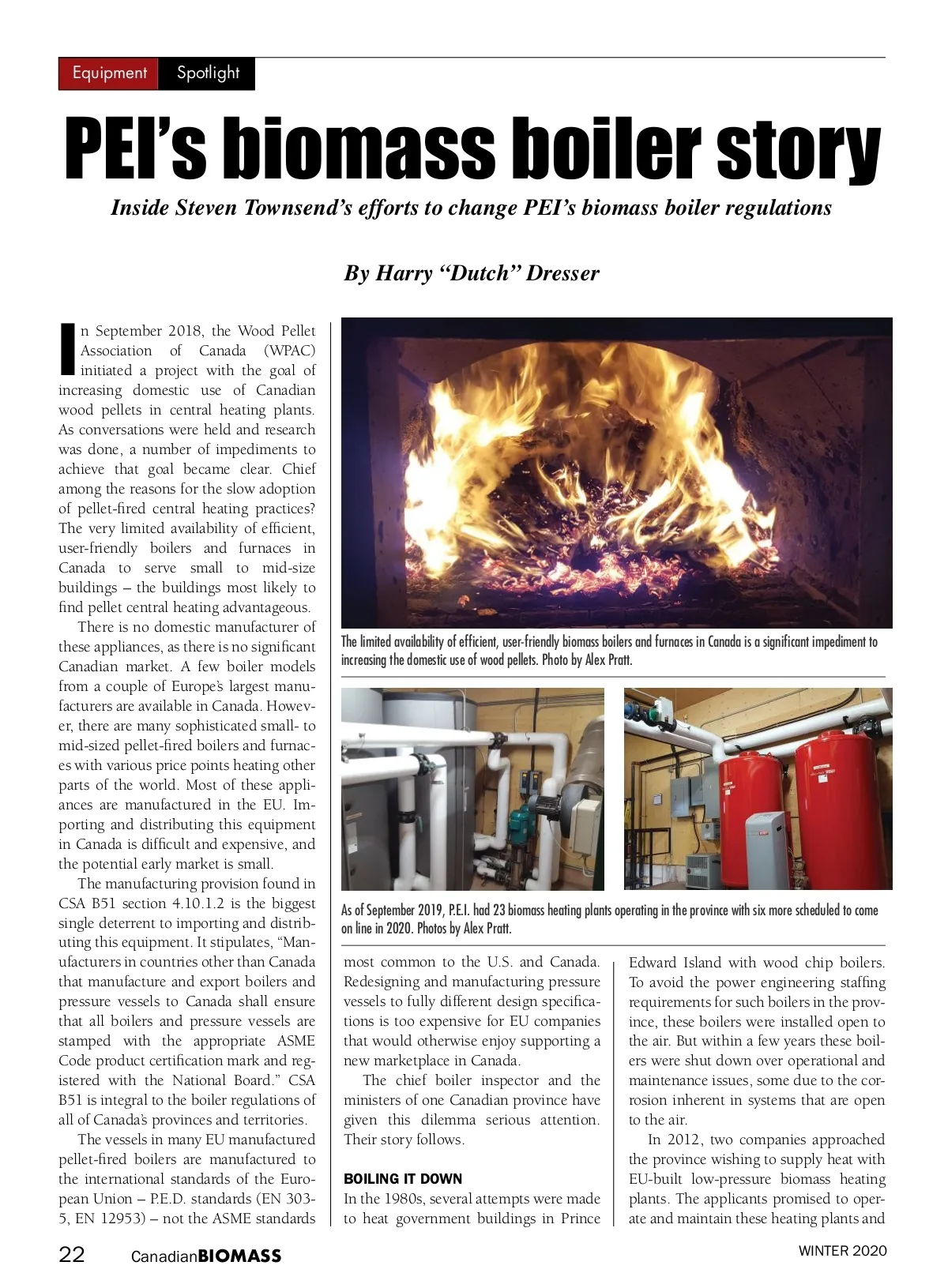
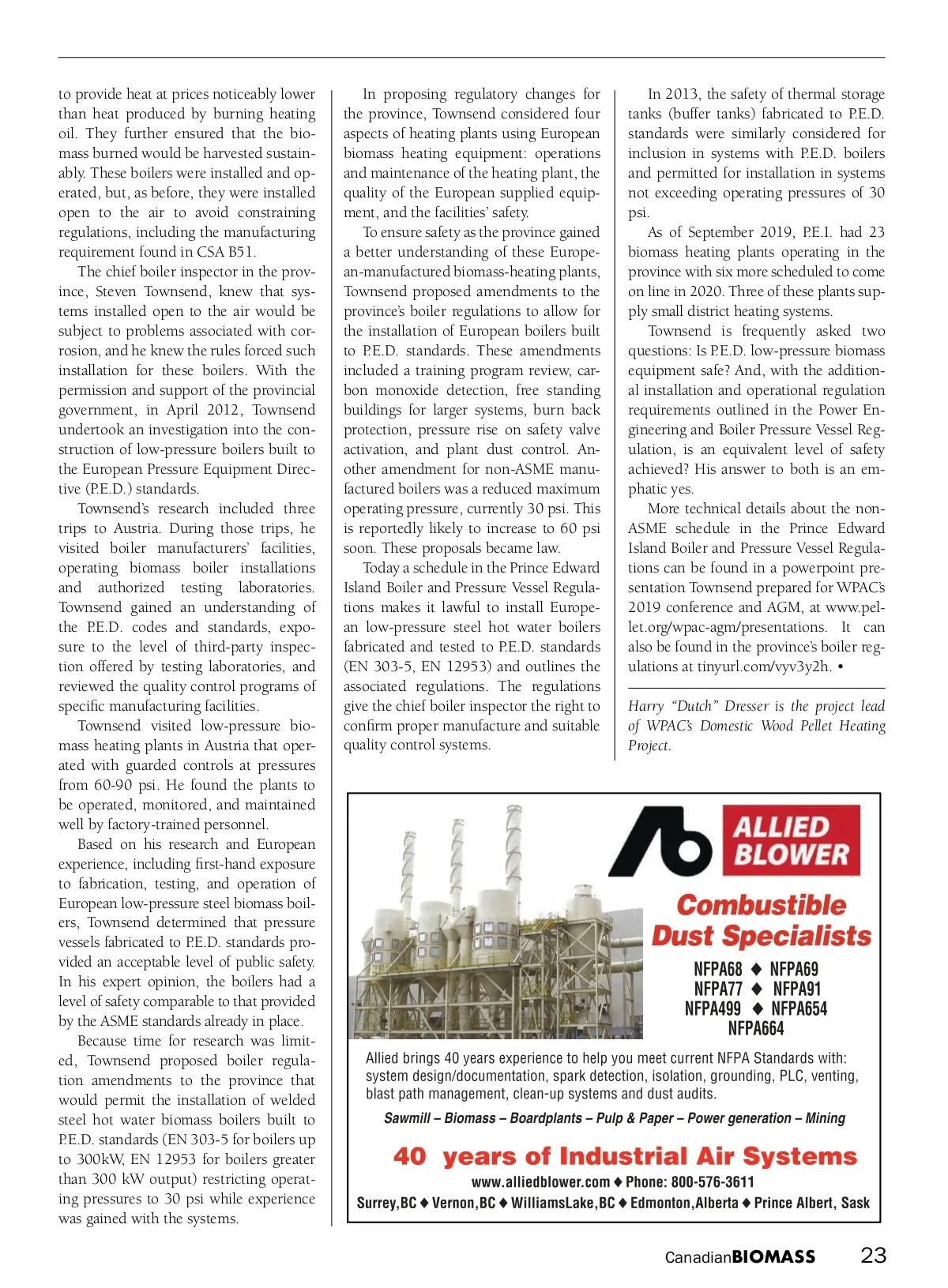
Equipment Spotlight PEI’s biomass boiler story Inside Steven Townsend’s efforts to change PEI’s biomass boiler regulations By Harry “Dutch” Dresser n September 2018, the Wood Pellet Association of Canada (WPAC) initiated a project with the goal of increasing domestic use of Canadian wood pellets in central heating plants. As conversations were held and research was done, a number of impediments to achieve that goal became clear. Chief among the reasons for the slow adoption of pellet-fired central heating practices? The very limited availability of efficient, user-friendly boilers and furnaces in Canada to serve small to mid-size buildings – the buildings most likely to find pellet central heating advantageous. There is no domestic manufacturer of these appliances, as there is no significant Canadian market. A few boiler models from a couple of Europe’s largest manu-facturers are available in Canada. Howev-er, there are many sophisticated small-to mid-sized pellet-fired boilers and furnac-es with various price points heating other parts of the world. Most of these appli-ances are manufactured in the EU. Im-porting and distributing this equipment in Canada is difficult and expensive, and the potential early market is small. The manufacturing provision found in CSA B51 section 4.10.1.2 is the biggest single deterrent to importing and distrib-uting this equipment. It stipulates, “Man-ufacturers in countries other than Canada that manufacture and export boilers and pressure vessels to Canada shall ensure that all boilers and pressure vessels are stamped with the appropriate ASME Code product certification mark and reg-istered with the National Board.” CSA B51 is integral to the boiler regulations of all of Canada’s provinces and territories. The vessels in many EU manufactured pellet-fired boilers are manufactured to the international standards of the Euro-pean Union – P.E.D. standards (EN 303-5, EN 12953) – not the ASME standards I The limited availability of efficient, user-friendly biomass boilers and furnaces in Canada is a significant impediment to increasing the domestic use of wood pellets. Photo by Alex Pratt. As of September 2019, P.E.I. had 23 biomass heating plants operating in the province with six more scheduled to come on line in 2020. Photos by Alex Pratt. most common to the U.S. and Canada. Redesigning and manufacturing pressure vessels to fully different design specifica-tions is too expensive for EU companies that would otherwise enjoy supporting a new marketplace in Canada. The chief boiler inspector and the ministers of one Canadian province have given this dilemma serious attention. Their story follows. BOILING IT DOWN In the 1980s, several attempts were made to heat government buildings in Prince Edward Island with wood chip boilers. To avoid the power engineering staffing requirements for such boilers in the prov-ince, these boilers were installed open to the air. But within a few years these boil-ers were shut down over operational and maintenance issues, some due to the cor-rosion inherent in systems that are open to the air. In 2012, two companies approached the province wishing to supply heat with EU-built low-pressure biomass heating plants. The applicants promised to oper-ate and maintain these heating plants and WINTER 2020 22 Canadian BIOMASS
Canadian Biomass Winter 2020: Page 22