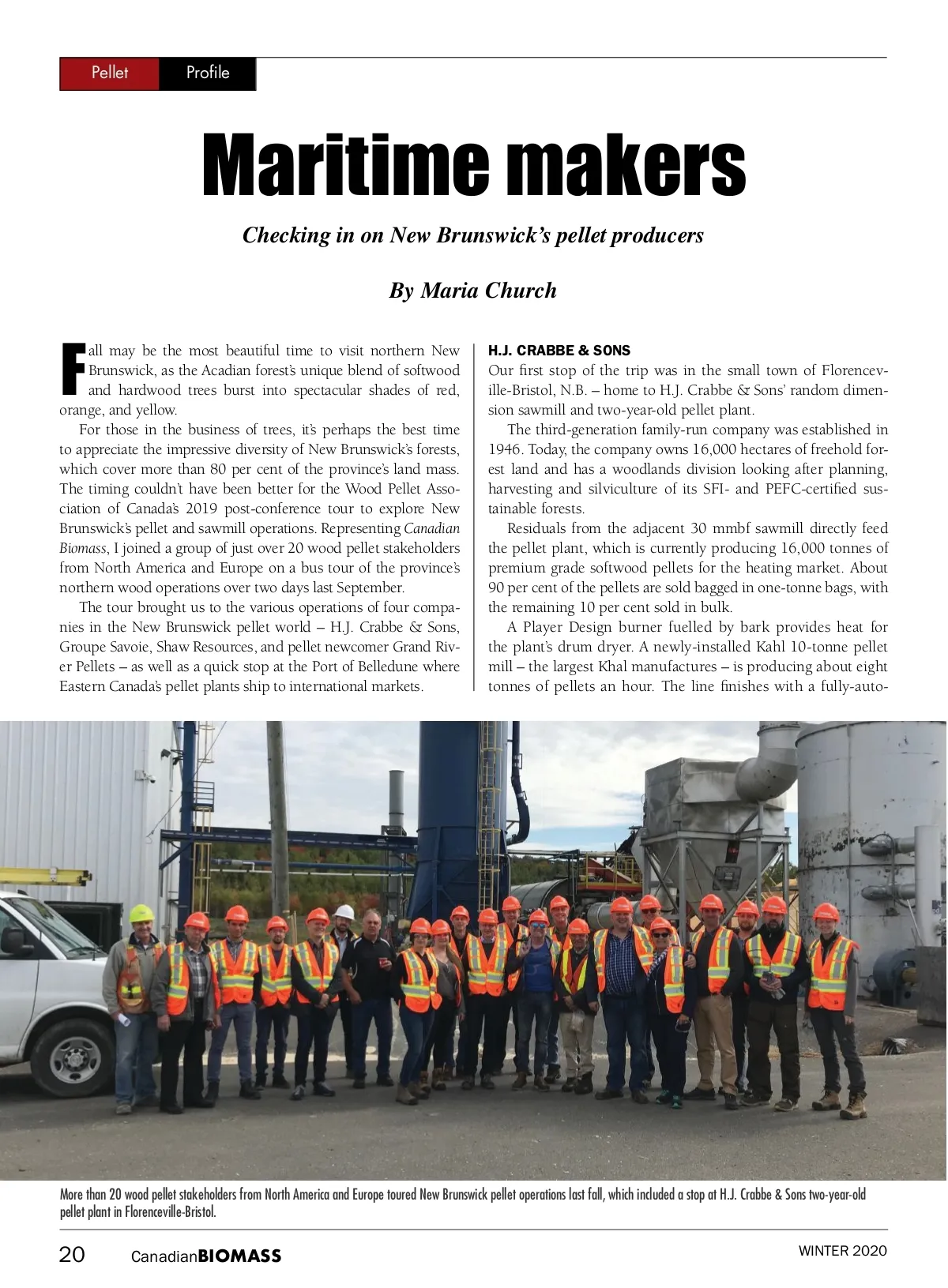
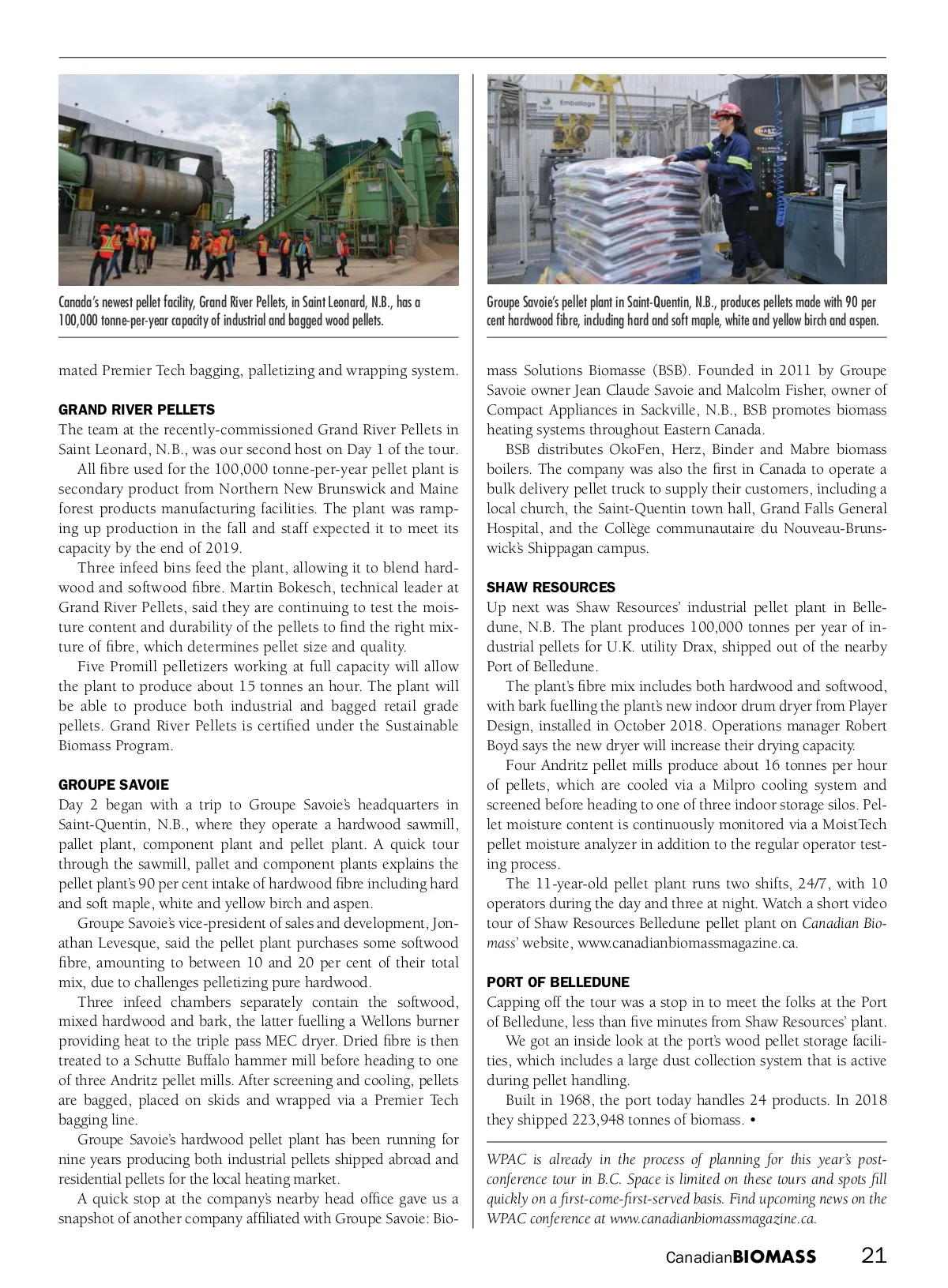
Canada’s newest pellet facility, Grand River Pellets, in Saint Leonard, N.B., has a 100,000 tonne-per-year capacity of industrial and bagged wood pellets. Groupe Savoie’s pellet plant in Saint-Quentin, N.B., produces pellets made with 90 per cent hardwood fibre, including hard and soft maple, white and yellow birch and aspen. mated Premier Tech bagging, palletizing and wrapping system. GRAND RIVER PELLETS The team at the recently-commissioned Grand River Pellets in Saint Leonard, N.B., was our second host on Day 1 of the tour. All fibre used for the 100,000 tonne-per-year pellet plant is secondary product from Northern New Brunswick and Maine forest products manufacturing facilities. The plant was ramp-ing up production in the fall and staff expected it to meet its capacity by the end of 2019. Three infeed bins feed the plant, allowing it to blend hard-wood and softwood fibre. Martin Bokesch, technical leader at Grand River Pellets, said they are continuing to test the mois-ture content and durability of the pellets to find the right mix-ture of fibre, which determines pellet size and quality. Five Promill pelletizers working at full capacity will allow the plant to produce about 15 tonnes an hour. The plant will be able to produce both industrial and bagged retail grade pellets. Grand River Pellets is certified under the Sustainable Biomass Program. GROUPE SAVOIE mass Solutions Biomasse (BSB). Founded in 2011 by Groupe Savoie owner Jean Claude Savoie and Malcolm Fisher, owner of Compact Appliances in Sackville, N.B., BSB promotes biomass heating systems throughout Eastern Canada. BSB distributes OkoFen, Herz, Binder and Mabre biomass boilers. The company was also the first in Canada to operate a bulk delivery pellet truck to supply their customers, including a local church, the Saint-Quentin town hall, Grand Falls General Hospital, and the Collège communautaire du Nouveau-Bruns-wick’s Shippagan campus. SHAW RESOURCES Day 2 began with a trip to Groupe Savoie’s headquarters in Saint-Quentin, N.B., where they operate a hardwood sawmill, pallet plant, component plant and pellet plant. A quick tour through the sawmill, pallet and component plants explains the pellet plant’s 90 per cent intake of hardwood fibre including hard and soft maple, white and yellow birch and aspen. Groupe Savoie’s vice-president of sales and development, Jon-athan Levesque, said the pellet plant purchases some softwood fibre, amounting to between 10 and 20 per cent of their total mix, due to challenges pelletizing pure hardwood. Three infeed chambers separately contain the softwood, mixed hardwood and bark, the latter fuelling a Wellons burner providing heat to the triple pass MEC dryer. Dried fibre is then treated to a Schutte Buffalo hammer mill before heading to one of three Andritz pellet mills. After screening and cooling, pellets are bagged, placed on skids and wrapped via a Premier Tech bagging line. Groupe Savoie’s hardwood pellet plant has been running for nine years producing both industrial pellets shipped abroad and residential pellets for the local heating market. A quick stop at the company’s nearby head office gave us a snapshot of another company affiliated with Groupe Savoie: Bio-Up next was Shaw Resources’ industrial pellet plant in Belle-dune, N.B. The plant produces 100,000 tonnes per year of in-dustrial pellets for U.K. utility Drax, shipped out of the nearby Port of Belledune. The plant’s fibre mix includes both hardwood and softwood, with bark fuelling the plant’s new indoor drum dryer from Player Design, installed in October 2018. Operations manager Robert Boyd says the new dryer will increase their drying capacity. Four Andritz pellet mills produce about 16 tonnes per hour of pellets, which are cooled via a Milpro cooling system and screened before heading to one of three indoor storage silos. Pel-let moisture content is continuously monitored via a MoistTech pellet moisture analyzer in addition to the regular operator test-ing process. The 11-year-old pellet plant runs two shifts, 24/7, with 10 operators during the day and three at night. Watch a short video tour of Shaw Resources Belledune pellet plant on Canadian Bio-mass ’ website, www.canadianbiomassmagazine.ca. PORT OF BELLEDUNE Capping off the tour was a stop in to meet the folks at the Port of Belledune, less than five minutes from Shaw Resources’ plant. We got an inside look at the port’s wood pellet storage facili-ties, which includes a large dust collection system that is active during pellet handling. Built in 1968, the port today handles 24 products. In 2018 they shipped 223,948 tonnes of biomass. • WPAC is already in the process of planning for this year’s post-conference tour in B.C. Space is limited on these tours and spots fill quickly on a first-come-first-served basis. Find upcoming news on the WPAC conference at www.canadianbiomassmagazine.ca. Canadian BIOMASS 21
Canadian Biomass Winter 2020: Page 21