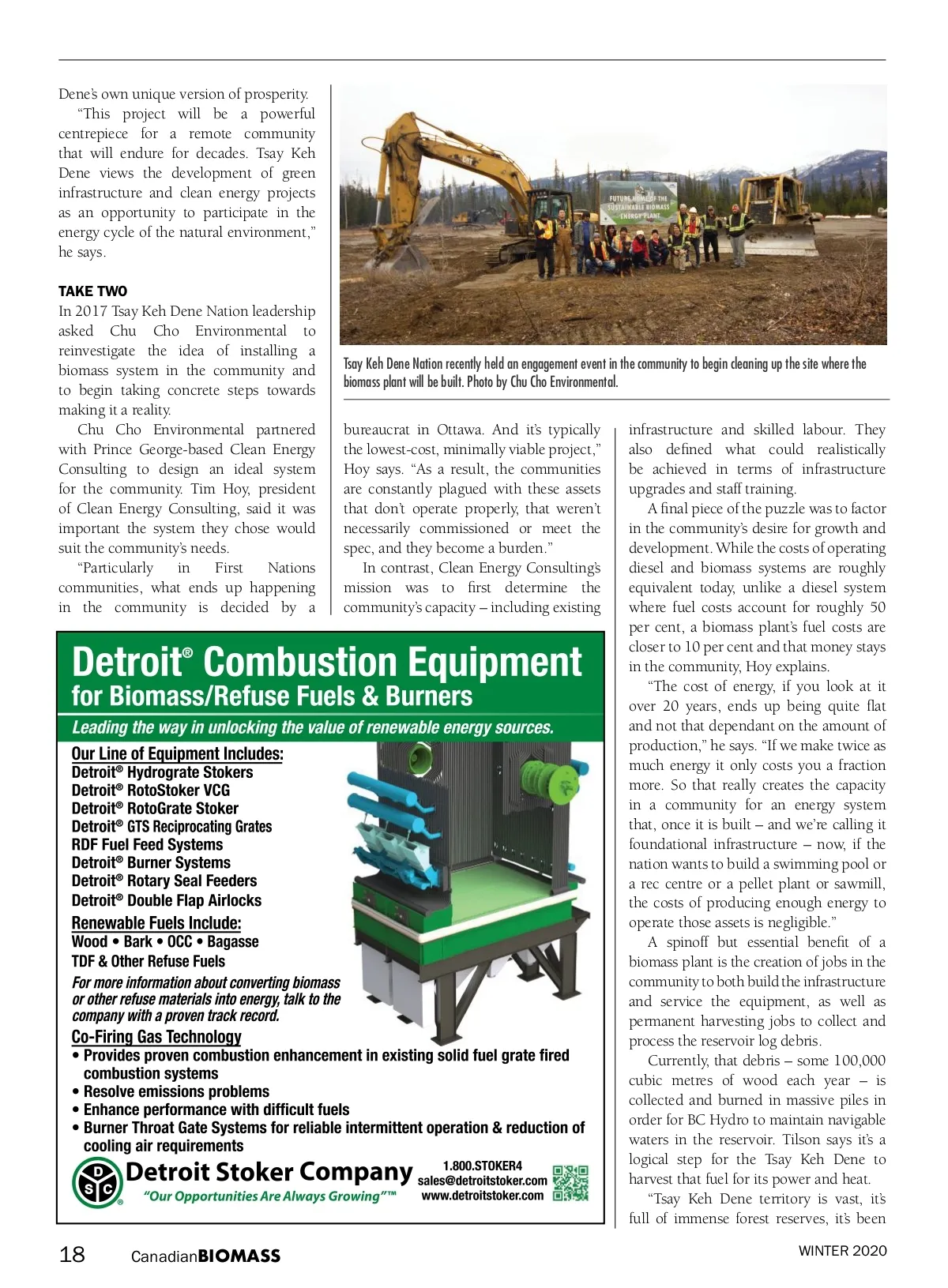
Dene’s own unique version of prosperity. “This project will be a powerful centrepiece for a remote community that will endure for decades. Tsay Keh Dene views the development of green infrastructure and clean energy projects as an opportunity to participate in the energy cycle of the natural environment,” he says. TAKE TWO In 2017 Tsay Keh Dene Nation leadership asked Chu Cho Environmental to reinvestigate the idea of installing a biomass system in the community and to begin taking concrete steps towards making it a reality. Chu Cho Environmental partnered with Prince George-based Clean Energy Consulting to design an ideal system for the community. Tim Hoy, president of Clean Energy Consulting, said it was important the system they chose would suit the community’s needs. “Particularly in First Nations communities, what ends up happening in the community is decided by a Tsay Keh Dene Nation recently held an engagement event in the community to begin cleaning up the site where the biomass plant will be built. Photo by Chu Cho Environmental. bureaucrat in Ottawa. And it’s typically the lowest-cost, minimally viable project,” Hoy says. “As a result, the communities are constantly plagued with these assets that don’t operate properly, that weren’t necessarily commissioned or meet the spec, and they become a burden.” In contrast, Clean Energy Consulting’s mission was to first determine the community’s capacity – including existing infrastructure and skilled labour. They also defined what could realistically be achieved in terms of infrastructure upgrades and staff training. A final piece of the puzzle was to factor in the community’s desire for growth and development. While the costs of operating diesel and biomass systems are roughly equivalent today, unlike a diesel system where fuel costs account for roughly 50 per cent, a biomass plant’s fuel costs are closer to 10 per cent and that money stays in the community, Hoy explains. “The cost of energy, if you look at it over 20 years, ends up being quite flat and not that dependant on the amount of production,” he says. “If we make twice as much energy it only costs you a fraction more. So that really creates the capacity in a community for an energy system that, once it is built – and we’re calling it foundational infrastructure – now, if the nation wants to build a swimming pool or a rec centre or a pellet plant or sawmill, the costs of producing enough energy to operate those assets is negligible.” A spinoff but essential benefit of a biomass plant is the creation of jobs in the community to both build the infrastructure and service the equipment, as well as permanent harvesting jobs to collect and process the reservoir log debris. Currently, that debris – some 100,000 cubic metres of wood each year – is collected and burned in massive piles in order for BC Hydro to maintain navigable waters in the reservoir. Tilson says it’s a logical step for the Tsay Keh Dene to harvest that fuel for its power and heat. “Tsay Keh Dene territory is vast, it’s full of immense forest reserves, it’s been WINTER 2020 4.625in x 5in -Detroit Combustion Equipment -Canadian Biomass 2019-03-29 OUTLINE.indd 1 CBM_Detroit Stoker_Spring19_CSA.indd 1 18 Canadian BIOMASS 3/29/2019 2:12:59 PM 2019-03-29 2:38 PM
Canadian Biomass Winter 2020: Page 18