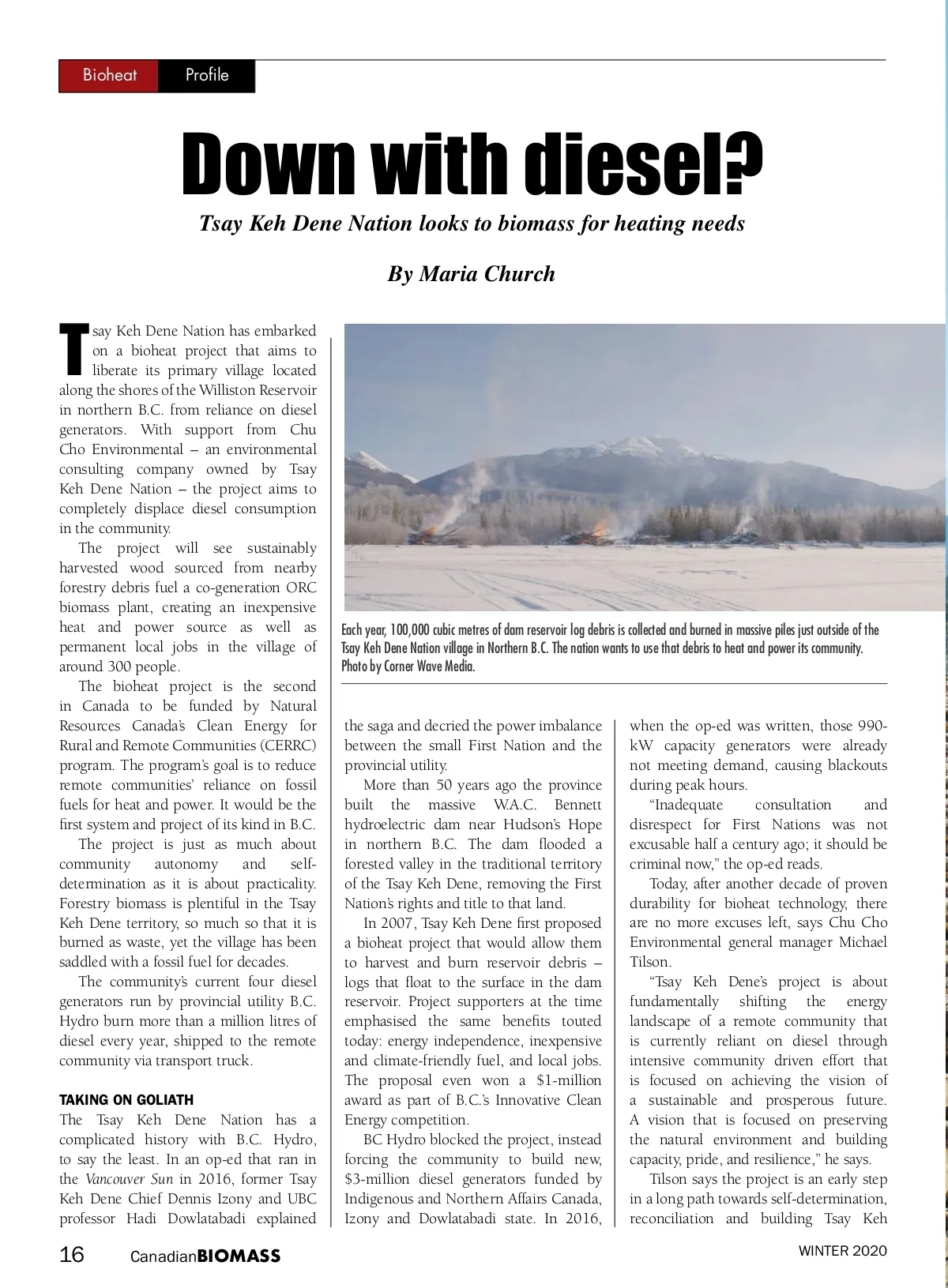
Bioheat Profile Down with diesel? Tsay Keh Dene Nation looks to biomass for heating needs By Maria Church say Keh Dene Nation has embarked on a bioheat project that aims to liberate its primary village located along the shores of the Williston Reservoir in northern B.C. from reliance on diesel generators. With support from Chu Cho Environmental – an environmental consulting company owned by Tsay Keh Dene Nation – the project aims to completely displace diesel consumption in the community. The project will see sustainably harvested wood sourced from nearby forestry debris fuel a co-generation ORC biomass plant, creating an inexpensive heat and power source as well as permanent local jobs in the village of around 300 people. The bioheat project is the second in Canada to be funded by Natural Resources Canada’s Clean Energy for Rural and Remote Communities (CERRC) program. The program’s goal is to reduce remote communities’ reliance on fossil fuels for heat and power. It would be the first system and project of its kind in B.C. The project is just as much about community autonomy and self-determination as it is about practicality. Forestry biomass is plentiful in the Tsay Keh Dene territory, so much so that it is burned as waste, yet the village has been saddled with a fossil fuel for decades. The community’s current four diesel generators run by provincial utility B.C. Hydro burn more than a million litres of diesel every year, shipped to the remote community via transport truck. TAKING ON GOLIATH T Each year, 100,000 cubic metres of dam reservoir log debris is collected and burned in massive piles just outside of the Tsay Keh Dene Nation village in Northern B.C. The nation wants to use that debris to heat and power its community. Photo by Corner Wave Media. The Tsay Keh Dene Nation has a complicated history with B.C. Hydro, to say the least. In an op-ed that ran in the Vancouver Sun in 2016, former Tsay Keh Dene Chief Dennis Izony and UBC professor Hadi Dowlatabadi explained the saga and decried the power imbalance between the small First Nation and the provincial utility. More than 50 years ago the province built the massive W.A.C. Bennett hydroelectric dam near Hudson’s Hope in northern B.C. The dam flooded a forested valley in the traditional territory of the Tsay Keh Dene, removing the First Nation’s rights and title to that land. In 2007, Tsay Keh Dene first proposed a bioheat project that would allow them to harvest and burn reservoir debris – logs that float to the surface in the dam reservoir. Project supporters at the time emphasised the same benefits touted today: energy independence, inexpensive and climate-friendly fuel, and local jobs. The proposal even won a $1-million award as part of B.C.’s Innovative Clean Energy competition. BC Hydro blocked the project, instead forcing the community to build new, $3-million diesel generators funded by Indigenous and Northern Affairs Canada, Izony and Dowlatabadi state. In 2016, when the op-ed was written, those 990-kW capacity generators were already not meeting demand, causing blackouts during peak hours. “Inadequate consultation and disrespect for First Nations was not excusable half a century ago; it should be criminal now,” the op-ed reads. Today, after another decade of proven durability for bioheat technology, there are no more excuses left, says Chu Cho Environmental general manager Michael Tilson. “Tsay Keh Dene’s project is about fundamentally shifting the energy landscape of a remote community that is currently reliant on diesel through intensive community driven effort that is focused on achieving the vision of a sustainable and prosperous future. A vision that is focused on preserving the natural environment and building capacity, pride, and resilience,” he says. Tilson says the project is an early step in a long path towards self-determination, reconciliation and building Tsay Keh WINTER 2020 16 Canadian BIOMASS
Canadian Biomass Winter 2020: Page 16