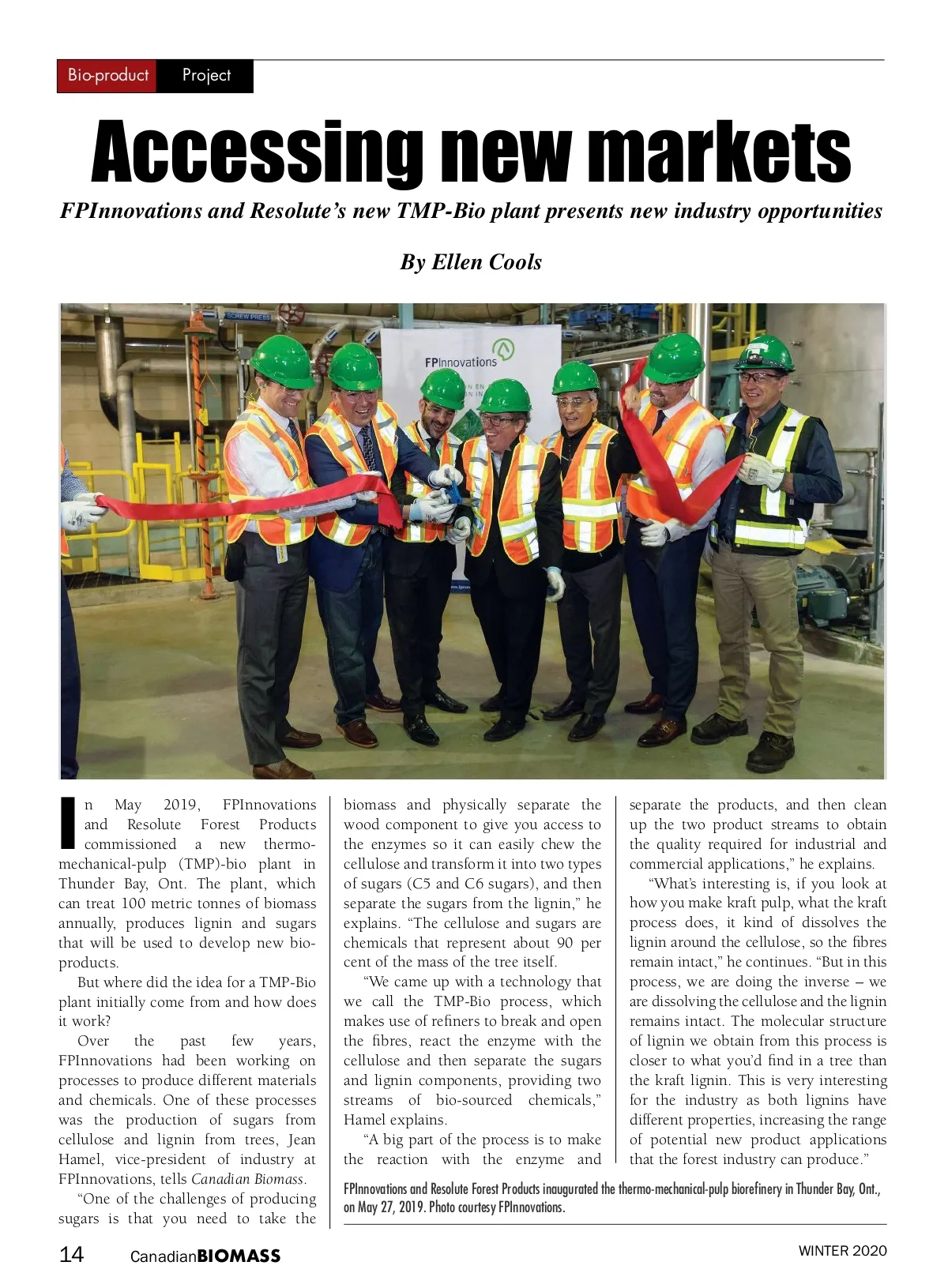
A STRATEGIC ALLIANCE PARTNERSHIP Initially, FPInnovations tested this process in a small-scale pilot plant in their facilities, using separate units to test different phases of the process. They used the results of these tests to design a larger scale plant as the process needs to be tested on an industrial scale and a continuous basis, Hamel says. “What we had was all separated small-size units and not necessarily very practical to produce significant quantities to be tested by potential users. Also, it was not sufficient to provide us with good information about how a full-size plant would look and how much it would cost because we needed to test and optimize the operating parameters,” he explains. In developing this technology, FPInnovations wanted to use pre-existing equipment or processes as much as possible. In 2016, the organization began discussing the possibility of developing a TMP-Bio pilot plant with its members and partners, and started looking for a site. Eventually, they formed a three-year strategic research alliance with Resolute Forest Products. The partnership stipulates that FPInnovations is in charge of constructing and operating the plant, while Resolute hosts the plant at its Thunder Bay pulp and paper mill and supports the integration of the plant in their facilities. Construction on the site began in September 2018. “It took about a year or two – eight months to build the plant, and then starting operations and commissioning,” Hamel says. “Now the plant produces sugars and lignin. We still have to do some fine-tuning, but we’re quite happy to have built the plant, as planned, on time and on budget, and we’re pretty happy with the outcome now. “We have a lot of discussion and guidance working closely with Resolute to help us conduct the project, which consists of both the on-site process and product applications for the three-year duration of the project,” he elaborates. Ten process units for the TMP-Bio process were installed in an area of Resolute’s pulp and paper mill that is no longer in use. The project development, which ultimately cost $23 million, required co-ordination from numerous supporting organizations. The federal government provided $5.8 million in funding to help accelerate the development of the plant, as well as production and commercialization of the green bio-chemicals derived from the TMP-Bio process. Other key players in the project’s development included the Ontario Centre for Research and Innovation in the Bio-Economy (CRIBE), FedNor, the Northern Ontario Heritage Fund Corporation (NOHFC), the Thunder Bay Community Economic Development Commission and the Ontario Ministry of Natural Resources and Forestry. The Ministère de Forêts, de la Faune et des Parcs du Quebec and the Nova Scotia Innovation Hub also contributed to the research on potential applications of the process. Once the plant was commissioned, FPInnovations and Resolute received an additional $2 million through Natural Resources Canada’s Clean Growth Program. NEW MARKETS potential to use both lignin and sugar in applications like creating animal feed additives. NEXT STEPS FPInnovations and Resolute are now approximately two years into the three-year project, and have found the new TMP-Bio plant represents an important step towards opening up new markets for the forest products sector. “For the last two years, we’ve been working on the applications of this process, and we have identified 15 potential applications,” Hamel says. “We have decided to go further, focusing on testing four or five of those potential applications.” Those applications include using the two types of sugars produced from the process (C5 and C6 sugars) in the chemical supply chain to produce plastic chemicals. “Right now, there’s a big demand around the world in terms of research and product development for making chemicals from these sugars instead of making them from oil-based products. So, there’s a new supply chain building and the chemists can use these chemicals and these sugars to make a different type of chemical, like succinic acid, and so on,” Hamel elaborates. The lignin produced in the process can also be used in different applications, such as in resins. There is also the Currently, a team of five researchers from FPInnovations work at the TMP-Bio plant full-time. “This is not an industrial process; it is a demonstration plant that is operating, and not on a 24-hour cycle,” Hamel explains. “We start the plant for a few days and then we stop and we look at the results to do some modifications. That’s really what demonstration plants are for. It’s to test different operating parameters aimed at optimizing the plant for the next phase, which will be an industrial site.” Testing the process and conducting experiments will allow FPInnovations to determine the best operating conditions, detect potential issues and make changes so the future full-size plant will have the best operations at the lowest cost. It also helps them evaluate potential risk; for example, the team wants to test reactor materials to see if there are any problems with corrosion. “That’s why nearly all of the process development goes through that phase – so you can minimize your risk when you’re going full-size and commercial,” Hamel says. The next phase for the plant will depend on which application is determined to be the most viable and the size of its market, as well as the strategy around product development. As the process is commercialized, FPInnovations will play a supporting role. The organization’s job is to make technologies such as the TMP-Bio process as mature as possible and reduce risks, obtain more information about the capital and operating costs, and to understand markets and customers, Hamel explains. The ultimate goal is to have one of the organization’s members construct and operate an industrial site and develop the new market. Regardless of which company takes up the torch, it’s clear the TMP-Bio technology presents multiple opportunities in new markets, especially as countries around the world look to transition from fossil fuels to renewable resources and processes. • Canadian BIOMASS 15
Canadian Biomass Winter 2020: Page 15