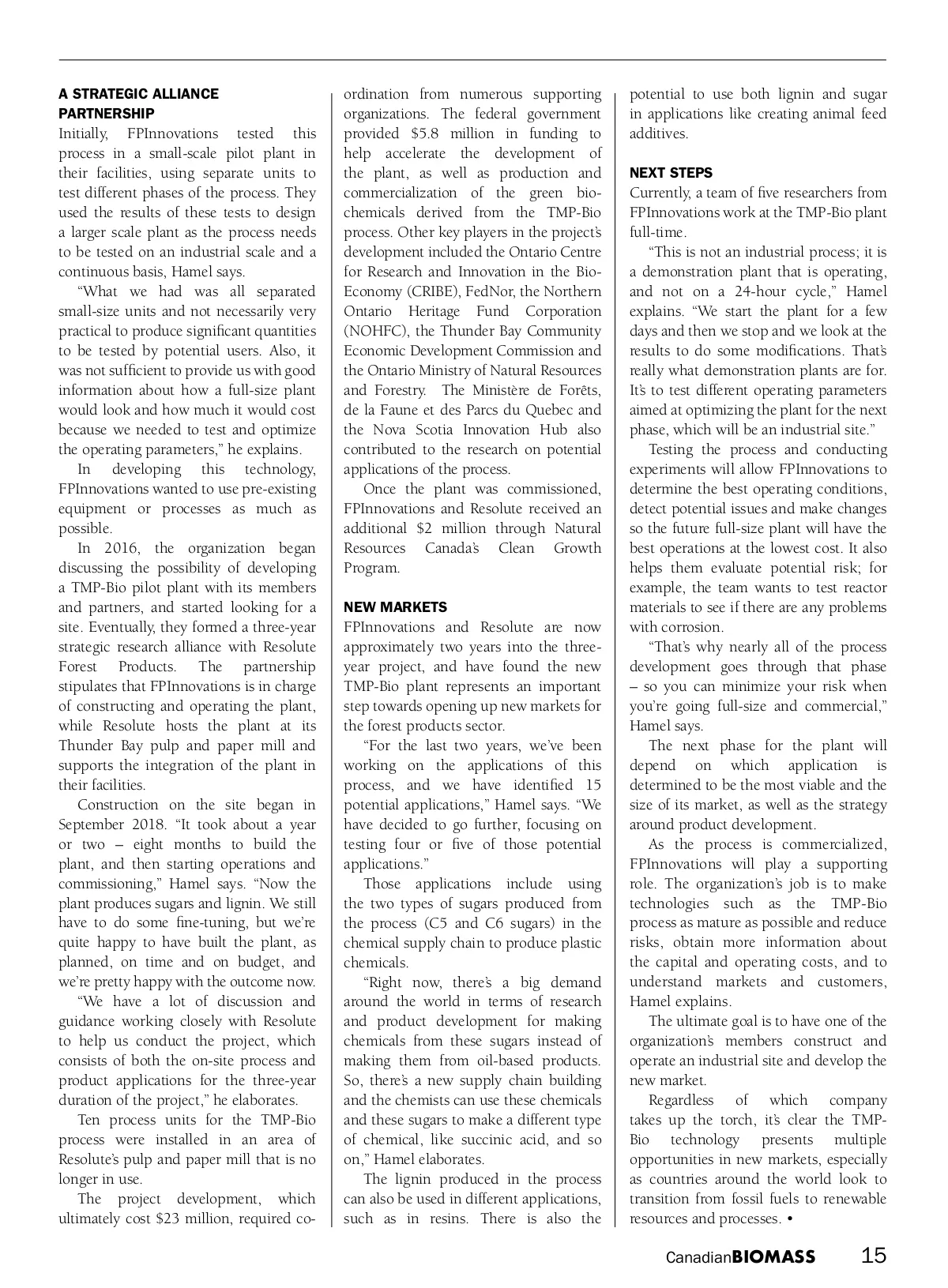
Bio-product Project FPInnovations and Resolute’s new TMP-Bio plant presents new industry opportunities By Ellen Cools Accessing new markets I n May 2019, FPInnovations and Resolute Forest Products commissioned a new thermo-mechanical-pulp (TMP)-bio plant in Thunder Bay, Ont. The plant, which can treat 100 metric tonnes of biomass annually, produces lignin and sugars that will be used to develop new bio-products. But where did the idea for a TMP-Bio plant initially come from and how does it work? Over the past few years, FPInnovations had been working on processes to produce different materials and chemicals. One of these processes was the production of sugars from cellulose and lignin from trees, Jean Hamel, vice-president of industry at FPInnovations, tells Canadian Biomass . “One of the challenges of producing sugars is that you need to take the biomass and physically separate the wood component to give you access to the enzymes so it can easily chew the cellulose and transform it into two types of sugars (C5 and C6 sugars), and then separate the sugars from the lignin,” he explains. “The cellulose and sugars are chemicals that represent about 90 per cent of the mass of the tree itself. “We came up with a technology that we call the TMP-Bio process, which makes use of refiners to break and open the fibres, react the enzyme with the cellulose and then separate the sugars and lignin components, providing two streams of bio-sourced chemicals,” Hamel explains. “A big part of the process is to make the reaction with the enzyme and separate the products, and then clean up the two product streams to obtain the quality required for industrial and commercial applications,” he explains. “What’s interesting is, if you look at how you make kraft pulp, what the kraft process does, it kind of dissolves the lignin around the cellulose, so the fibres remain intact,” he continues. “But in this process, we are doing the inverse – we are dissolving the cellulose and the lignin remains intact. The molecular structure of lignin we obtain from this process is closer to what you’d find in a tree than the kraft lignin. This is very interesting for the industry as both lignins have different properties, increasing the range of potential new product applications that the forest industry can produce.” FPInnovations and Resolute Forest Products inaugurated the thermo-mechanical-pulp biorefinery in Thunder Bay, Ont., on May 27, 2019. Photo courtesy FPInnovations. WINTER 2020 14 Canadian BIOMASS
Canadian Biomass Winter 2020: Page 14