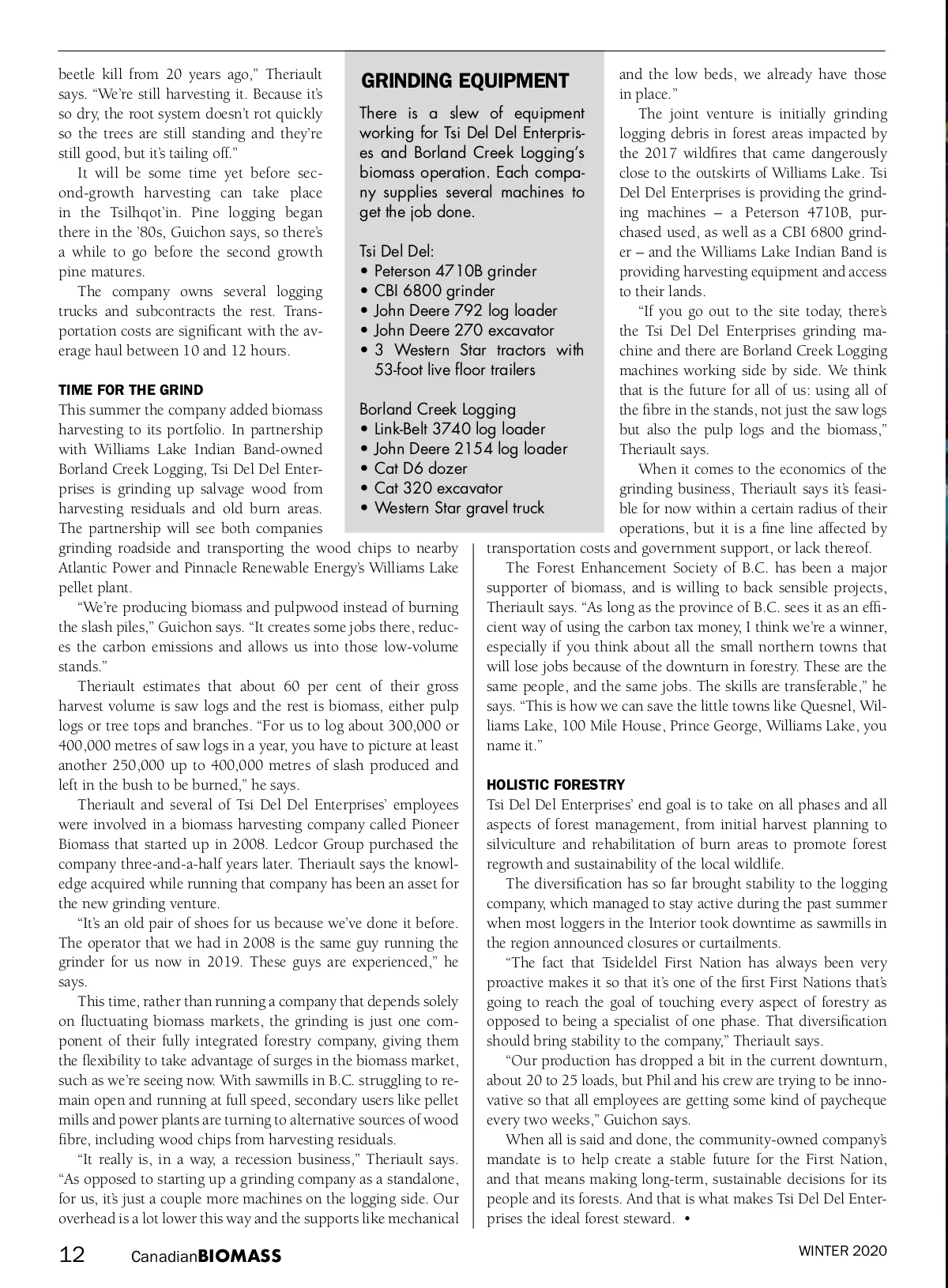
and the low beds, we already have those in place.” The joint venture is initially grinding There is a slew of equipment logging debris in forest areas impacted by working for Tsi Del Del Enterpris-the 2017 wildfires that came dangerously es and Borland Creek Logging’s close to the outskirts of Williams Lake. Tsi biomass operation. Each compa-Del Del Enterprises is providing the grind-ny supplies several machines to ing machines – a Peterson 4710B, pur-get the job done. chased used, as well as a CBI 6800 grind-er – and the Williams Lake Indian Band is Tsi Del Del: providing harvesting equipment and access • Peterson 4710B grinder to their lands. • CBI 6800 grinder “If you go out to the site today, there’s • John Deere 792 log loader the Tsi Del Del Enterprises grinding ma-• John Deere 270 excavator chine and there are Borland Creek Logging • 3 Western Star tractors with machines working side by side. We think 53-foot live floor trailers that is the future for all of us: using all of TIME FOR THE GRIND the fibre in the stands, not just the saw logs Borland Creek Logging This summer the company added biomass but also the pulp logs and the biomass,” • Link-Belt 3740 log loader harvesting to its portfolio. In partnership Theriault says. • John Deere 2154 log loader with Williams Lake Indian Band-owned When it comes to the economics of the • Cat D6 dozer Borland Creek Logging, Tsi Del Del Enter-grinding business, Theriault says it’s feasi-• Cat 320 excavator prises is grinding up salvage wood from ble for now within a certain radius of their • Western Star gravel truck harvesting residuals and old burn areas. operations, but it is a fine line affected by The partnership will see both companies transportation costs and government support, or lack thereof. grinding roadside and transporting the wood chips to nearby The Forest Enhancement Society of B.C. has been a major Atlantic Power and Pinnacle Renewable Energy’s Williams Lake supporter of biomass, and is willing to back sensible projects, pellet plant. Theriault says. “As long as the province of B.C. sees it as an effi-“We’re producing biomass and pulpwood instead of burning cient way of using the carbon tax money, I think we’re a winner, the slash piles,” Guichon says. “It creates some jobs there, reduc-especially if you think about all the small northern towns that es the carbon emissions and allows us into those low-volume will lose jobs because of the downturn in forestry. These are the stands.” same people, and the same jobs. The skills are transferable,” he Theriault estimates that about 60 per cent of their gross says. “This is how we can save the little towns like Quesnel, Wil-harvest volume is saw logs and the rest is biomass, either pulp liams Lake, 100 Mile House, Prince George, Williams Lake, you logs or tree tops and branches. “For us to log about 300,000 or name it.” 400,000 metres of saw logs in a year, you have to picture at least another 250,000 up to 400,000 metres of slash produced and left in the bush to be burned,” he says. HOLISTIC FORESTRY Theriault and several of Tsi Del Del Enterprises’ employees Tsi Del Del Enterprises’ end goal is to take on all phases and all were involved in a biomass harvesting company called Pioneer aspects of forest management, from initial harvest planning to Biomass that started up in 2008. Ledcor Group purchased the silviculture and rehabilitation of burn areas to promote forest company three-and-a-half years later. Theriault says the knowl-regrowth and sustainability of the local wildlife. edge acquired while running that company has been an asset for The diversification has so far brought stability to the logging the new grinding venture. company, which managed to stay active during the past summer “It’s an old pair of shoes for us because we’ve done it before. when most loggers in the Interior took downtime as sawmills in The operator that we had in 2008 is the same guy running the the region announced closures or curtailments. grinder for us now in 2019. These guys are experienced,” he “The fact that Tsideldel First Nation has always been very says. proactive makes it so that it’s one of the first First Nations that’s This time, rather than running a company that depends solely going to reach the goal of touching every aspect of forestry as on fluctuating biomass markets, the grinding is just one com-opposed to being a specialist of one phase. That diversification ponent of their fully integrated forestry company, giving them should bring stability to the company,” Theriault says. the flexibility to take advantage of surges in the biomass market, “Our production has dropped a bit in the current downturn, such as we’re seeing now. With sawmills in B.C. struggling to re-about 20 to 25 loads, but Phil and his crew are trying to be inno-main open and running at full speed, secondary users like pellet vative so that all employees are getting some kind of paycheque mills and power plants are turning to alternative sources of wood every two weeks,” Guichon says. fibre, including wood chips from harvesting residuals. When all is said and done, the community-owned company’s “It really is, in a way, a recession business,” Theriault says. mandate is to help create a stable future for the First Nation, “As opposed to starting up a grinding company as a standalone, and that means making long-term, sustainable decisions for its for us, it’s just a couple more machines on the logging side. Our people and its forests. And that is what makes Tsi Del Del Enter-overhead is a lot lower this way and the supports like mechanical prises the ideal forest steward. • beetle kill from 20 years ago,” Theriault says. “We’re still harvesting it. Because it’s so dry, the root system doesn’t rot quickly so the trees are still standing and they’re still good, but it’s tailing off.” It will be some time yet before sec-ond-growth harvesting can take place in the Tsilhqot’in. Pine logging began there in the ’80s, Guichon says, so there’s a while to go before the second growth pine matures. The company owns several logging trucks and subcontracts the rest. Trans-portation costs are significant with the av-erage haul between 10 and 12 hours. GRINDING EQUIPMENT 12 Canadian BIOMASS WINTER 2020
Canadian Biomass Winter 2020: Page 12